


Fintech Executive Interview Questions for Global Leadership in 2026
What if the very expertise that built your current success is the primary obstacle to your 2026 expansion? As the digital economy matures, the distinction between technical proficiency and strategic wisdom becomes a critical divide for any growing firm. Identifying a leader who can master the nuances of PSD3 and AI governance requires more than a standard conversation. It demands a suite of sophisticated fintech executive interview questions that reveal how a candidate thinks under pressure. You need a partner who possesses the quiet confidence to lead through global regulatory shifts whilst maintaining the integrity of your brand.
We understand the quiet anxiety that accompanies a high stakes appointment, especially when a single mis-hire can prove so incredibly costly. This article identifies the precise questions required to evaluate high calibre leaders who can navigate a globalised landscape with precision. You will discover a framework for assessing executive resilience and the foresight needed for sustainable growth. We provide the clarity you need to select a leader who aligns perfectly with your long-term vision, ensuring your interests are managed with expert care and meticulous attention to detail.
Key Takeaways
- Understand the transition from technical execution to systemic strategic oversight required for the modern fintech elite.
- Discover how to probe for architectural resilience and technical vision whilst maintaining the highest uptime standards.
- Identify the specific fintech executive interview questions that reveal a candidate’s depth of knowledge regarding global regulatory shifts like PSD3.
- Learn to distinguish between short term commercial acquisition and the nuanced strategic wisdom needed for long term market expansion.
- Recognise why a discreet and personalised approach to executive search is the most effective method for securing high calibre global leadership.
To secure the highest calibre of talent, we invite you to contact our specialist consultants for a bespoke advisory session regarding your executive search needs.
The Evolution of Fintech Leadership Assessment
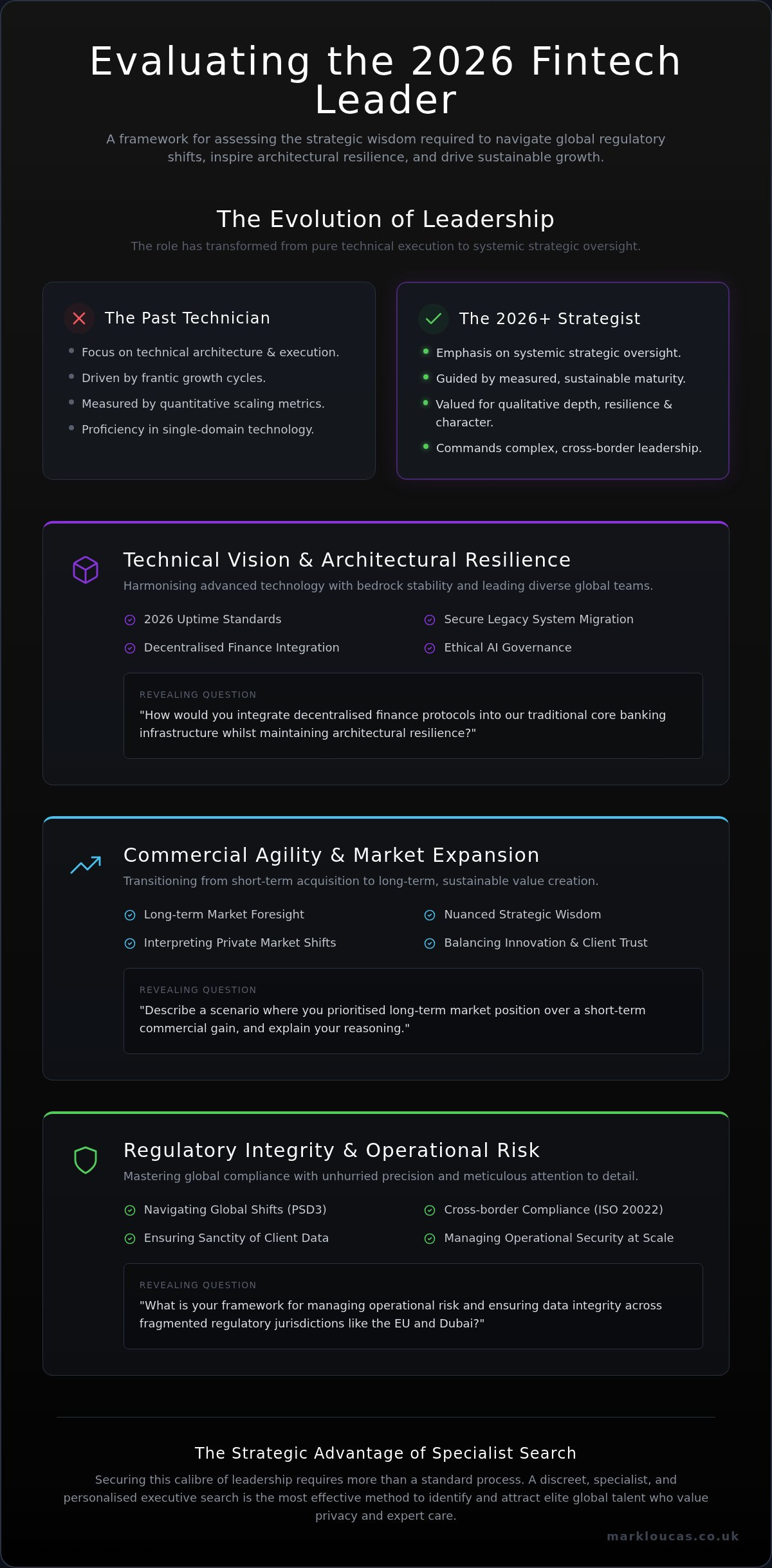
The evolution of Financial technology (Fintech) has been marked by a transition from frantic growth to a more measured, systemic maturity. In 2026, the elite fintech executive is no longer merely a technical architect but a strategic guardian. This shift requires a new methodology for evaluation, focusing on those who can harmonise the rapid advancements in AI governance with the bedrock stability of traditional banking protocols. Assessment now prioritises qualitative depth over simple quantitative metrics. Whilst a track record of scaling is useful, it’s the candidate’s resilience and character that determine their suitability for global hubs like London or Dubai. Our boutique approach to recruitment ensures a selection of candidates who possess the unhurried precision required for such prestigious roles. When formulating fintech executive interview questions, boards must look beyond the CV to find the wisdom required for complex, cross-border leadership. This process requires a discreet eye and a commitment to identifying individuals who value privacy and tailored solutions as much as technological progress.
Defining Strategic Depth in the Digital Banking Sector
The transition from transactional services to fully integrated financial ecosystems represents a significant hurdle for many leaders. Evaluating a candidate’s ability to navigate this shift is essential, particularly within the context of digital banking recruitment. A high calibre leader must interpret how private market shifts and non-public opportunities influence the firm’s long-term trajectory. They should demonstrate a sophisticated understanding of how various components of a banking stack interact to create a seamless, secure user experience. Probing a candidate on their ability to manage these non-public shifts reveals whether they possess the insider knowledge necessary to thrive in premium urban centres.
The Interplay of Technology and Human Centric Leadership
Elite leadership in 2026 balances automated efficiency with a meticulous attention to customer trust. The most successful executives don’t just innovate; they do so without compromising operational security or the personal touch that discerning clients expect. It’s vital to use fintech executive interview questions that reveal how a leader fosters a culture of innovation whilst adhering to refined service standards. In an industry often driven by volume, the ability to maintain an intimate, personalised approach to client interests is a mark of true distinction. This balance ensures that the firm remains both competitive and deeply respected amongst a global clientele that values discretion and expert care above all else.
For organisations seeking to appoint business critical technical leaders, our team can facilitate a discreet search to identify the industry’s most distinguished professionals.
Probing Technical Vision and Architectural Resilience
Evaluating a Chief Technology Officer in 2026 requires a significant departure from standard software engineering metrics. The focus must shift toward architectural resilience and the ability to maintain 2026 uptime standards whilst migrating legacy systems that no longer serve the modern enterprise. Boards should employ specific fintech executive interview questions that challenge a candidate’s strategy for integrating decentralised finance protocols into traditional core banking infrastructure. It’s about finding a leader who understands the ethical implementation of AI within the fintech and banking technology stack, ensuring that innovation never compromises the sanctity of client data. Leading diverse engineering teams across multiple global jurisdictions requires a rare blend of technical authority and the unhurried patience of a seasoned diplomat.
Architectural Strategy for Global Payments
Scaling payments infrastructure across fragmented regulatory zones is a delicate exercise in architectural craftsmanship. Candidates must explain how they ensure resilience when navigating the varying local requirements of hubs like Singapore or Dubai. Probing their specific experience with ISO 20022 migration and real time gross settlement systems provides immediate insight into their technical depth. A sophisticated leader knows when to invest in proprietary builds to protect unique intellectual property and when to leverage strategic third party integrations to maintain a competitive pace. This balance is critical for maintaining the steady, reassuring pulse of a high value financial service.
Future Proofing the Product Roadmap
The next five years of open banking evolution will demand a visionary approach to product development that transcends simple feature releases. High calibre executives must demonstrate how they prioritise technical debt against the relentless pressure for rapid market expansion into new territories. An essential part of the evaluation involves asking how they would justify an expensive, business critical architectural pivot to a discerning board of directors. The ideal candidate frames such decisions as a necessary investment in the firm’s long term structural integrity rather than a mere operational cost. This level of strategic foresight ensures the firm is never in a rush to fix avoidable errors, reflecting the diligence required in high value transactions.
If you require assistance in mapping the current talent landscape for these specialised roles, you may wish to consult with our boutique advisors for a tailored solution.
If your firm is poised for international growth, we recommend you reach out to our advisors to discuss our strategic market mapping and talent advisory services.
Evaluating Commercial Agility and Market Expansion
Identifying a Chief Revenue Officer who prioritises the nuance of long term partnership over the fleeting gratification of short term acquisition is a primary challenge for the modern board. Within the sphere of specialised financial recruitment, the ideal candidate must demonstrate an ability to build high performing sales teams that respect the firm’s established prestige. These leaders are expected to navigate cross border revenue recognition and manage the complexities of currency volatility with a steady hand. An executive at this level must possess the gravitas to communicate a grand vision to institutional investors, ensuring the firm’s trajectory remains stable during periods of rapid expansion. This unhurried approach suggests a firm that is never in a rush, mirroring the patience required for high value transactions.
Defining Commercial Acumen in High Stakes Fintech
Commercial acumen in 2026 is defined as the rare ability to synchronise product value with complex market dynamics and ever-shifting regulatory constraints. A sophisticated leader identifies non public revenue opportunities in emerging hubs like Dubai or Singapore by leveraging deep-seated local connections rather than relying on public data alone. When developing fintech executive interview questions for this role, boards should probe the candidate’s history of managing high value transactions and their involvement in strategic exits. It’s this depth of experience that separates a mere manager from a true commercial visionary. Institutional investors in the current climate are increasingly discerning, looking for leaders who can articulate a vision that encompasses both profitability and systemic resilience.
Scaling Revenue without Compromising Brand Integrity
Aggressive growth targets often threaten the delicate architecture of a boutique brand’s reputation. The CRO plays a pivotal role in aligning sales, marketing, and product teams under a unified strategy that values quality over volume. It is essential to assess whether a candidate can manage the unhurried pace of high end, concierge style client relationships whilst still meeting the firm’s commercial objectives. Effective fintech executive interview questions should explore how a leader maintains this balance, ensuring that every new partnership reflects the meticulous attention to detail that the brand represents. Managing revenue across multiple jurisdictions involves more than just accounting; it requires a strategic understanding of how regional economic shifts impact the bottom line. A leader who can anticipate these fluctuations whilst maintaining a calm, professional exterior is invaluable to a globalised firm.
To ensure your senior appointments meet the rigorous standards of global regulators, please contact Mark Loucas Ltd for a consultation on compliance and risk leadership search.
Assessing Regulatory Integrity and Operational Risk
Regulatory integrity is no longer a peripheral concern for the modern firm. It sits at the very heart of a brand’s reputation. In 2026, the strategic role of a compliance officer has transformed into that of a central architect who must balance the stringent requirements of the European AI Act with the need for commercial agility. Boards must employ fintech executive interview questions that evaluate a candidate’s philosophy on transparency with both the board and the regulator. An elite leader doesn’t just report on risks; they guide the organisation through the complexities of shifting global mandates with quiet confidence. This requires a candidate who can maintain the highest standards of operational resilience amongst increasing cyber threats and complex infrastructure dependencies. Finding such a leader demands a discreet approach that values privacy and tailored solutions above all else.
Navigating the Complexities of Global Compliance
Maintaining a consistent global compliance framework whilst adapting to the specific local variations of the UAE or the UK requires a meticulous attention to detail. A high calibre candidate should be able to articulate how they ensure the firm’s integrity remains uncompromised across fragmented jurisdictions. It’s often revealing to probe the candidate’s own hiring standards by asking about the best interview questions for compliance experts. This reveals how they intend to build a team that can turn compliance from a perceived cost centre into a distinct competitive advantage. Such an advantage acts as a signal of exclusivity and reliability to institutional investors and discerning clients alike.
Operational Resilience and Crisis Management
Operational resilience is truly tested during systemic failures or intense regulatory audits. A Chief Operating Officer must demonstrate the ability to maintain a steady, reassuring pulse even when infrastructure dependencies are under significant strain. When formulating fintech executive interview questions, it is vital to ask for specific examples of leading a firm through a period of crisis. The tension between rapid innovation and the meticulous requirements of financial stability is a constant challenge for the modern executive. The ideal executive response to a significant data breach scenario involves a calm, immediate activation of pre-defined protocols whilst maintaining absolute transparency with all relevant stakeholders. This unhurried precision reflects the diligence required in high value transactions and ensures the firm’s long term vision remains intact.
If you require a leader with the strategic depth to manage these high stakes risks, please consult our specialist search team for a tailored advisory session.
We invite you to partner with our consultancy to gain access to the most exclusive talent pools in the global fintech sector.
The Strategic Advantage of Specialist Executive Search
Selecting a leader who defines a firm’s trajectory requires more than a standard recruitment process. It demands the unhurried and discreet approach of a boutique advisor who understands the weight of a high value appointment. Whilst volume driven firms focus on speed, our methodology for fintech executive search prioritises the meticulous alignment of vision and character. By using market mapping and deep intelligence, we identify distinguished professionals who aren’t actively seeking new roles. This ensures that when you deploy your fintech executive interview questions, you’re engaging with the highest calibre of talent available globally.
Larger corporate entities often lack the intimate, personalised approach that a discerning clientele expects. We provide a service that feels like a high end concierge, moving logically from the grand vision of your firm to the granular details of a candidate’s history. Cultural alignment isn’t a marketing cliché; it’s a core requirement for a successful senior appointment that stands the test of time.
Accessing Non Public Talent Pools
Our deep connections within prestigious urban centres and financial districts allow us to source candidates that remain invisible to the wider market. These non public opportunities are the hallmark of an exclusive search, where privacy and confidentiality are maintained with expert care. A connected boutique advisor understands the patience required to manage these high value transactions; they ensure that both the organisation and the executive candidate feel respected throughout the journey, well before the first fintech executive interview questions are even asked. This level of discretion is essential for protecting the interests of the initiated.
Tailored Solutions for a Discerning Clientele
We deliberately shun the impersonal nature of high pressure tactics in favour of curated excellence and refined service. By focusing exclusively on permanent fintech recruitment and digital banking placements, we offer a level of niche expertise that larger firms can’t replicate. Securing a leader who can navigate the complexities of 2026 requires diligence and a shared commitment to sophisticated standards. This unhurried pace ensures that every selection is made with the absolute confidence that the candidate aligns with your firm’s long term vision, ensuring your interests are managed with the highest degree of professionalism.
To ensure your organisation is positioned to attract the industry’s most distinguished leaders, we invite you to contact our boutique advisors for a confidential consultation regarding your executive search requirements.
Securing Your Firm’s Future Leadership
The transition toward a more regulated and globalised digital economy requires a leader who possesses both technical foresight and strategic depth. By employing sophisticated fintech executive interview questions, you can identify high calibre individuals who are capable of navigating the complexities of PSD3 and AI governance with unhurried precision. We’ve examined the importance of architectural resilience and the necessity of commercial agility, ensuring your firm remains competitive whilst maintaining its prestigious reputation.
With over a decade of specialist recruitment experience, Mark Loucas Ltd provides a discreet and personalised approach to executive search. Our deep expertise in global payments and digital banking infrastructure allows us to offer exclusive access to non public executive talent pools that larger corporate entities cannot reach. Discover how our bespoke executive search solutions can transform your leadership team. With the right advisor, you can secure the one leadership hire that defines your firm’s trajectory for years to come. We look forward to managing your interests with expert care and meticulous attention to detail.
Frequently Asked Questions
What are the most critical fintech executive interview questions for 2026?
The most critical fintech executive interview questions for 2026 focus on a leader’s ability to navigate the transition to real-time payments and AI-driven operational models. You should ask how they plan to leverage PSD3 frameworks to enhance open banking services across European markets. Another vital inquiry involves their strategy for maintaining liquidity amongst shifting global interest rates. These questions ensure the candidate possesses the foresight required for high-stakes leadership in a rapidly evolving sector.
How do you evaluate a CTO’s ability to manage AI governance in fintech?
Assessing a CTO’s approach to AI governance requires probing their understanding of algorithmic transparency and ethical data sourcing. Ask for specific examples of how they’ve implemented robust guardrails to prevent bias within automated lending or fraud detection systems. A capable leader will explain their methodology for balancing rapid innovation with strict regulatory compliance. This ensures the firm’s technological advancements don’t compromise security or the trust of a discerning clientele who value meticulous attention to detail.
What should I look for in a Chief Revenue Officer for a global fintech firm?
When seeking a Chief Revenue Officer for a global fintech firm, look for a proven track record in orchestrating multi-regional go-to-market strategies. They must demonstrate a deep understanding of local market nuances, particularly in emerging hubs like Dubai or Singapore. The ideal candidate possesses the ability to build resilient partnership ecosystems that drive sustainable growth. Their experience should reflect a sophisticated approach to scaling revenue whilst maintaining the brand’s reputation for excellence and exclusivity in every transaction.
How can a specialist recruiter help with fintech executive search?
A specialist recruiter like Mark Loucas Ltd provides access to an elite, non-public network of talent that’s often invisible to larger corporate entities. By utilising detailed market mapping and intelligence, we identify high-calibre professionals who align with your specific architectural and cultural requirements. Our boutique approach ensures your search is handled with the utmost discretion and tailored attention. This expertise is particularly valuable when developing fintech executive interview questions for roles that require niche technical knowledge.
What are the key regulatory questions to ask a fintech compliance officer?
You should ask a potential compliance officer how they intend to manage the final stages of ISO 20022 migration and the implementation of PSD3. Inquire about their experience in navigating the disparate regulatory requirements of global jurisdictions like the UK and the UAE. A strong candidate will describe their process for integrating compliance into the product development lifecycle. This proactive stance is essential for protecting the firm from the risks associated with high-stakes payments infrastructure and complex regulations.
Why is cultural fit so important for senior fintech appointments?
Cultural fit is paramount because senior leaders set the emotional tone and operational rhythm of the entire organisation. In the fintech sector, a leader must balance the agility of a startup with the disciplined professionalism of a financial institution. Assessing this fit involves exploring their leadership philosophy and how they manage diverse, high-performing teams across different time zones. A misalignment here can lead to friction that disrupts the unhurried, meticulous progress required for long-term success and stable growth.
How do I identify a leader who can handle cross border payments complexity?
Identifying a leader capable of handling cross-border payments requires evaluating their technical grasp of clearing systems and foreign exchange liquidity management. Ask them to detail their experience in solving friction points within international settlement cycles. They should demonstrate a sophisticated understanding of the infrastructure needed to support seamless global transactions. This expertise ensures the firm can navigate the complexities of moving capital across borders whilst maintaining the high standards expected by institutional clients and private investors.
What is the best way to assess an executive’s resilience during a crisis?
The best way to assess resilience is through behavioural questions that require the executive to recount specific instances of crisis management. Ask how they maintained operational stability during a significant market downturn or a technical failure. Listen for a calm, methodical approach to problem-solving and an ability to communicate clearly under pressure. This reveals whether they possess the quiet confidence and steady pulse necessary to guide a firm through periods of intense volatility and unexpected global challenges.

Article by
Liam Henfrey
Liam Henfrey is a seasoned specialist in the payments and banking sectors with over two decades of experience. As the Founder and CEO of FINOPSIS and Managing Director at Mark Loucas Ltd, he advises organisations on complex financial operations and technology. His career includes senior roles at PwC, Deloitte, and Visa Europe.
Related Fintech Recruitment Guides
If you liked this guide then you may also like the following: