


How to Handle a Counter Offer in the Fintech Sector
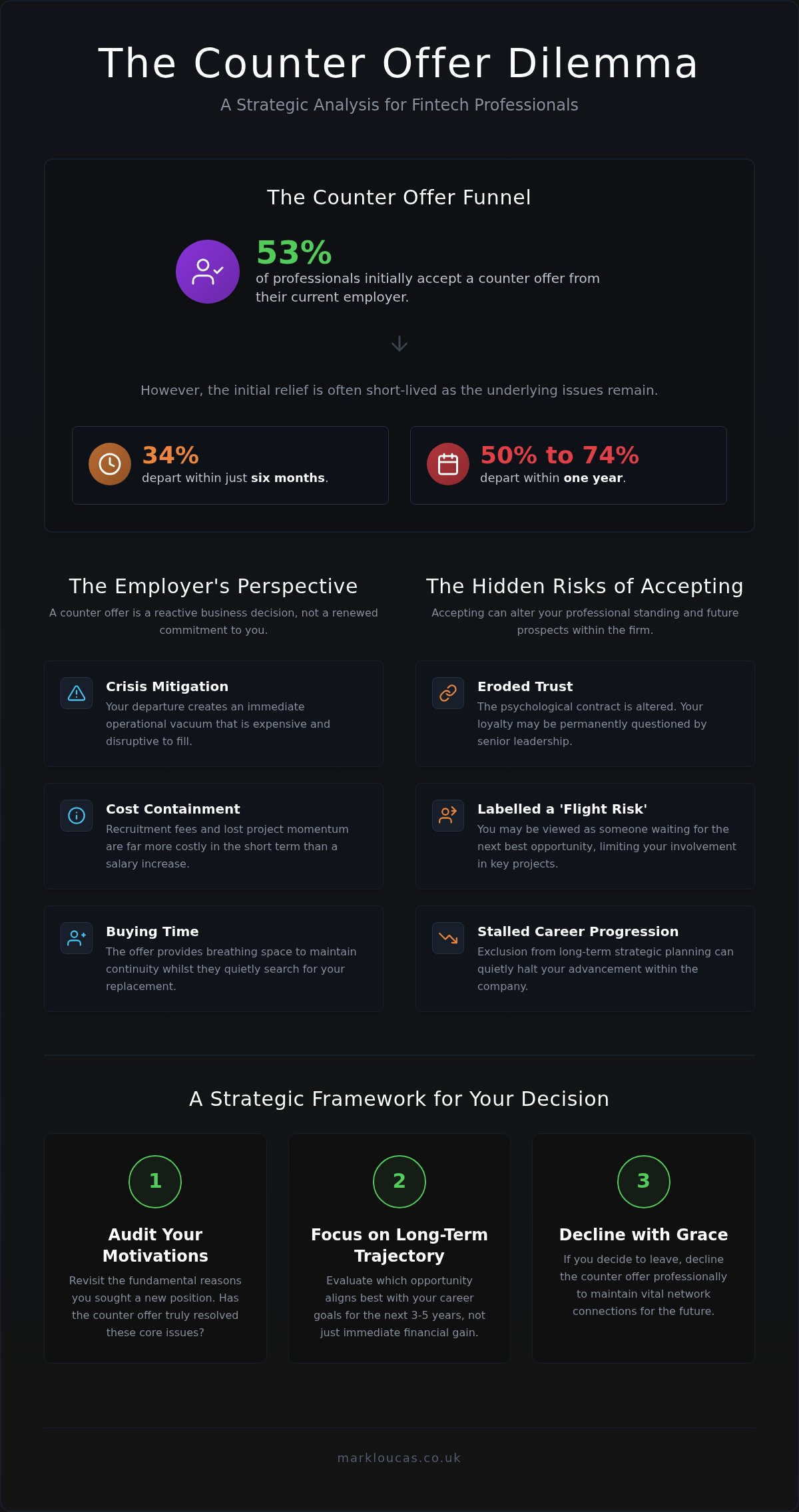
Whilst 53 per cent of professionals choose to accept a counter offer, verified data reveals that 34 per cent of those individuals depart their firm within just six months. It’s an understandably flattering moment when a current employer suddenly recognises your value with a refined package, yet this gesture often masks the underlying reasons you initially sought a new challenge. You likely feel a sense of loyalty to your colleagues and a genuine concern about burning bridges with a prospective employer. Mastering how to handle a counter offer requires a calm detachment and a focus on your long term career trajectory rather than a reactive response to immediate financial incentives.
We believe that for senior leaders in the fintech sector, these pivotal decisions deserve more than a simple comparison of figures. This guide provides a sophisticated framework to help you evaluate the true cost of staying versus the strategic potential of your new role. You’ll find precise scripts for declining offers with grace and an analysis of how your choice impacts your future security amongst shifting market dynamics. We will explore how to maintain your professional integrity whilst ensuring your career momentum remains unhindered by promises that may not address the core of your professional needs.
Key Takeaways
- Understand that counter offers are often reactive measures designed to mitigate recruitment costs rather than genuine strategic investments in your professional development.
- Learn how to handle a counter offer with professional objectivity by auditing your original motivations for seeking a new position in the first place.
- Recognise the subtle risks to your future security and reputation that can arise when a resignation is tendered and then subsequently retracted.
- Master the scripts required to decline an offer with grace, ensuring you maintain vital connections within the elite fintech network whilst moving forward.
- Develop a strategy for maintaining your career momentum by focusing on long term trajectory instead of immediate, short term financial incentives.
If you are currently weighing up your options or preparing for a sensitive resignation, you may find it beneficial to speak with a specialist advisor on our contact page to discuss your strategy in confidence.
Understanding why employers make counter offers
A counter offer is seldom a reward for past performance. It is more accurately described as a reactive solution to an immediate operational crisis. When you announce your departure, you create a vacuum that is both expensive and time consuming to fill. In the context of the legal definition of a counter offer, your employer is effectively rejecting your resignation in favour of a temporary truce. For senior leaders, learning how to handle a counter offer begins with recognising that this sudden generosity is often born of necessity rather than a renewed appreciation for your unique talents.
In the highly specialised fintech landscape, the cost of replacing an executive is substantial. Beyond the standard recruitment fees, which can often exceed six months of a candidate’s salary, there is the intangible cost of lost momentum. For firms involved in digital banking recruitment, the departure of a key figure can stall critical infrastructure projects or delay the launch of a new payments platform. This makes retention a significantly cheaper short term alternative for the firm, even if it requires a substantial salary increase or a title change that wasn’t on the table a week prior.
The financial logic behind the offer
The mathematics of retention are straightforward for most fintech firms. Losing a senior professional during a critical growth phase can lead to missed milestones that impact valuation. By offering a defensive salary increase, the employer is essentially buying time. This breathing space allows them to maintain project continuity whilst they quietly begin the process of identifying your eventual replacement. It is a pragmatic business decision, designed to protect the firm’s interests rather than your individual career path.
Emotional versus strategic retention
It’s vital to distinguish between an employer who genuinely values your future and one who simply fears the chaos of your absence. Once you have expressed a desire to leave, the psychological contract with your employer is fundamentally altered. The trust that previously underpinned your relationship is often replaced by a lingering suspicion regarding your loyalty. Even if the company culture appears supportive, the power dynamic has shifted. You may find yourself excluded from long term strategic planning or passed over for sensitive projects, as you are now viewed as a flight risk who could depart at any moment.
If you require a discreet consultation regarding your career strategy, our specialist advisors are available via our contact page to provide tailored guidance.
The hidden risks of accepting a counter offer
Accepting a counter offer is often a seductive proposition, particularly when it arrives with the promise of enhanced compensation and renewed corporate devotion. However, for senior professionals, the psychological contract with an employer is fragile. Once you have signalled your intention to depart, the foundation of trust is irrevocably altered. Understanding how to handle a counter offer requires a clear eyed assessment of how your professional standing changes the moment you decide to stay. Verified research from Robert Half UK indicates that 34 per cent of employees who accept a counter offer are gone within six months, whilst between 50 and 74 per cent depart within a year. These figures suggest that the reprieve offered by a counter proposal is rarely permanent.
Trust and loyalty in the executive suite
In the upper echelons of fintech leadership, loyalty is a currency of significant value. When you tender your resignation, you are perceived as having mentally checked out of the firm’s long term vision. Senior stakeholders may subsequently view you as a flight risk, which can subtly influence their decisions regarding strategic planning or the allocation of high stakes projects. This label is difficult to shed. Even if your performance remains exemplary, the suspicion remains that you are merely waiting for a more lucrative opportunity to present itself. This shift in perception can stall your internal career progression, making you an observer rather than a primary architect of the firm’s future.
Why the original problems remain
A salary increase is a financial instrument; it is not a cultural remedy. Most professionals seek new roles because of fundamental issues such as a lack of professional development, a misaligned company culture, or stagnant leadership. These systemic problems are not resolved by a higher monthly deposit into your bank account. Evaluating a counter offer requires you to ask whether the reasons you initially decided to leave have been addressed. If the core frustrations remain, the initial excitement of the pay rise will eventually dissipate, leaving you in the same position you were in months earlier. For those navigating these complex waters, seeking an external perspective from a fintech talent advisor can provide the clarity needed to ensure your career momentum is not lost to a temporary fix.
If you are currently navigating a complex career transition and require a discreet perspective, you can reach out to our senior advisors through our contact page for an introductory conversation.
Evaluating your options with professional objectivity
Making a decision at the executive level requires a level of detachment that can be difficult to maintain amidst the flattery of a counter proposal. Understanding how to handle a counter offer requires more than a cursory glance at a spreadsheet; it demands a rigorous audit of your career trajectory. You must evaluate the total remuneration package, including bonuses, equity, and stock options, whilst acknowledging that financial incentives are often the least complex part of the equation. A strategic career move is rarely about the money alone. It is about the environment, the vision, and the platform for your next decade of growth. When determining how to handle a counter offer at this level, objectivity is your most valuable asset.
Consider the broader implications for your professional reputation within the elite fintech community. Retracting an acceptance from a new firm can signal a lack of decisiveness, potentially closing doors to future opportunities. Research highlighted by the Harvard Business Review regarding the risks of accepting a counteroffer suggests that the underlying issues that prompted a job search are seldom resolved by a reactive pay rise. You must decide if you are staying for the right strategic reasons or simply out of a familiar fear of the unknown.
The original motivation audit
Revisiting your initial catalyst for change is an essential exercise. When you first sought out a fintech recruiter, you were likely motivated by factors that extend far beyond a simple base salary. Perhaps the current environment stifles your autonomy, or the product roadmap lacks the vision required for the next decade of digital finance. Whilst a counter offer may include a lucrative bonus, it rarely restructures the internal architecture of a firm to accommodate your desire for a better work life balance. You must be honest about whether the offer addresses specific grievances or simply papers over the cracks of a stagnant culture.
Market positioning and future growth
The fintech landscape of 2026 is defined by rapid evolution in AI and decentralised finance. Using professional market mapping and intelligence allows you to see where the industry is moving and which role places you at the centre of that growth. A counter offer might feel like a victory in the present, but you should consider which firm provides the more robust platform for future fintech executive search opportunities. Your value is determined by your exposure to emerging technologies and your ability to lead through disruption. Choose the path that enhances your marketability for the long term, rather than the one that offers the easiest path today.
If you are preparing for a difficult conversation and require a confidential sounding board, please visit our contact page to arrange a consultation with one of our senior partners.
How to decline a counter offer with grace
Declining a counter offer is a delicate exercise in reputation management. Within the tight-knit fintech community, particularly amongst the leaders in the payments sector, how you leave a firm is often remembered as vividly as how you arrived. Mastering how to handle a counter offer involves maintaining a tone of quiet confidence whilst ensuring your departure doesn’t disrupt the firm’s critical infrastructure. You must focus your explanation on the future and the specific alignment of the new role, rather than dwelling on the past or the perceived shortcomings of your current employer. This approach preserves your professional integrity and ensures that your network remains intact.
The verbal rejection strategy
For senior executives, a face to face meeting or a video call is the only appropriate medium for this conversation. It demonstrates a level of professional respect that a simple email cannot convey. During the discussion, use phrases that show genuine gratitude for the opportunity whilst remaining resolute. You might say, “I am truly appreciative of the offer and the confidence you’ve shown in me; however, after careful consideration, I have decided that the new role is the right strategic step for my career at this time.” It’s essential to prepare for a second or even a third counter offer during the conversation. Be firm. Reiterate that your decision is final and based on long term goals rather than immediate compensation.
Finalising the transition
Your priority during your notice period should be the preservation of project continuity. Offer to lead the handover process and assist in identifying a successor if appropriate. This level of diligence ensures you leave on exceptional terms, keeping the door open for future specialised financial recruitment opportunities that may arise later in your career. When it comes to external communications, ensure your LinkedIn announcement is gracious and focuses on the positive experiences you had with your current firm. A well managed exit protects your network and reinforces your status as a leader who values professional integrity above all else. If you would like to discuss your specific situation in more detail, you can reach out to us directly for expert advice on managing your transition.
To ensure your next career move is executed with the precision and discretion it deserves, please visit our contact page to speak with a specialist consultant.
Strategic career management beyond the resignation
Once the final decision is made and the counter proposal has been declined, your focus must shift entirely to the horizon. Mastering how to handle a counter offer is not merely about the moment of rejection; it is about the clean break that follows. You’ve chosen a new path based on a strategic assessment of your long term goals. Commit to this new direction with absolute clarity. This transition period is an opportunity to solidify a personal brand synonymous with reliability and strategic foresight.
The fintech sector is remarkably interconnected. Your reputation as a decisive leader is built on the consistency of your actions during these pivotal moments. By moving forward with confidence, you signal to the market that your career moves are calculated and purposeful. This clarity of intent is what distinguishes elite professionals in the global payments and banking sectors.
Onboarding with excellence
Channel the intellectual energy that was required during your negotiations into your first ninety days at the new organisation. You’ll find it beneficial to set clear, measurable milestones that demonstrate your value from day one. This proactive approach reassures your new employer that their investment was sound. It also helps you integrate into the company culture whilst establishing your authority in your new role. Focus on building strong relationships with your new peers and stakeholders to ensure your transition is as smooth as possible.
Maintaining your professional network
Your career is a long term asset that requires constant cultivation. Staying connected with fintech recruitment agencies in london ensures you remain visible for high value, non-public opportunities. Even after a successful move, the market remains volatile. Research from 2026 indicates that 52 per cent of employees are open to leaving their roles, suggesting that the talent landscape is in a state of constant flux. Being a known entity amongst specialist advisors provides a layer of security and insight that is invaluable.
If your former employer approaches you in the future, handle the interaction with the same professional grace you displayed during your exit. The fintech world is small, and a former colleague today could be a key partner or client tomorrow. By maintaining a network of elite connections, you ensure that your career momentum is never left to chance. You’re not just filling a role; you’re managing a strategic professional journey.
If you are navigating a complex career move in the Fintech sector, please contact us for discreet and expert guidance from our boutique advisory team.
Securing your professional future
The decision to move forward with a new opportunity or remain with a current employer is a defining moment for any senior executive. We have explored the intricate motivations behind reactive offers and the potential risks to your professional standing that can arise from retractions. Ultimately, mastering how to handle a counter offer requires a steadfast commitment to your long term vision rather than a response to temporary financial incentives. By maintaining your integrity and focusing on strategic growth, you ensure that your career momentum remains unhindered by short term distractions.
Our firm provides a boutique approach to fintech executive search, combining a global reach with the intimate local expertise of our London centre. With our specialist knowledge of the payments industry, we offer the nuanced perspective required to manage high value transitions with total discretion. Your career is a carefully crafted narrative, and we are here to ensure that every chapter reflects your ambition and excellence. We look forward to supporting your continued success in the evolving fintech landscape.
Frequently Asked Questions
What is the main reason people accept a counter offer?
People often accept a counter offer because it feels like a safe path that avoids the immediate disruption of a career transition. The familiarity of their current environment and the promise of immediate financial reward provide a sense of comfort that can be quite seductive. However, whilst the money might increase, the underlying cultural or structural issues that prompted the initial search usually remain unchanged.
Does accepting a counter offer affect my reputation?
Accepting a counter offer can occasionally cast a shadow on your professional standing within the niche fintech community. Whilst most firms behave professionally, your current employer may view your loyalty with a degree of caution moving forward. Similarly, the firm you turned down might be hesitant to engage with you in the future, which could limit your access to private, non-public opportunities.
Should I tell my new employer about the counter offer?
It’s generally wise to maintain a level of discretion and avoid mentioning the specifics of a counter offer to your new employer. Sharing this information can create unnecessary friction and may suggest that your commitment is based purely on financial gain rather than the role itself. If you decide to move forward with the new role, focus on the unique opportunities and the refined culture of their organisation instead.
Can I use a counter offer to negotiate a better deal at my new firm?
Attempting to use a counter offer as a bargaining chip with a new firm is a delicate strategy that often carries significant risk. In the world of executive search, this approach can appear transactional and might erode the trust you’ve built during the interview process. Knowing how to handle a counter offer involves negotiating based on your specific value and the market intelligence we provide to ensure a fair result.
What should I do if my current employer gets angry when I decline?
If your current employer reacts with frustration when you decline their offer, remain calm and maintain your professional composure. Their emotional response is often a reflection of the pressure they feel to retain talent in a competitive market like London or Dubai. Maintain your poise. Acknowledge their perspective with a short, definitive statement of your decision and ensure your departure is handled with the utmost grace.
Is it ever a good idea to stay after resigning?
Staying after resigning is rarely the best course of action because the fundamental reasons for your departure are seldom addressed by a salary increase. Once you’ve signalled your intent to leave, the dynamic of trust is permanently altered amongst the leadership team. Trust is fragile. Knowing how to handle a counter offer involves recognising that a long term career strategy is more valuable than a short term financial adjustment.
How do I know if a counter offer is genuine?
A genuine counter offer should address your original grievances with a clear, documented plan for change rather than just a simple pay rise. You must assess whether the firm is offering a sincere path for growth or simply buying time to find your replacement at a later date. Look for concrete commitments to your professional development and a shift in the organisational behaviour that caused your initial dissatisfaction.
What happens if I accept and then regret it?
If you accept a counter offer and later regret the decision, it’s important to reflect on your career goals with a trusted advisor. You may find that the initial issues resurface within a few months, leaving you back at the start of your search. In such cases, we provide the individualised attention required to navigate the next steps with quiet confidence and find a more suitable permanent role.

Article by
Liam Henfrey
Liam Henfrey is a seasoned specialist in the payments and banking sectors with over two decades of experience. As the Founder and CEO of FINOPSIS and Managing Director at Mark Loucas Ltd, he advises organisations on complex financial operations and technology. His career includes senior roles at PwC, Deloitte, and Visa Europe.
Related Fintech Recruitment Guides
If you liked this guide then you may also like the following: