


Avoiding Hiring Mistakes for Senior Roles in the 2026 Fintech Sector
What if the most significant financial risk to your organisation in 2026 is not a sudden market shift, but the quiet misalignment of a single executive appointment? With the cost of a bad hire for senior roles often exceeding 213% of their annual salary, the stakes for your leadership team have never been higher. You are likely familiar with the disruption that follows a mismatch in strategic vision; it is a drain on resources that extends far beyond recruitment fees to impact team morale and momentum. Successfully avoiding hiring mistakes for senior roles requires more than a standard search; it demands a sophisticated understanding of the current fintech landscape and the specific nuances of the ISO 20022 migration.
We understand that for a discerning fintech leader, the priority is not merely filling a vacancy but securing an individual of rare distinction who can navigate complex regulatory frameworks like the EU AI Act. This article promises to reveal how you can safeguard your organisation through strategic planning and access to elite, non-public talent pools. We shall examine a repeatable framework for executive success, moving from the grand vision of your firm’s future to the granular details of candidate behaviour and cultural synergy.
Key Takeaways
- Quantify the true cost of executive turnover and learn how to protect your organisation from significant strategic delays.
- Master the art of avoiding hiring mistakes for senior roles by aligning every appointment with a future-focused strategic mandate rather than legacy requirements.
- Identify candidates who possess the precise blend of leadership excellence and the technical depth necessary for modern fintech compliance.
- Adopt a rigorous and structured interview process that provides the clarity needed to make confident, unbiased hiring decisions at the highest level.
- Leverage niche market intelligence to secure elite, non-public talent that traditional recruitment methods often overlook.
To ensure your next leadership appointment aligns perfectly with your long-term objectives, we invite you to speak with our specialist advisors for tailored recruitment support.
The True Cost of Senior Recruitment Errors
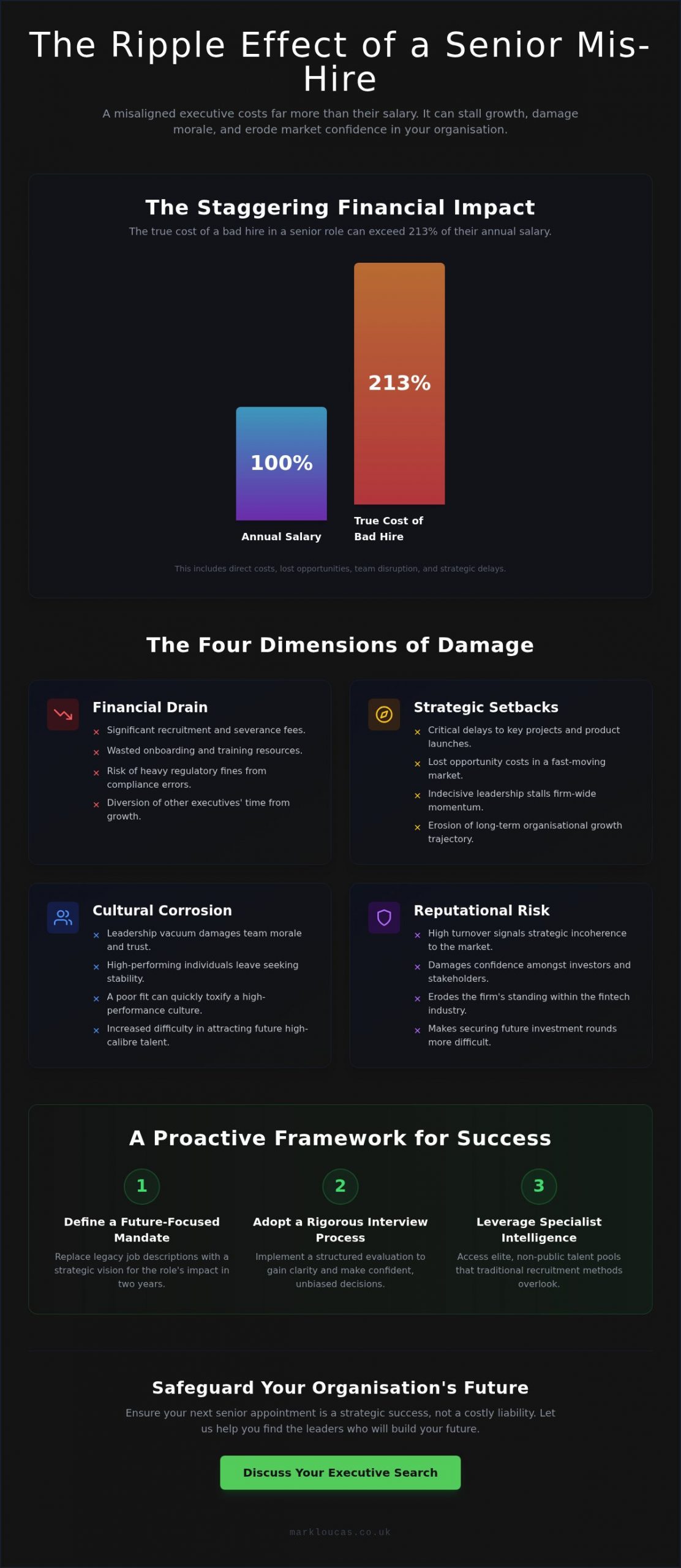
Senior appointments are the architectural anchors of a fintech organisation. When a director or C-suite executive is misaligned with the company’s trajectory, the fallout is rarely confined to a single department. Research indicates that the cost of a bad hire for senior roles typically ranges between 150% and 213% of their annual salary. This figure, whilst staggering, often fails to account for the invisible erosion of value caused by strategic delays and lost opportunity costs that can stall a firm’s growth for years.
A failed appointment at the director level creates a vacuum of leadership that quickly impacts team morale. High-performing individuals often feel the weight of a leader’s indecision or technical inadequacy, which can lead to wider talent attrition as your best people seek stability elsewhere. Maintaining a steady hand at the top is essential. A sophisticated approach to avoiding hiring mistakes for senior roles ensures that every placement strengthens the firm’s foundations rather than creating cracks in the corporate structure.
Beyond internal dynamics, high leadership turnover sends a troubling signal to the market. Investors and stakeholders value continuity and predictable execution above all else. Frequent changes in the executive suite suggest a lack of strategic coherence, potentially damaging your firm’s reputation amongst the very partners who provide the capital and confidence required for expansion. In a sector as interconnected as fintech, a single public departure can ripple through the industry, making the task of securing future investment far more arduous.
Financial Implications and Resource Drain
Direct financial impact includes not just recruitment fees and onboarding expenses, but also significant severance packages. However, the indirect drain on resources is often more damaging. Other members of the C-suite must divert their attention from growth initiatives to manage the fallout of the failed hire. In the payments industry, these errors are magnified by the necessity of a specialized recruitment service to ensure compliance expertise. A single oversight in a senior compliance role can lead to heavy regulatory fines and operational paralysis.
The Cultural Ripple Effect
A poor leadership fit can toxicise a high-performance fintech culture with surprising speed. Projects of immense complexity, such as digital banking migrations or major product launches, rely on absolute trust and clarity from the top. When an executive lacks the requisite depth or cultural alignment, momentum stalls and innovation is stifled. Executive churn also makes it increasingly difficult to attract future high-calibre talent. Elite candidates are discerning; they look for environments of excellence and stability, avoiding firms where the revolving door of leadership suggests a fractured vision.
We suggest that you get in touch with our team to discuss your workforce planning and ensure your next senior appointment is built for future success.
Defining the Strategic Mandate for Future Growth
Legacy job descriptions are often the silent architects of recruitment failure. By the time a senior role is advertised, the document used to define it is frequently a relic of the company’s past needs rather than a blueprint for its future. This retrospective approach is a primary hurdle in avoiding hiring mistakes for senior roles. Instead of simply listing duties, boards must establish a strategic mandate. This mandate acts as a visionary document, detailing exactly where the organisation must stand in two years. It focuses on the evolution of the fintech landscape, from shifting regulatory pressures to the integration of generative AI within core banking systems.
Success in this area requires more than just identifying a list of skills. It involves the fintech executive search process being treated as a strategic acquisition of leadership. This means looking beyond the immediate vacancy to understand how a new appointee will catalyse growth. When the board is aligned on what success looks like, the search becomes a targeted mission to find a specific calibre of individual who can execute that vision with precision.
Moving Beyond the Job Description
To ensure clarity, firms should identify three non-negotiable outcomes the senior hire must achieve within their first twelve months. Whether it is navigating the complexities of the ISO 20022 migration or restructuring a global payments team, these objectives provide a definitive yardstick for performance. Differentiating between essential technical depth and desirable leadership traits is vital. Whilst charisma is attractive, the specific technical nuances of modern fintech require a leader who understands the granular mechanics of the industry. Market mapping provides the necessary intelligence here, offering a vivid picture of the elite talent currently operating within the shadows of the non-public market.
Stakeholder Alignment and Board Consensus
Conflict amongst the leadership team regarding a new hire’s profile is a common pitfall. Before the search begins, a meticulous process of gathering input from every key stakeholder is essential. This ensures that the final candidate profile reflects a unified vision. Utilising a structured interview methodology from the outset helps maintain this alignment by providing objective data points for comparison. For those seeking bespoke guidance on board-level searches, our expertise in specialised financial recruitment offers a discreet and highly connected approach to finding the right fit. Aligning the board ensures that the new executive enters an environment of support rather than one of fractured expectations.
If you find that your internal consensus is shifting, it may be time to consult with a boutique advisor to refine your strategic mandate.
If you require a bespoke approach to identifying high-calibre leaders, we invite you to contact our London office for expert talent advisory.
Evaluating Niche Technical Skills and Leadership Behaviour
In the high-stakes environment of 2026, the allure of a charismatic leader can often overshadow the necessity for deep technical proficiency. This ‘halo effect’ is a common pitfall in avoiding hiring mistakes for senior roles; an articulate executive may impress at the board level whilst lacking the granular knowledge required to oversee complex digital transformations. In fintech, where the margin for error is razor-thin, leadership must be underpinned by a genuine mastery of the underlying technology and regulatory landscape. Charisma alone cannot navigate a technical crisis.
Relying solely on past performance in adjacent sectors, such as traditional retail banking, is often a misleading strategy. Leadership behaviour in a legacy institution rarely mirrors the agility required in a digital-first environment. Instead, success is better predicted by assessing how a candidate adapts to rapid cycles of innovation and shifting market demands. Verifying a candidate’s expertise in modern standards, such as the ISO 20022 messaging standard or cloud-native banking architecture, is non-negotiable. Deep niche expertise is the primary safeguard against compliance failures that often stem from senior hires who lack a granular understanding of evolving regulatory standards.
Assessing Fintech Specific Competencies
Senior payments roles now demand a sophisticated grasp of RTGS systems and evolving regulatory frameworks. To move beyond theoretical knowledge, firms should employ case-study based assessments that mirror real-world crises. This approach reveals a candidate’s practical problem-solving abilities under pressure. Referencing amongst the niche fintech community provides a layer of verification that standard background checks cannot reach; it uncovers the candidate’s true reputation amongst their peers. Authentic technical depth is revealed in the details of execution.
Measuring Leadership Style and Cultural Alignment
The transition from a traditional retail bank to a lean fintech startup is often fraught with friction. A leader accustomed to vast support structures may struggle when asked to be hands-on in a digital-first banking environment. Measuring specific behaviours, such as the ability to foster innovation whilst maintaining rigorous compliance, is essential. Psychometric testing serves as a valuable tool here, offering a data-driven perspective on long-term cultural fit and ensuring the individual’s values align with the firm’s unique ethos. This ensures the leader can thrive within your specific organisational architecture.
To ensure your selection process is as refined as the talent you seek, we encourage you to book a consultation to refine your interview strategy.
Designing a Structured Executive Interview Process
Experienced senior candidates are often masters of the interview, possessing a refined ability to deliver polished, rehearsed responses that can sometimes obscure their true operational depth or suitability for a specific challenge. A disorganised or informal process is a significant risk factor in failing to identify these gaps. Elite talent, particularly those in high demand within the fintech sector, expect a recruitment journey that reflects the professionalism and precision of the firm they are considering joining. A disjointed experience not only drives away top-tier individuals but also undermines the firm’s authority. Implementing a rigorous methodology is a cornerstone of avoiding hiring mistakes for senior roles, ensuring that every interaction is a deliberate assessment of strategic and cultural fit.
With the average time to hire for senior fintech roles reaching 42 days in the first quarter of 2026, every stage of the process must be optimised for both efficiency and accuracy. A structured approach ensures consistency and allows for a more objective comparison between candidates. This framework moves logically from the grand vision of the organisation to the granular verification of the candidate’s professional history.
The Five Step Executive Interview Framework
- Step 1. Preparation and scoring criteria. Before the first meeting, every interviewer must be aligned on the strategic mandate. Using a pre-defined scoring matrix for each competency reduces subjectivity and ensures that every candidate is measured against the same standards of excellence.
- Step 2. The strategic vision round. This session assesses future-readiness. It challenges the candidate to articulate how they would navigate the complexities of the 2026 fintech landscape, focusing on growth, innovation, and long-term sustainability.
- Step 3. The technical deep-dive. This stage involves a case study or a specific presentation. It is designed to test real-world problem-solving abilities and verify that the candidate’s technical mastery is as deep as their professional profile suggests.
- Step 4. The cultural and behavioural alignment session. The focus here is on leadership style and whether their personal values mirror the firm’s unique ethos. This is about finding an individual who can thrive within your specific organisational architecture.
- Step 5. The thorough reference check. Final verification involves deep-dive conversations with former peers and superiors. This is not a mere formality but a critical step to confirm the candidate’s history of success and leadership behaviour.
Avoiding Unconscious Bias in Senior Selection
Unconscious bias is a persistent threat in executive hiring, often leading boards to favour candidates who feel familiar rather than those who are most capable. To mitigate this, standardising questions across all candidates is essential. This ensures a fair comparison based on merit and evidence rather than personal rapport. For instance, when evaluating a critical regulatory lead, utilising interview questions for compliance experts can provide the necessary structure to probe beyond surface-level knowledge. A diverse interview panel also offers a broader perspective, often identifying strengths or risks that a single interviewer might overlook. Above all, one must resist the urge to accelerate the timeline. Rushing the process is a major mistake that often leads to biased decisions and, ultimately, a poor hire.
If you are ready to elevate your assessment methodology, please contact our executive search specialists for a confidential review of your hiring protocols.
To ensure your organisation benefits from the discretion and market depth required for a successful executive appointment, we suggest you reach out to our specialist consultants for a confidential discussion.
The Value of Specialist Intelligence in Senior Appointments
The quest for elite leadership often requires a departure from the impersonal, volume-driven nature of large corporate recruitment entities. These massive firms frequently prioritise speed and database matching over the intimate, tailored solutions that a high-value transaction demands. A boutique advisor, by contrast, operates with a quiet confidence and a focus on curated excellence. This approach is fundamental to avoiding hiring mistakes for senior roles, as it allows for a deeply professional assessment of how a candidate’s history and character align with your firm’s grand vision. It’s a service that values the granular details of a mandate, ensuring that every introduction is handled with expert care and refined service—a results-driven ethos shared by Big Voice Ltd, which helps SMEs grow through digital marketing that focuses on commercial outcomes rather than vanity metrics.
Before a position is ever formally advertised, the process of de-risking the appointment should already be well underway. Our role as fintech banking technology recruiters involves a constant pulse on the market, providing the niche intelligence required to understand talent availability and competitive positioning. This proactive strategy ensures that your search is built upon a foundation of reliability and directness. By leveraging a discreet network of contacts, a specialist advisor can provide immediate local authority and expertise, guiding your organisation through the complexities of the 2026 landscape without the pressure of aggressive sales tactics.
Accessing the Passive Talent Market
The most exceptional senior talent is rarely found amongst those actively browsing job boards or public listings. These individuals are often deeply embedded in successful projects, requiring a patient and unhurried approach to even consider a new opportunity. Accessing this non-public talent pool requires a connected advisor who can act as a trusted intermediary, facilitating introductions with the sincerity and privacy that elite candidates expect. This focus on private opportunities serves as a signal of exclusivity, ensuring that your firm is presented only to the most distinguished professionals in the sector.
While executive search focuses on leadership, many fintech firms also find immense value in diversifying their talent acquisition strategies to include high-level operational support. Agencies such as Amplify Yourself, LLC specialise in this area, connecting business owners with skilled virtual assistants from the Philippines to ensure that as the leadership team grows, the foundation of the company remains agile and well-supported.
De-risking the Search with Market Intelligence
Market mapping and talent advisory are essential tools for any organisation looking to secure its strategic momentum. These services provide a vivid picture of the talent landscape, allowing you to benchmark salary expectations and benefit packages for the year 2026 with absolute precision. Within the context of fintech recruitment agencies in London, this intelligence helps you navigate the specific cultural and economic nuances of premium urban centres. By understanding the movement of talent before the search begins, you can ensure your offer is both attractive and grounded in market reality, significantly increasing the likelihood of long-term retention.
To secure a leadership team that embodies excellence and strategic foresight, we invite you to contact our executive search team for a confidential consultation.
Securing the Future of Your Leadership Team
The 2026 fintech sector demands a departure from conventional recruitment methods. We have explored how a precisely defined strategic mandate and a structured interview process act as essential safeguards for your organisation’s momentum. By prioritising niche technical mastery amongst your leadership candidates alongside cultural alignment, you ensure that every executive appointment becomes a catalyst for innovation rather than a source of strategic delay. Successfully avoiding hiring mistakes for senior roles requires a partner who understands the intricate nuances of the non-public market and the value of absolute discretion.
Since 2011, Mark Loucas Ltd has operated as a highly connected boutique advisor, specialising in permanent executive search and talent advisory with over a decade of fintech expertise. We pride ourselves on providing a tailored service that manages your interests with expert care and refined excellence. We invite you to partner with Mark Loucas Ltd for your next senior fintech appointment to ensure your leadership team is built upon a foundation of rarity and distinction. With the right strategic intelligence, your organisation is perfectly positioned to thrive in the years ahead.
Frequently Asked Questions
How much does a bad senior hire actually cost a fintech company
A bad senior hire typically costs an organisation between 150% and 213% of their annual salary. This significant financial burden includes direct expenses such as recruitment fees and severance packages, alongside indirect costs like lost productivity and strategic delays. In the fintech sector, the impact often extends to regulatory risks and the potential for heavy fines if the appointee fails to manage complex compliance frameworks correctly.
Can a specialist recruiter really reduce the risk of hiring mistakes
A specialist advisor reduces risk by providing access to elite, non-public talent pools that are often invisible to larger corporate entities. By focusing on niche market intelligence, they ensure that every candidate is vetted for both technical mastery and strategic alignment. This discreet approach is a cornerstone of avoiding hiring mistakes for senior roles, as it prioritises the quality and long-term retention of leadership rather than simply filling a vacancy at speed.
What is the most common mistake made during executive search
The most frequent error is relying on a legacy job description that reflects the company’s past rather than its future requirements. This retrospective approach fails to account for the rapid evolution of the fintech landscape, such as the shifting demands of the ISO 20022 migration. Organisations should instead establish a strategic mandate that focuses on the specific outcomes the leader must achieve over the next two years to ensure continued growth.
Is cultural fit more important than technical skill in senior fintech roles
Neither should be prioritised at the expense of the other; they are complementary pillars of a successful appointment. Technical skill is essential for navigating the complex regulatory and architectural demands of digital banking, whilst cultural alignment ensures the leader can inspire their team and drive long-term vision. A mismatch in either area will eventually lead to friction and the likely failure of the executive within their new environment.
How can I verify the niche expertise of a senior payments candidate
Verification requires a combination of case-study based assessments and rigorous referencing within the niche fintech community. Assessments should mirror real-world technical challenges, such as overseeing an RTGS system transition, to test practical problem-solving abilities. Deep-dive conversations with former peers and industry insiders often reveal a candidate’s true technical reputation more accurately than a polished professional profile or a standard background check during the selection process.
What happens if a senior hire fails within the first six months of their role
The failure of a senior hire within six months causes significant disruption to strategic momentum and can damage team morale. Beyond the high financial replacement costs, the organisation faces a loss of confidence from stakeholders and potential attrition amongst high-performing staff. This revolving door of leadership suggests a fractured vision, making it increasingly difficult to attract the high-calibre talent required for future expansion and stability.
How can market mapping prevent hiring errors before the search begins
Market mapping de-risks the search by providing a comprehensive overview of the competitive landscape and talent availability. It allows boards to benchmark salary packages and requirements against current market realities for 2026. This intelligence ensures the role is positioned correctly from the outset, preventing the error of searching for a profile that doesn’t exist or failing to attract the most qualified candidates due to misaligned expectations.
Why is a structured interview process critical for senior appointments
A structured process is essential for reducing unconscious bias and ensuring a fair comparison between highly experienced candidates. By standardising questions and scoring criteria, the interview panel can move beyond rehearsed answers to gather objective data on a candidate’s suitability. This methodology provides a reliable framework for making confident, evidence-based decisions, ensuring that the final selection is based on merit and strategic fit rather than personal rapport.

Article by
Liam Henfrey
Liam Henfrey is a seasoned specialist in the payments and banking sectors with over two decades of experience. As the Founder and CEO of FINOPSIS and Managing Director at Mark Loucas Ltd, he advises organisations on complex financial operations and technology. His career includes senior roles at PwC, Deloitte, and Visa Europe.
Related Fintech Recruitment Guides
If you liked this guide then you may also like the following: