


Mastering Managing Up for Fintech Professionals in 2026
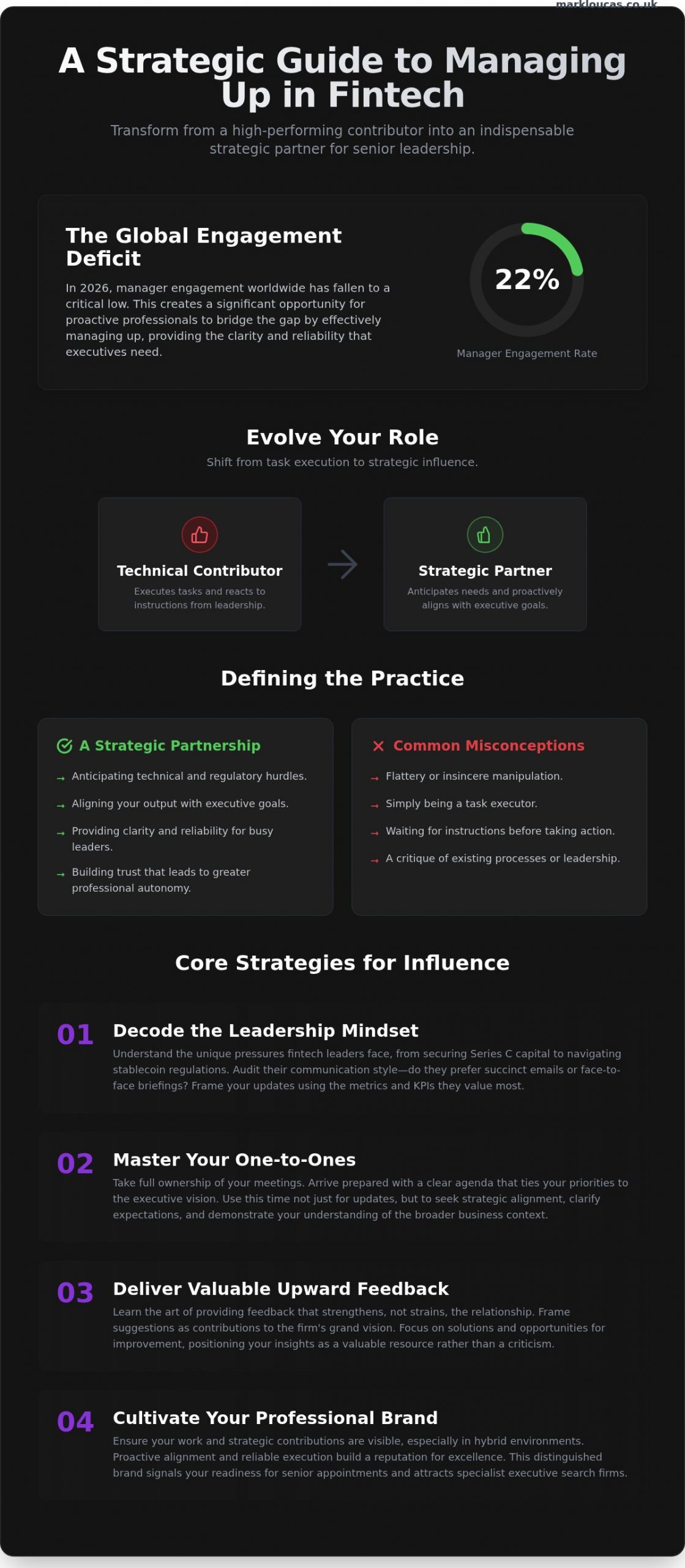
What if the most significant obstacle to your next senior appointment isn’t your technical prowess, but the invisible friction between your desk and the boardroom? In the relentless, high-pressure environment of global fintech, it’s common to feel that your strategic contributions are lost amongst the noise of scaling and shifting regulations. You likely find yourself striving for alignment whilst navigating the quiet, often frustrating absence of clear executive feedback. With manager engagement falling to a low of 22% worldwide in 2026, the necessity of managing up has never been more vital. Leadership is often a solitary pursuit.
This guide will show you how to transform from a high-performing contributor into a trusted strategic partner. You will discover how to cultivate a sophisticated relationship with senior leadership that secures your professional autonomy and accelerates your impact within the global fintech ecosystem. We shall explore the precise methods for gaining executive visibility and aligning your personal trajectory with the overarching vision of the firm, ensuring your expertise is recognised where it matters most. Success requires a curated approach.
Key Takeaways
- Redefine your relationship with leadership by evolving from a technical contributor into a strategic partner who anticipates executive requirements.
- Gain insight into the nuanced pressures fintech leaders face, including intricate regulatory shifts and the rigorous demands of capital acquisition.
- Master the art of managing up by taking full ownership of your one to one meetings to ensure your priorities align with the executive vision.
- Learn to deliver upward feedback that resonates as a valuable contribution to the grand vision rather than a critique of existing processes.
- Cultivate a distinguished professional brand that signals your readiness for senior appointments and attracts the attention of specialist executive search firms.
If you are looking to elevate your career within the global financial landscape, you may wish to contact our team for bespoke talent advice tailored to your specific aspirations.
Defining Managing Up in the Fintech Sector
In the sophisticated ecosystem of modern finance, the concept of What is Managing Up? transcends simple workplace collaboration. It’s a strategic partnership designed to align your individual output with the overarching executive goals of the firm. Within digital banking, this skill involves the meticulous anticipation of technical and regulatory hurdles before they manifest as critical issues for leadership. As we move through 2026, the industry is seeing a period of regulatory maturation, particularly concerning AI decision-making and cybersecurity. Proactive professionals don’t wait for instructions; they provide the roadmap. Managing up isn’t about flattery or manipulation. Instead, it’s about providing the clarity and reliability that busy executives require to navigate a landscape defined by rapid change. For those engaging with fintech executive search, demonstrating this capability is often the differentiator between a standard candidate and a high-calibre leader. Precision matters.
Moving Beyond the Manager Employee Dynamic
True excellence in the fintech sector requires a shift from being a mere task executor to becoming a trusted strategic advisor. This evolution is rooted in the proactive management of expectations and the delivery of solutions that reflect a deep understanding of the broader business context. In our hybrid work environments, critical career decisions are often made during informal conversations. By mastering the art of managing up, you ensure your work remains visible and valued even when you aren’t in the room. This fosters a level of professional trust that naturally leads to greater autonomy. It allows you to operate with a degree of independence that is rare in high-stakes environments. Professional discretion remains paramount whilst building this relationship; you must act as a reliable confidant who understands the weight of executive responsibility.
Why Strategic Alignment Matters in Payments and Banking
Alignment is the cornerstone of success when delivering complex projects, such as those involving RTGS payment consulting. In these highly regulated financial environments, even minor misalignments can lead to significant bureaucratic friction or compliance risks. Strategic alignment ensures that every technical decision supports the long-term vision of the organisation. This proactive behaviour reduces workplace friction and enhances the overall performance of the team. It creates a culture of excellence where senior stakeholders feel supported, allowing the firm to move with both speed and stability. Reliable leadership starts with a shared vision. When you align your personal trajectory with the goals of the board, you become an indispensable asset to the firm’s future growth.
If you are considering your next move within the global financial sector, you may wish to speak with our consultants about senior leadership roles that align with your unique expertise.
Decoding Leadership Mindset and Communication Styles
To effectively master managing up, one must first understand the unique psychological architecture of a fintech executive. These leaders operate under a weight of responsibility that often remains invisible to their teams. In 2026, the pressures of securing Series C capital raises or navigating the maturing landscape of stablecoin regulations are omnipresent. An executive’s time is their most precious asset; therefore, your interactions must be curated with extreme care. Auditing your manager’s communication style is a subtle art that requires observation rather than interrogation. Do they prefer the succinct clarity of a bulleted email, or the nuanced context of a brief, face to face briefing? Identifying these preferences allows you to deliver information in their favourite format, making the process of managing up feel like a seamless extension of their own workflow. Precision builds trust.
Beyond communication, you must familiarise yourself with the specific metrics that define their success. Whether it is Customer Acquisition Cost efficiency or the speed of regulatory reporting, knowing these key performance indicators allows you to frame your updates in a language they already value. Meticulous attention to detail is non-negotiable. A single error in a financial projection can erode months of built trust, whilst a perfectly presented data set signals that you are ready for greater responsibility.
Identifying Executive Priorities in Fast Paced Environments
Uncovering what truly keeps a leader awake at night requires looking past the stated quarterly goals. Whilst the public mission may focus on user growth, the actual strategic pressure might be an upcoming audit or a looming competitive threat in a specific district like the Dubai International Financial Centre. Aligning your daily tasks with these high level objectives ensures your output is always relevant. You become the person who solves problems they haven’t yet had the time to articulate. This level of foresight is what separates a standard employee from a future leader.
Adapting Your Approach to Different Management Personas
Fintech attracts diverse leadership archetypes. The visionary founder often prioritises grand innovation and disruptive speed, requiring you to be the grounding force that ensures feasibility. Conversely, the pragmatic banker, perhaps transitioning from a traditional institution, values risk mitigation and structured reporting. Tailoring your communication to these personas ensures maximum influence. In all interactions, remain unhurried and precise. This composure signals a level of seniority that is highly attractive to those seeking specialised leadership talent for their next major venture.
High calibre candidates who are ready to secure a position that recognises their strategic value should get in touch with us to discuss their next move.
Core Strategies for Influencing Senior Stakeholders
Influence is rarely the result of a single grand gesture; rather, it is built through the steady accumulation of reliability and foresight. When you are managing up, you must transition from being a recipient of instructions to being the architect of the interaction. In the fast-paced fintech environment, executives frequently operate with incomplete information. Your role is to provide the missing context that allows for decisive action. This begins with taking absolute ownership of the one on one meeting structure. Many professionals treat these sessions as passive updates, yet the most effective leaders use them to shape executive perception. By preparing a structured agenda and circulating it twenty-four hours in advance, you demonstrate a level of organisational discipline that is highly valued in the unhurried world of specialised financial recruitment. Success is intentional.
Senior stakeholders are often besieged by problems. To stand out, you must consistently present solutions. When a technical or regulatory hurdle arises, avoid the temptation to simply flag the issue. Instead, provide a succinct overview of the situation followed by three viable mitigation paths, clearly highlighting your recommended course of action. This proactive reporting reduces executive anxiety by providing a sense of control. It signals that you are an insider who understands the competitive landscape and the nuances of risk management.
Mastering the Art of the One on One Meeting
A high-level fintech agenda should prioritise strategic alignment over tactical minutiae. Consider a structure that begins with a brief look at critical milestones, moves into risk mitigation strategies for AI decision-making or stablecoin compliance, and concludes with resource requirements. Pivot the conversation by asking, “Does my current focus align with your primary strategic concerns for this quarter?” This dialogue transforms the meeting from a routine check-in into a collaborative strategy session, fostering a level of professional intimacy that is essential for career progression. It ensures your efforts are always visible and relevant.
Proactive Risk Management and Solution Oriented Reporting
In the highly regulated world of digital banking, flagging potential risks is a duty; doing so whilst offering solutions is a skill. Use executive summaries to frame complex data for quick decision-making. Focus on the impact of technical debt or regulatory shifts on the firm’s long-term profitability. Mastering the art of managing up through solution-oriented reporting establishes your authority and prepares you for senior appointments. By removing the cognitive burden from your manager, you become an indispensable partner. This meticulous approach to reporting establishes your authority and prepares you for the most exclusive career opportunities.
For those seeking a more personal approach to their professional trajectory, we invite you to reach out to Mark Loucas for discreet career guidance regarding your next senior appointment.
Navigating High Stakes Situations and Feedback
The ability to provide constructive insight to those above you is a hallmark of a sophisticated leader. In a scaling fintech, where the pace of development often outstrips operational capacity, managing up requires a delicate balance of empathy and assertiveness. When your supervisor is under extreme external pressure, perhaps from demanding investors or tightening capital markets, your role is to act as a stabilising influence. You must know when to provide support and when to gently challenge assumptions that may lead to technical debt or regulatory exposure. This is particularly relevant when evaluating senior talent; for instance, understanding the best interview questions to ask your compliance expert candidate reveals whether they possess the fortitude to manage upward pressure during a high-stakes audit. Composure is a rare and valuable commodity.
Providing Upward Feedback with Professional Tact
Whilst the traditional sandwich method remains a staple of management training, senior leaders often appreciate a more direct and unhurried approach. Sophisticated professionals frame their feedback as a contribution to the grand vision of the firm. It isn’t about personal preference; it’s about protecting the organisation’s reputation and long-term viability. Choosing the right setting is vital. A private, scheduled briefing is far more effective than a public challenge. By positioning your observations as a way to mitigate collective risk, you ensure your voice is heard without triggering defensive behaviours. This level of tact is what defines an elite advisor.
Handling Disagreements in Technical or Regulatory Contexts
Handling disagreements requires a framework rooted in objective reality rather than emotion. In technical or regulatory contexts, the use of precise data and current market intelligence acts as an anchor for your argument. If a deadline is unrealistic, present the trade-offs in terms of quality and compliance. Speak with quiet confidence and directness. This approach demonstrates that you value the firm’s success above your own comfort. It signals a level of maturity that is essential for those aspiring to the highest levels of executive leadership. When you disagree with data, you aren’t challenging authority; you are upholding excellence.
Establishing this level of trust is a long-term endeavour. If you are prepared to explore how your strategic communication skills can lead to more exclusive opportunities, please consult with our fintech executive search team today.
Leadership requires a discreet partner who understands the nuances of the global financial market. If you are a senior professional seeking your next significant challenge, we encourage you to contact our executive search team to discuss private opportunities that align with your refined expertise.
The Role of Managing Up in Career Progression
Transitioning from a technical expert to a leadership figure is a journey defined by the quality of your professional relationships. Mastering the art of managing up acts as the catalyst for this transformation. It builds a professional brand that is exceptionally attractive to fintech executive search firms, who prioritising individuals capable of navigating the complex interpersonal dynamics of the boardroom. By acting as a trusted advisor to senior leadership, you cultivate a reputation that transcends your current role. This visibility amongst the initiated and highly connected boutique advisors ensures that when non-public opportunities arise, your name is already associated with strategic reliability. Excellence is rarely overlooked.
This skill also provides a sophisticated way to answer the weakness for job interview question. Instead of offering a cliché, you can demonstrate genuine growth in stakeholder management. You might explain how you evolved your approach to align more closely with executive vision whilst maintaining technical integrity. This level of self-awareness signals a maturity that is highly sought after in senior appointments.
Building Trust and Visibility for Executive Appointments
A consistent track record of managing up creates an enduring narrative of reliability and strategic thinking. In the exclusive world of executive placements, where many roles are never advertised, your professional reputation is your most valuable asset. Securing non-public executive opportunities requires more than just performance; it requires the trust of those who already hold power. Demonstrating the maturity required for C suite roles involves showing that you can support a CEO through periods of intense scrutiny. It proves you have the temperament to handle the unhurried and meticulous nature of high-value transactions. Reliability is the cornerstone of leadership.
Leveraging Specialist Recruitment for Your Next Strategic Move
At Mark Loucas, we look for candidates who can articulate their strategies for managing complex upward relationships with precision. During a search process, the ability to describe how you aligned a technical roadmap with a board’s financial goals is highly persuasive. This curated excellence in professional relationships offers long-term value that technical skills alone cannot provide. It signals that you are ready for a bespoke solution to your career progression. True talent is always in demand, and the ability to manage the needs of senior stakeholders is the ultimate indicator of your readiness for the next level. Success is a collaborative endeavour.
Professionals who value a tailored approach to their career growth often find that a private advisor is essential. You may contact our executive search team to discuss how we can support your strategic ambitions.
Elevating Your Influence Within the Boardroom
Mastering the art of managing up is a lifelong pursuit of refinement and strategic alignment. By moving beyond tactical execution to anticipate executive needs, you secure the autonomy and visibility required for the most exclusive senior appointments. Success in the modern fintech sector is built upon a foundation of trust and the ability to navigate complex regulatory landscapes with quiet confidence. Since 2011, we’ve acted as a discreet advisor for high calibre talent across the global payments and digital banking sectors. Our specialist executive search process is designed to match your unique capabilities with organisations that value sophisticated leadership and meticulous attention to detail. We invite you to Partner with the fintech recruitment experts at Mark Loucas for your next executive move. Your expertise deserves a platform that recognises its true worth and supports your continued ascent. The future of finance is yours to shape.
Frequently Asked Questions
What does managing up actually mean in a professional context?
Managing up is the deliberate practice of consciously working with your superior to obtain the best possible results for you, your manager, and the firm. It’s a sophisticated dance of anticipating needs and providing clarity before it’s requested. This approach fosters a partnership built on mutual trust and shared objectives, ensuring every project reflects the meticulous standards and the refined vision of the organisation.
Is managing up the same as being a brown-noser or sycophant?
Managing up is a strategic professional skill focused on efficiency and mutual success, whereas sycophancy is merely insincere flattery for personal gain. True professional alignment seeks to improve the workflow and output of the entire team. It’s a hallmark of high-calibre talent who understand that their own success is inextricably linked to the success and the peace of mind of their leadership.
How do I manage up if my boss is a micromanager in a high pressure role?
You should overwhelm a micromanager with proactive communication and transparency to build the trust they currently lack. By providing detailed updates and hitting every deadline before they have a chance to check in, you demonstrate a level of reliability that eventually allows them to step back. This approach is particularly effective in fast-paced environments like the digital banking centres of London or Dubai.
Can I give feedback to a CEO or founder without risking my position?
You can certainly offer feedback to a founder if it’s framed within the context of the company’s strategic growth and long-term vision. Focus on data-driven insights and potential solutions rather than personal grievances. Founders often appreciate directness from their senior team members, provided the conversation remains private and is delivered with the discretion expected at an elite executive level.
What are the most common mistakes people make when trying to manage up?
The most frequent error is assuming your manager already knows everything you’re working on or what obstacles you’re currently facing. Another mistake is failing to adapt your communication style to match theirs, which creates unnecessary friction. Effective managing up requires a deep understanding of your manager’s priorities and a commitment to making their professional life easier through meticulous preparation and quiet confidence.
How does mastering the art of managing up help with executive search opportunities?
Mastering the art of managing up significantly enhances your profile for exclusive executive search opportunities by signalling a high degree of emotional intelligence. Specialists in fintech talent advisory frequently seek candidates who demonstrate the ability to influence leadership whilst maintaining professional discretion. It shows you’re ready for the nuanced challenges of senior management within the world’s most prestigious and competitive financial districts.
What should I do if my manager is resistant to my efforts to manage up?
If a manager resists your efforts, you must remain patient and continue to deliver exceptional results whilst subtly adjusting your approach. Focus on the areas where they feel the most pressure and offer support that directly alleviates that specific burden. Sometimes, the most effective strategy is to lead by example, demonstrating the value of your partnership through unwavering reliability and a tailored approach to problem-solving.
Is managing up more important in fintech than in traditional banking?
The dynamic nature of the fintech sector makes managing up a vital skill compared to the more rigid hierarchies found in traditional banking. In an industry defined by rapid technological shifts and constant regulatory evolution, the ability to guide leadership through complex decisions is invaluable. It ensures the firm remains agile, allowing for a more intimate and personalised approach to business growth and market intelligence.

Article by
Liam Henfrey
Liam Henfrey is a seasoned specialist in the payments and banking sectors with over two decades of experience. As the Founder and CEO of FINOPSIS and Managing Director at Mark Loucas Ltd, he advises organisations on complex financial operations and technology. His career includes senior roles at PwC, Deloitte, and Visa Europe.
Related Fintech Recruitment Guides
If you liked this guide then you may also like the following: