


Building a Diverse Leadership Team Through Better Hiring
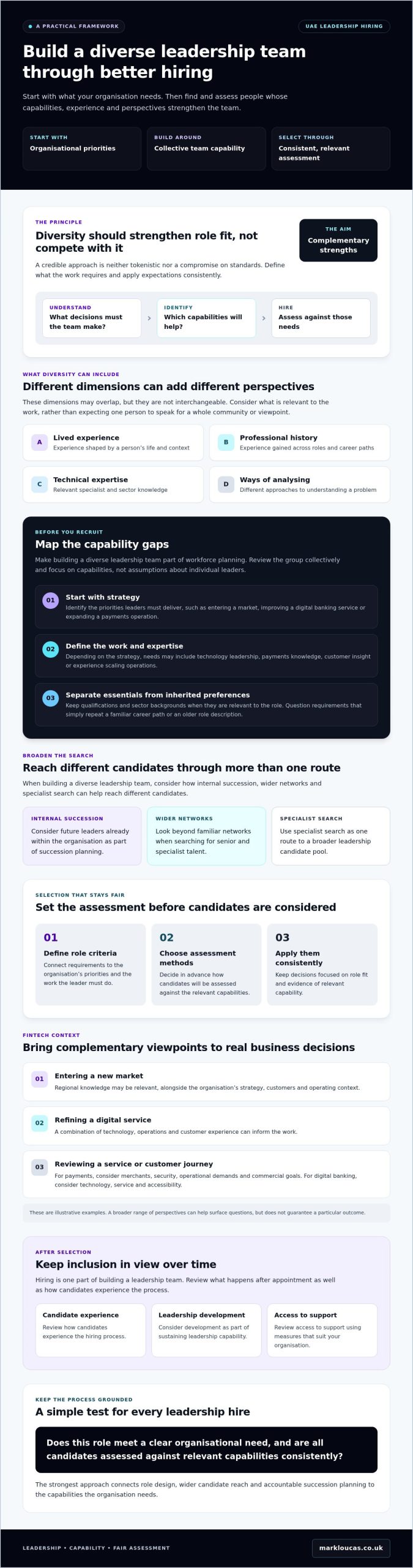
What if a more diverse leadership team could improve role fit rather than compete with it? Building a diverse leadership team through better hiring starts with identifying the capabilities, experience and perspectives your organisation needs, then assessing candidates against those needs consistently. For organisations in the UAE, that means looking beyond familiar networks when searching for senior and specialist talent with the support of Mark Loucas Ltd.
It’s reasonable to be cautious. Diversity can be difficult to define, and representation alone won’t show whether a hiring process is fair or whether people can contribute fully once appointed. A credible approach is neither tokenistic nor a compromise on standards. It sets clear expectations and applies them consistently.
This article explains how to define leadership diversity in a way that reflects your organisation, identify capability gaps and broaden the search for suitable candidates. It also covers practical steps for role design, candidate assessment and accountable succession planning. The aim is a leadership team whose members bring complementary strengths and perspectives, selected through a process grounded in organisational needs.
Key Takeaways
- Connect leadership roles to organisational priorities, then identify the skills and experience the team needs collectively.
- Review capability gaps systematically, without making assumptions about individual leaders.
- When building a diverse leadership team, consider how internal succession, wider networks and specialist search can reach different candidates.
- Set role criteria and assessment methods in advance so decisions focus on relevant capabilities.
- Review candidate experience, leadership development and access to support over time, using measures that suit your organisation.
If you’re considering a senior fintech hire, you can discuss your leadership hiring needs with Mark Loucas.
Why Building a Diverse Leadership Team Starts With Business Needs
Building a diverse leadership team is not about assembling a particular look or meeting a single representation measure. It is about understanding what the organisation needs to do and bringing together leaders whose skills, experience and perspectives complement one another. Start with the business need: what decisions must the team make, and what capabilities will help it make them well?
Leadership diversity is the range of relevant backgrounds, expertise and perspectives that helps a leadership team understand challenges and consider decisions from more than one point of view. The right mix depends on the organisation, its strategy and the role. Consider diversity across the team rather than expecting one person to speak for an entire community or viewpoint.
What diversity can mean in a leadership context
Diversity can include lived experience, professional history, technical expertise and different ways of analysing a problem. These dimensions may overlap, but they are not interchangeable. A leader’s experience of a customer group, for example, does not make them a representative of every customer with a similar background.
Start by asking which perspectives and capabilities are relevant to the organisation’s plans. A team preparing to enter a new market may need regional knowledge. A team refining a digital service may benefit from a combination of technology, operations and customer experience. The aim is to strengthen the team collectively, not to make assumptions about individuals.
The broader idea of workforce diversity can help frame the different dimensions involved. For a leadership team, the practical question is which dimensions matter to the work and how candidates can demonstrate relevant capabilities fairly.
Why leadership composition matters in fintech
In fintech, digital banking and payments, leadership decisions can shape product priorities, customer journeys and growth plans. A team with complementary experience can examine decisions from operational, technical and customer perspectives. This does not guarantee a particular outcome, but it can help surface questions that a narrower set of experiences might miss.
For example, a payments business reviewing a new service could consider how it works for different types of merchants, alongside security, operational demands and commercial goals. A digital banking team might assess a proposed customer journey through technology, service and accessibility perspectives. These are illustrative examples, not claims about results.
For organisations in the UAE, the relevant mix will depend on their strategy, customers and operating context. Define the business need first, then use it to guide role design and hiring. This keeps the focus on capability and fair assessment rather than symbolic appointments.
When reviewing leadership needs in fintech, a conversation about leadership talent planning can help clarify the brief.
How to Map Leadership Gaps Before You Recruit
A clear gap review helps distinguish a genuine hiring need from a role description that has simply been carried forward. Begin with the organisation’s direction, then identify the capabilities its leadership team will need. This makes building a diverse leadership team part of workforce planning, rather than a separate exercise.
Start with strategy and the work leaders must do
Identify the priorities leaders will be responsible for, such as entering a market, improving a digital banking service or expanding a payments operation. Then define the work and expertise needed to support those priorities. Depending on the strategy, this might include technology leadership, payments knowledge, customer insight or experience scaling operations.
Separate essential capabilities from preferences inherited from older role descriptions. For each requirement, ask whether it is necessary to do the work or simply reflects a familiar career path or previous post-holder. A qualification or sector background may matter for a role, but include it because it is relevant, not just because it has always been listed.
Turn the team review into a useful hiring brief
Review the leadership group collectively against the capabilities the strategy requires. Focus on what the team can draw on, not assumptions about any individual’s identity or experience. A simple table can record each priority, the expertise currently available, where coverage is limited and whether there is a succession option.
For example, a business planning a significant technology change might find strong product leadership but limited experience delivering similar transformations. That is a capability observation, not a judgement about any leader’s potential. Describe the gap in terms of the work to be done and the evidence a candidate would need to provide.
Use the review to choose the right response. A gap might call for recruitment, development, succession planning or a combination. If external hiring is appropriate, turn the findings into a brief that sets out the outcomes, essential capabilities and assessment questions. This gives hiring managers a practical basis for comparing candidates.
When internal networks offer a narrow view of available talent, structured market research can help clarify the wider candidate landscape. Mark Loucas provides market mapping and intelligence for fintech, digital banking and payments. For a related perspective on progression and support after appointment, read this article on helping diverse hires reach senior leadership.
For external search or market mapping, you can discuss your leadership hiring requirements with Mark Loucas.
Where a broader search for senior fintech talent is needed, a discussion about executive search can help establish the requirements.
How to Reach and Assess a Broader Leadership Candidate Pool
Once the role is clear, choose sourcing routes that match its requirements. Relying on familiar referrals alone can keep a search within a narrow network. A considered mix of internal succession, direct outreach, professional networks and specialist search can help you reach candidates with relevant experience from a wider range of career paths.
Choose sourcing routes that fit the leadership brief
Internal succession may suit a role where a potential successor understands the organisation and can show evidence of the required capabilities. It can also support continuity. However, an internal route may not address a specialist skills gap or bring in experience the team does not currently have. Compare internal and external candidates against the same role requirements.
Direct outreach and broader professional networks can extend reach beyond immediate referrals. For a specialist leadership brief, market mapping can provide a structured view of relevant talent across organisations and sectors. This helps you test whether your initial network reflects the wider candidate landscape. Where payments expertise is central, payments industry recruitment expertise may be one specialist search route to consider.
Fintech executive search may also be worth considering when internal networks do not reach the required candidate pool. The right route depends on the role, the experience sought and the reach of your existing networks. No sourcing method guarantees a diverse shortlist.
Assess candidates consistently and fairly
Before interviews begin, agree role-related criteria and decide what evidence will demonstrate each capability. Ask comparable candidates the same core questions, then use follow-ups to clarify their examples. This creates a more consistent basis for discussion, although structure alone cannot remove every source of bias.
Assess evidence rather than familiarity or presentation style. Depending on the brief, this might include:
- Outcomes the candidate delivered and their contribution to them.
- Judgement shown when handling complex or changing priorities.
- How they worked with colleagues, customers and other stakeholders.
- Relevant specialist expertise, such as experience in digital banking, payments or technology.
Use a shared scoring guide and record the evidence behind each assessment. This helps the panel compare candidates against the brief instead of changing expectations as interviews progress. It also supports building a diverse leadership team through role fit and consistent evaluation, rather than relying on assumptions about candidates.
If you’re weighing up external search for a senior fintech role, you can discuss your executive search requirements with Mark Loucas.
For a considered discussion about leadership talent needs, you can speak with Mark Loucas.
How to Make Inclusive Leadership Hiring Work After Selection
A fair appointment is only one part of building a diverse leadership team. Once a leader joins, the organisation’s day-to-day practices influence how clearly they can contribute, make decisions and build working relationships. Plan support as part of the appointment, rather than leaving it to chance.
Create conditions for new leaders to contribute
During onboarding, explain practical expectations, decision rights, key stakeholder relationships and measures of success. Make informal networks and established routines visible where they affect how work gets done. This gives a new leader a clearer route into the role and reduces reliance on unspoken assumptions.
Mentoring can provide space to discuss the role and its challenges. Sponsorship can help a leader gain access to relevant projects, relationships and opportunities. Neither should substitute for fair access across the organisation. Invite feedback on barriers, but don’t expect one person to speak for everyone with a similar background or experience.
Managers can check whether expectations and support are applied consistently. Are leaders assessed against the same agreed outcomes? Do they have comparable access to information, decision-making forums and development opportunities? These questions can reveal where established practices may need attention.
Connect hiring with succession and development
External recruitment is one part of leadership planning. Review internal development and succession pipelines alongside it, so future opportunities are visible and progression criteria are clear. This helps organisations consider whether to address a capability gap through hiring, development or both.
For roles requiring specialist knowledge, such as digital banking leadership, understanding the digital banking recruitment landscape can help clarify the experience available in the market and inform a realistic role brief. The right approach depends on the organisation’s needs and the capabilities required.
An inclusive hiring process can support fairer consideration, but it cannot guarantee a particular appointment or outcome. Its value lies in clear criteria, consistent treatment and practical support after selection. Together, these steps make inclusion part of how leadership works, rather than a promise attached only to recruitment.
If you’re reviewing leadership hiring or succession needs in fintech, discuss your requirements with Mark Loucas.
For leadership hiring priorities, you can arrange a conversation about your hiring needs.
How to Review Progress and Choose the Right Recruitment Support
Building a diverse leadership team is an ongoing process, not a single hiring decision. Regular review can show whether role design, sourcing and assessment are helping the organisation reach and evaluate suitable candidates, and whether development pathways support future leadership needs.
Review the process as well as team composition
Look for patterns across each stage of hiring. Consider where candidates hear about roles, who progresses, how consistently the panel applies its criteria and whether development opportunities are accessible. Choose measures that suit the organisation and the information it can responsibly review. Don’t treat one appointment or figure as proof of lasting progress.
Candidate and stakeholder feedback can add useful context. Ask candidates whether the role and process were clear, and ask hiring stakeholders where criteria or decisions were difficult to apply. Keep questions specific: did candidates understand the assessment format, and could panel members explain how their decisions related to the agreed requirements?
Handle hiring information with care. Limit access to those who need it, avoid sharing identifiable candidate details unnecessarily and review results in a way that protects confidentiality. Use findings to refine role requirements, outreach methods and selection criteria. If a capability is repeatedly difficult to find, revisit whether the brief is too narrow or whether development could address part of the need.
Decide when specialist recruitment support may help
Internal teams may have strong networks, but those networks might not reach every relevant candidate. Market mapping can clarify the wider talent landscape and inform outreach for a specialist leadership brief. Executive search may be useful when a role is senior or the required experience is difficult to reach through existing channels. Neither approach guarantees a particular shortlist or hiring outcome.
Mark Loucas is an independent specialist recruitment consultancy focused on permanent and executive search across fintech, digital banking and payments. Its related services include market mapping and intelligence, talent advisory, and contract and interim solutions. The appropriate support depends on the brief and should complement a clear, fair assessment process.
For organisations in the UAE, review whether the hiring approach reflects the capabilities needed for local business priorities. Keep the focus on evidence: who can access the opportunity, how candidates are assessed and what the organisation learns from each search.
If you’re shaping a difficult leadership brief, discuss your priorities with Mark Loucas.
If you’re considering your next leadership hire, you can discuss your priorities in confidence.
Build Leadership Capability With a Clearer Hiring Approach
Building a diverse leadership team begins with the capabilities your organisation needs, then carries through into how you reach candidates, assess evidence and support leaders after appointment. Review the process over time, using measures that suit your organisation and protect candidate confidentiality. This keeps progress grounded in practical decisions rather than a single appointment or figure.
For a difficult senior brief, specialist market knowledge can help broaden the search beyond familiar networks. Mark Loucas is an independent consultancy founded in 2011, specialising in recruitment across fintech, digital banking and payments, with executive search, market mapping and talent advisory services.
If you’re considering your next leadership hire, discuss your leadership hiring priorities in confidence. A thoughtful brief and fair process can help you build a leadership team equipped for the organisation’s next stage.
Frequently Asked Questions
What does building a diverse leadership team mean?
Building a diverse leadership team means bringing together leaders with complementary skills, professional backgrounds, experiences and perspectives relevant to the organisation’s needs. It is not about expecting one person to represent an entire community or relying on a single measure of representation. The relevant mix varies by organisation and role. In fintech, it could include different combinations of payments, digital banking, technology, customer and operational experience.
How do you start building a diverse leadership team?
Start with the organisation’s priorities and the work its leaders need to deliver. Identify the capabilities required, then review what the leadership group already brings collectively. This can show whether the next step is recruitment, development, succession planning or a combination. Before advertising or approaching candidates, check that each role requirement is relevant and that assessment criteria describe the evidence needed to demonstrate capability.
Can a diverse leadership team improve business decision-making?
A leadership team with varied and relevant experience can bring different questions and viewpoints to decisions about products, customers and growth. For example, a payments business considering a service change might weigh customer needs alongside technology and operational demands. A broader range of perspectives can help a team examine assumptions, but it does not guarantee better decisions. Clear evidence, sound judgement and constructive discussion remain essential.
How can organisations make leadership hiring more inclusive?
Make role requirements clear, use sourcing routes beyond familiar referrals and assess candidates against consistent criteria. Structured interviews with the same core questions for comparable candidates can support fairer comparison, although they cannot remove every source of bias. Explain the selection process and success measures clearly. Inclusion also continues after appointment through useful onboarding, access to decision-making and development opportunities applied consistently.
How do you assess candidates fairly for senior roles?
Agree role-related criteria before interviews and define what evidence would demonstrate each one. Ask comparable candidates the same core questions, then assess their examples of outcomes, judgement, collaboration and specialist expertise against a shared guide. Record the evidence behind decisions rather than relying on familiarity or interview style alone. Panel members can discuss differing assessments and check that their conclusions relate to the agreed requirements.
What should a company measure when reviewing leadership diversity?
Review measures that reflect the organisation’s hiring process and priorities. These might include where candidates learn about roles, progression through selection stages, consistency of assessment and access to leadership development. Candidate and hiring stakeholder feedback can show whether the process was clear. Compare patterns over time without treating a single appointment or figure as proof of progress, and protect confidentiality when handling candidate information.
When should an organisation use executive search to build a diverse leadership team?
Executive search may help when a senior or specialist role is difficult to fill through internal succession or familiar networks. A specialist recruiter can contribute sector knowledge and candidate outreach, while market mapping can clarify the wider talent landscape. Mark Loucas Ltd provides fintech executive search and recruitment across fintech, digital banking and payments, alongside market mapping and intelligence. These services can support a search, but cannot guarantee a diverse appointment.

Article by
Liam Henfrey
Liam Henfrey is a seasoned specialist in the payments and banking sectors with over two decades of experience. As the Founder and CEO of FINOPSIS and Managing Director at Mark Loucas Ltd, he advises organisations on complex financial operations and technology. His career includes senior roles at PwC, Deloitte, and Visa Europe.
Related Fintech Recruitment Guides
If you liked this guide then you may also like the following: