


The Strategic Role of a Chief Technology Officer in the 2026 Fintech Sector
What if the most significant threat to your firm’s expansion isn’t a lack of capital, but the absence of a leader who can bridge the gap between complex engineering and commercial resilience? As the global fintech market is projected to reach USD 460.76 billion in 2026, the requirement for a sophisticated chief technology officer has shifted from mere technical oversight to high-level strategic architecture. You likely recognise the exhausting challenge of keeping pace with agentic AI and stablecoin regulations whilst ensuring your infrastructure remains impenetrable. It’s a high-stakes environment where the wrong hire leads to stagnation, yet the right one unlocks unprecedented scale.
This article reveals the evolving responsibilities and essential expertise required for a technology leader to drive innovation and growth in the modern fintech landscape. We’ll examine the nuanced differences between the CTO and CIO roles, providing a bespoke framework for identifying the elite talent capable of delivering substantial ROI in the payments and banking sectors. By understanding the profile of a modern technology architect, you can ensure your organisation isn’t just participating in the market, but actively defining its future.
Key Takeaways
- Understand how the technology lead has transitioned from a back-office function to a front-line commercial driver.
- Learn the core duties of a chief technology officer in 2026, specifically regarding the meticulous management of high-stakes payments infrastructure.
- Gain a refined analysis of the distinct yet complementary roles of the CTO and CIO within large-scale digital banking organisations.
- Identify the elevated skill set required for elite technology leadership, balancing profound technical depth with sophisticated stakeholder management.
- Discover why a specialist boutique advisor is essential for accessing the non-public talent market during an executive search.
If you are looking to secure a leader who balances technical depth with commercial acumen, contact our boutique consultancy to explore our bespoke executive search services.
Defining the Chief Technology Officer within the Modern Fintech Landscape
The Chief Technology Officer (CTO) has emerged as a cornerstone of the modern C-suite, particularly within the discerning world of high-end financial services. This position is no longer a back-office function tasked with maintaining legacy systems. It’s a front-line commercial driver. In the elite corridors of the fintech and banking technology sectors, the role requires a rare blend of craftsmanship and foresight. Defining such a critical position requires an unhurried and diligent approach, ensuring that the selected leader possesses the quiet confidence to manage both complex codebases and high-level board expectations.
The distinction between a standard technology manager and a true strategic leader is found in their meticulous attention to detail. In premium urban centres like London’s Square Mile, the chief technology officer is expected to be a highly connected advisor. They must understand the non-public opportunities that arise from emerging technologies. This level of expertise isn’t found in volume-driven recruitment. It requires a tailored solution that focuses on the specific needs of a high-value organisation.
The Evolution of Technology Leadership in Finance
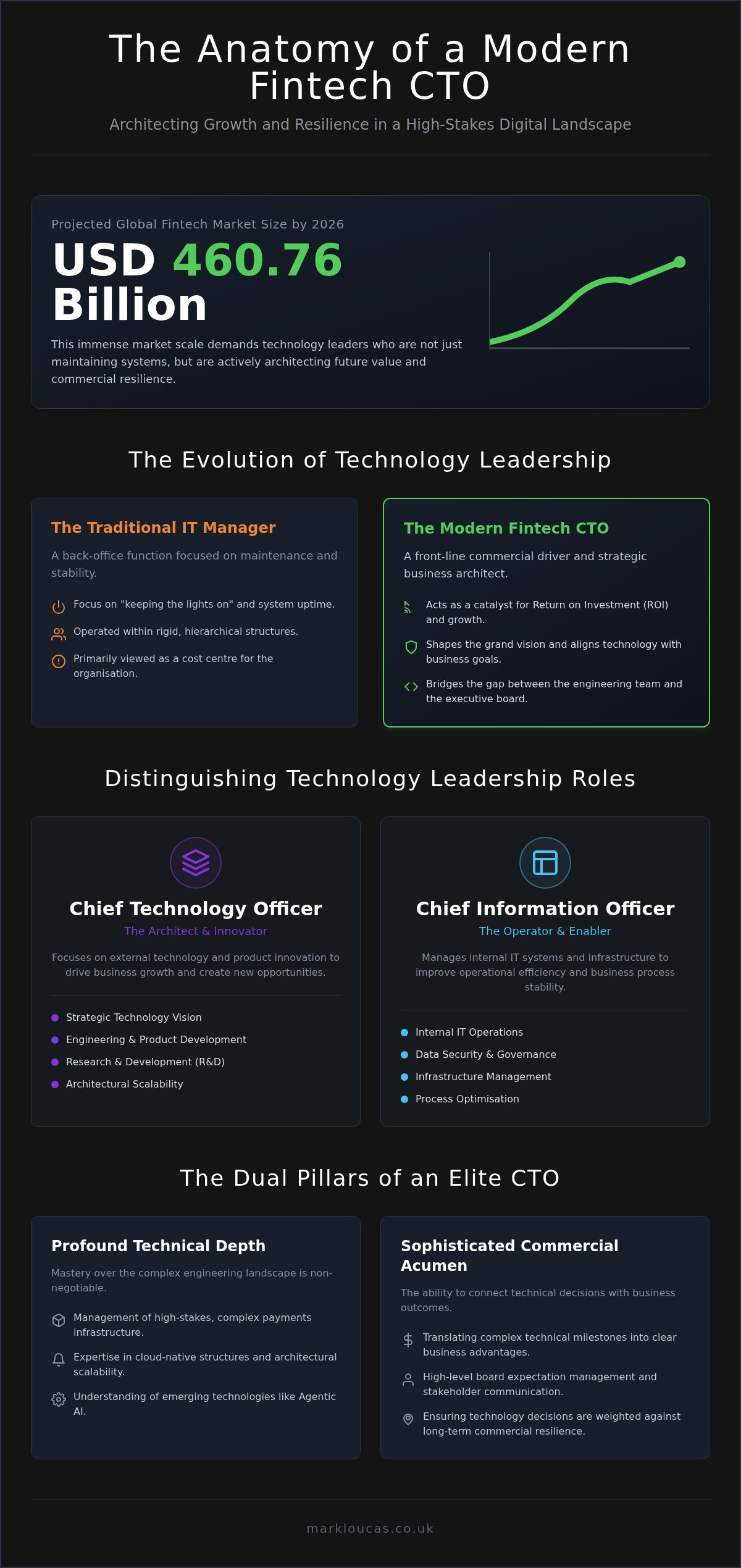
Traditional banking IT roles were often defined by rigid hierarchies and a focus on keeping the lights on. Modern fintech demands a more agile, sophisticated perspective. We’ve seen a decisive shift towards customer-centric technology solutions that feel both intuitive and secure. By 2026, the industry has moved beyond simple digitisation. The requirement now is for architectural scalability that can support the rapid re-bundling of financial services. An elite leader understands that the underlying infrastructure must be as elegant as the user interface it supports—to explore how such systems are developed, you can visit Larasoft for insights into bespoke web applications. It’s about building for the future whilst respecting the meticulous standards of the present.
The CTO as a Business Strategist
A high-calibre chief technology officer acts as a strategic architect who shapes the grand vision of the organisation. Technical decisions are never made in isolation. They are weighted against long-term business growth and commercial resilience. Whether it is adopting cloud-native structures or implementing agentic AI for fraud prevention, every choice must align with the broader engineering roadmap. This alignment ensures that technology acts as a catalyst for ROI rather than a cost centre. The most successful leaders in this space possess the commercial acumen to translate complex technical milestones into clear business advantages. They bridge the gap between the engineering team and the executive board with ease.
Finding the right leader requires an intimate understanding of the market, which is why we invite you to speak with our specialist advisors about your executive needs.
Primary Responsibilities and the Strategic Vision of a CTO
The 2026 landscape is defined by a global fintech market projected at USD 460.76 billion, a figure that reflects the immense scale of modern digital finance. Within this expansive environment, the chief technology officer must manage high-stakes payments infrastructure with meticulous care and a steady hand. It’s no longer enough to simply maintain system uptime. The role now demands a profound level of regulatory resilience and architectural foresight. These leaders foster an elite culture of engineering excellence by setting the highest standards for technical craftsmanship. Success in this area frequently relies on high-calibre payments industry recruitment to source the niche talent required for modern, complex banking systems. This is particularly vital as the industry moves towards the re-bundling of services into sophisticated super apps that require seamless integration.
Architecting Scalable and Secure Systems
A successful leader selects a technology stack that supports global expansion whilst maintaining absolute security. This involves the graceful management of cloud-native infrastructure alongside the necessary integration of legacy systems that still form the backbone of many institutions. The migration to ISO 20022 standards and the adoption of Real-Time Gross Settlement (RTGS) are critical priorities in 2026. These are not merely technical updates. They represent fundamental shifts in how value moves across borders. The CTO ensures these transitions remain seamless and unhurried, acting as a discreet advisor to the board. They ensure that the architecture is not just functional but also future-proofed against the increasingly sophisticated landscape of cyber threats.
Driving Innovation and Product Development
Identifying emerging trends like agentic AI and blockchain is a core responsibility that requires both technical depth and commercial foresight. The chief technology officer oversees the product development lifecycle to ensure every technical feature delivers genuine commercial value to the organisation. By maintaining and protecting proprietary technology, they create a distinct and lasting competitive advantage in a crowded market. This requires a steady, reassuring pulse in leadership that allows for rapid innovation without compromising the core stability or security of the organisation. Agentic AI systems are now being utilised for autonomous fraud detection, requiring the CTO to balance this innovation with rigorous ethical oversight and data privacy.
If you require assistance in mapping the talent landscape for these high-stakes roles, our boutique team is here to provide tailored advice.
To ensure your organisation identifies the precise profile required for your current stage of growth, please contact our expert consultants for a private discussion.
Distinguishing the Chief Technology Officer from the Chief Information Officer
The distinction between the Chief Information Officer (CIO) and the chief technology officer is often blurred in general discourse, yet in the elite tiers of the 2026 fintech sector, the two roles remain sharp and complementary. Within a large digital banking organisation, these positions operate in a sophisticated partnership, each managing a distinct side of the technological coin. Whilst the CIO typically oversees the internal systems and data security that keep the institution running, the CTO focuses on the engineering of products that the customer actually touches. In smaller, more agile firms, these responsibilities are frequently combined into a single high-calibre appointment. This requires a leader with the rare ability to manage both corporate infrastructure and high-level product innovation with equal diligence. The CTO is the architect of the technical product, whilst the CIO is the custodian of the corporate institution.
Internal Operations versus External Innovation
A CIO focuses on internal efficiency, ensuring that the corporate infrastructure is robust and that employees have the tools they need to perform. Their success is often measured by system uptime, cost-saving through automation, and the integrity of internal data flows. Conversely, the chief technology officer is primarily concerned with the technical vision for customer-facing assets. They drive the development of the super apps and embedded finance solutions that define a brand’s market presence. Their success is measured by product adoption, technical scalability, and the speed at which new features can be deployed to a discerning global audience. These two streams of work must be perfectly aligned to ensure that the internal machinery can support the external grand vision.
Budgetary and Resource Management
The CIO typically manages the broad IT budget for the entire organisation, covering everything from hardware procurement to enterprise software licences. They are the gatekeepers of operational expenditure. In contrast, the CTO focuses on research and development investment and the acquisition of elite engineering talent. They seek out the craftsmen who can build proprietary technology that offers a lasting competitive advantage. Both functions rely heavily on specialised financial recruitment to source the niche professionals required for such high-stakes environments. Whether it is finding a DevOps specialist for the CTO or a cybersecurity expert for the CIO, the quality of the hire remains the ultimate anchor of reliability for the organisation’s long-term growth.
If you require a bespoke approach to identifying a leader who possesses this rare blend of technical depth and commercial foresight, we invite you to speak with our specialist consultants for a private consultation.
Essential Skills and the Profile of a High Calibre Technology Leader
The profile of an elite technology leader in 2026 is defined by a quiet confidence and a discreet, highly connected approach to leadership. These individuals are not merely technical managers. They are sophisticated architects who move amongst the highest levels of the organisation with ease. A high calibre chief technology officer possesses a rare ability to balance profound technical craftsmanship with the nuanced demands of stakeholder management. This level of expertise ensures that the interests of the organisation are managed with expert care, avoiding the volume-driven approach of larger entities. To support such a refined vision, these leaders often rely on high-quality DevOps recruitment to build the resilient, automated pipelines that allow for unhurried but steady innovation.
Securing such a leader requires an understanding of the non-public talent market, where the most distinguished professionals often reside. These individuals value privacy and tailored solutions, mirroring the boutique service they provide to their own organisations. They are the insiders who understand that a single, definitive technical decision can act as an anchor of reliability for years to come.
Technical Mastery and Regulatory Fluency
In the modern landscape, technical mastery must be paired with absolute regulatory fluency. An elite chief technology officer maintains a deep knowledge of cybersecurity and data privacy, ensuring that every architectural layer is impenetrable. They must understand the nuances of the compliance function, working in close alignment with those responsible for navigating the complex web of global financial regulations. This involves staying ahead of changes such as the EU’s MiCA regulation or the US GENIUS Act, ensuring that innovation never outpaces security. Their role is to provide a steady, reassuring pulse that allows the organisation to explore digital assets and agentic AI whilst remaining entirely within the bounds of international law.
Commercial Acumen and Boardroom Influence
The ability to translate complex technical milestones into clear commercial value is what separates a standard manager from a true C-suite strategist. These leaders possess the boardroom influence required to align engineering roadmaps with the grand vision of the organisation. They play a pivotal role in capital raising and forming strategic partnerships, acting as a credible and authoritative voice for investors. Their communication style is patient and diligent, ensuring that every technical investment is understood as a driver of long-term business growth. By speaking the language of ROI as fluently as the language of code, they ensure that technology remains a front-line commercial asset.
For organisations seeking to refine their leadership profile, our boutique advisory service offers the market mapping and intelligence required to secure elite talent.
To begin a confidential conversation regarding your leadership requirements, please contact our boutique consultancy for a tailored advisory service.
Executing an Executive Search for a Chief Technology Officer
The acquisition of an elite technology leader is a delicate process that requires more than a simple database search. In the high-stakes world of 2026 digital finance, a specialist fintech executive search is essential to identify individuals who possess both technical craftsmanship and commercial foresight. These high-calibre professionals rarely inhabit public job boards; instead, they reside within a non-public talent market accessible only to those with deep, long-standing connections. Identifying a chief technology officer who can truly transform an organisation requires a partner who acts as a discreet, knowledgeable insider. At Mark Loucas Ltd, our approach is defined by an unhurried pace, ensuring that every candidate is vetted with the meticulous attention to detail that our discerning clientele expects. We prioritise a perfect cultural and technical fit over the impersonal, volume-driven speed of larger corporate entities.
Securing a leader of this stature is an investment in the organisation’s grand vision. It requires a patient and diligent communication style to attract individuals who are already successful in their current roles. By acting as a boutique advisor, we provide the personalised attention needed to navigate these high-value transactions with quiet confidence and expert care.
The Risks of a Generalist Search
Volume-driven recruitment agencies often fail to grasp the niche requirements of a modern payments or banking infrastructure. They may overlook the critical need for regulatory fluency or the ability to manage complex technical migrations mentioned earlier in this guide. The cost of a bad hire at the executive level is profound, affecting not just the immediate engineering roadmap but also the long-term trust of investors. We mitigate these risks through data-driven market mapping and intelligence, providing a clear picture of the talent landscape before any introductions are made. This rigorous process ensures that the search is anchored in reliability and directness, protecting the interests of the firm at every stage.
Securing the Future of Your Fintech
The right chief technology officer acts as a visionary who can significantly enhance a company’s valuation. By building proprietary technology and fostering a culture of engineering excellence, they accelerate time-to-market for innovative products that capture global market share. This acceleration is achieved without compromising the security or stability that is the hallmark of a premium financial institution. Our commitment is to provide an elite and personalised service that treats your organisation as our sole focus. We understand that the right technology architect is not just a hire but a cornerstone of your future growth, providing the steady pulse required to lead in a competitive and rapidly evolving sector.
If you require a bespoke approach to identifying a leader who possesses this rare blend of technical depth and commercial foresight, we invite you to speak with our specialist consultants for a private consultation.
Leadership for a Resilient Fintech Future
The role of the chief technology officer has reached a point of unprecedented strategic importance. It’s no longer a matter of simply managing systems; it’s about architecting the commercial resilience of the entire firm. Throughout this analysis, we’ve explored the necessity of a leader who can navigate the complexities of agentic AI and ISO 20022 whilst maintaining the quiet confidence required in the boardroom. This elite profile is rare, yet it is the ultimate anchor of reliability for any organisation aiming to thrive in the 2026 landscape.
Since 2011, Mark Loucas Ltd has provided a discreet and highly connected advisory service, specialising in high-stakes payments infrastructure and maintaining access to elite, non-public talent pools. We understand that the right leader doesn’t just manage innovation but actively secures the future valuation of your fintech. To discuss your specific requirements for executive talent or to learn more about our bespoke search solutions, please feel free to contact our specialist consultants. With the right architectural vision, your organisation is perfectly positioned to define the next era of financial excellence.
Frequently Asked Questions
What is the average salary for a Chief Technology Officer in the UK fintech sector
Base compensation for this role is highly competitive and reflects the immense responsibility of managing high-stakes financial infrastructure. Whilst specific UK figures vary based on the scale of the institution, global benchmarks in 2026 show that a chief technology officer in the fintech sector can expect a base salary ranging from $320,000 to $420,000. Total compensation packages, which frequently include performance bonuses and significant equity, often exceed $600,000 for leaders in established firms.
Does a CTO need to have a background in software engineering
A profound foundation in software engineering is almost always essential for a technology leader in this sector. This background provides the technical depth required to make informed architectural decisions and earns the respect of elite engineering teams. Whilst the role has transitioned into a strategic C-suite position, the ability to understand the granular details of the codebase remains an anchor of reliability for the organisation. It allows the leader to bridge the gap between complex engineering and commercial objectives.
How does the CTO role differ in a startup versus an established digital bank
In a startup environment, the position is often hands-on and requires the leader to manage both the technical product and the internal IT infrastructure. These firms frequently combine the CTO and CIO responsibilities into a single high-calibre appointment. Conversely, in an established digital bank, the role is more strategic and external-facing. The leader focuses on long-term scalability, regulatory resilience, and the re-bundling of services into sophisticated super apps whilst delegating daily technical tasks to specialised teams.
What are the top three priorities for a new CTO in their first ninety days
The first priority is to conduct a meticulous audit of the existing technology stack to identify technical debt and architectural vulnerabilities. Following this, the leader must align the engineering roadmap with the organisation’s grand vision to ensure that every technical investment drives commercial ROI. Finally, they should focus on assessing the engineering talent pool. Building a culture of excellence is vital for maintaining a competitive advantage in a market that moves at a steady and unhurried pulse.
Is a Chief Technology Officer the same as a Head of Engineering
These positions are distinct despite their close collaboration within the technology function. The chief technology officer is a board-level strategist who focuses on the technical vision, external innovation, and long-term business growth. In contrast, the Head of Engineering is more internally focused on the execution of that vision. They manage the daily delivery of software, oversee the engineering budget, and focus on the professional development of the technical staff.
How does a CTO manage cybersecurity risks in 2026
Management of cybersecurity in 2026 relies on the adoption of agentic AI systems that can execute autonomous fraud detection and multi-step financial workflows. These systems work alongside a zero-trust architecture to protect sensitive data and high-value transactions. The leader also ensures that the organisation remains in full compliance with global regulations such as the EU’s MiCA and the US GENIUS Act. This meticulous attention to detail ensures that the firm remains impenetrable whilst continuing to innovate.

Article by
Liam Henfrey
Liam Henfrey is a seasoned specialist in the payments and banking sectors with over two decades of experience. As the Founder and CEO of FINOPSIS and Managing Director at Mark Loucas Ltd, he advises organisations on complex financial operations and technology. His career includes senior roles at PwC, Deloitte, and Visa Europe.
Related Fintech Recruitment Guides
If you liked this guide then you may also like the following: