


Interim CTO for a Scale-up: A Fintech Hiring Guide
What if the technology bottleneck isn’t a lack of engineers, but a lack of clear leadership? For a fintech scale-up, an interim CTO for a scale-up can bring focused direction when product delivery slows, technology decisions become harder to manage or the founder is carrying too much strategic responsibility.
These pressures don’t always mean it’s time to appoint a permanent CTO. A temporary leadership appointment can provide experienced oversight while the business clarifies its needs, provided the role has a defined purpose, clear decision-making authority and a realistic scope.
This guide explains when an interim CTO may suit a fintech scale-up in the UAE, what they can be accountable for and how to set a focused mandate before starting the search. It also explains how to assess a candidate’s experience against your product, team and growth plans.
Mark Loucas Ltd is an independent specialist recruitment consultancy focused on fintech, payments and digital banking. Its contract and interim recruitment solutions help connect businesses with technology leaders whose experience fits the challenge, rather than simply the job title.
Key Takeaways
- Look for signs such as delivery bottlenecks, rising technical complexity or a leadership gap to decide whether temporary technology leadership is needed.
- Set the interim CTO’s remit around the scale-up’s priorities, with clear responsibility for technology direction, engineering leadership and delivery oversight where relevant.
- Compare interim, fractional and permanent appointments by their time commitment, continuity and purpose before choosing the right fit.
- Turn the business need into a concise brief with agreed decision rights, progress measures and a planned handover.
- When hiring an interim cto for a scale-up, assess relevant fintech experience and use specialist recruitment to find a leader suited to your context.
For a discussion about interim technology leadership in fintech, speak with Mark Loucas.
When a scale-up should consider an interim CTO
Growth can bring more customers, products and delivery pressure, while technology decisions become harder to make quickly and consistently. When ownership is unclear, teams may wait for direction, priorities can compete and founders can find themselves making decisions that need sustained technical leadership.
An interim CTO gives a scale-up temporary senior technology leadership to address a defined business need, guide agreed priorities and support a clear transition. The appointment is most useful when the gap is real and time-sensitive, but the company has not established that it needs a permanent CTO in the long term.
Signals that technology leadership has become a constraint
Look for recurring patterns rather than one difficult sprint. Repeated disputes about which work takes priority, who can approve technical decisions or how engineering capacity is allocated may point to unclear ownership. A single project delay could reflect a specific dependency or a change in scope. If delays persist across initiatives, decisions repeatedly return to the founder or teams lack a shared direction, the underlying issue may be leadership rather than an isolated delivery problem.
Founder dependence is another useful signal. If the founder routinely has to resolve engineering trade-offs or coordinate technical teams, they may have less time for customers, fundraising or commercial execution. An interim leader can take responsibility for an agreed area of technology leadership, giving the founder room to focus elsewhere without assuming that a permanent executive appointment is already the right answer.
Why fintech growth can sharpen the need for interim leadership
Fintech work can involve close coordination between product, engineering, payments and digital banking teams. As products and internal responsibilities develop, decisions in one area may affect delivery in another. The broader field of Financial Technology (Fintech) spans technology used across financial services, so a leader’s experience should relate to the company’s actual products and operating context, not just a generic technology brief.
The right appointment depends on the scale-up’s stage and immediate objectives. A business managing a specific platform transition may need focused leadership for that period; another may need someone to clarify engineering priorities and strengthen coordination. Neither situation means every growing fintech needs a CTO. Consider an interim cto for a scale-up when there is a defined leadership gap, clear work for the appointee to own and a credible point at which the business can review what comes next.
Before opening a search, write down what is blocked, which decisions lack an owner and what should be different by the end of the assignment. If the need is narrow and ongoing, an interim appointment may not fit. If it is broader, temporary and linked to a defined period of change, interim leadership can provide continuity while the company considers its longer-term structure.
For help defining the role and identifying interim fintech leadership talent, discuss your recruitment needs with Mark Loucas.
What an interim CTO should own in a fintech scale-up
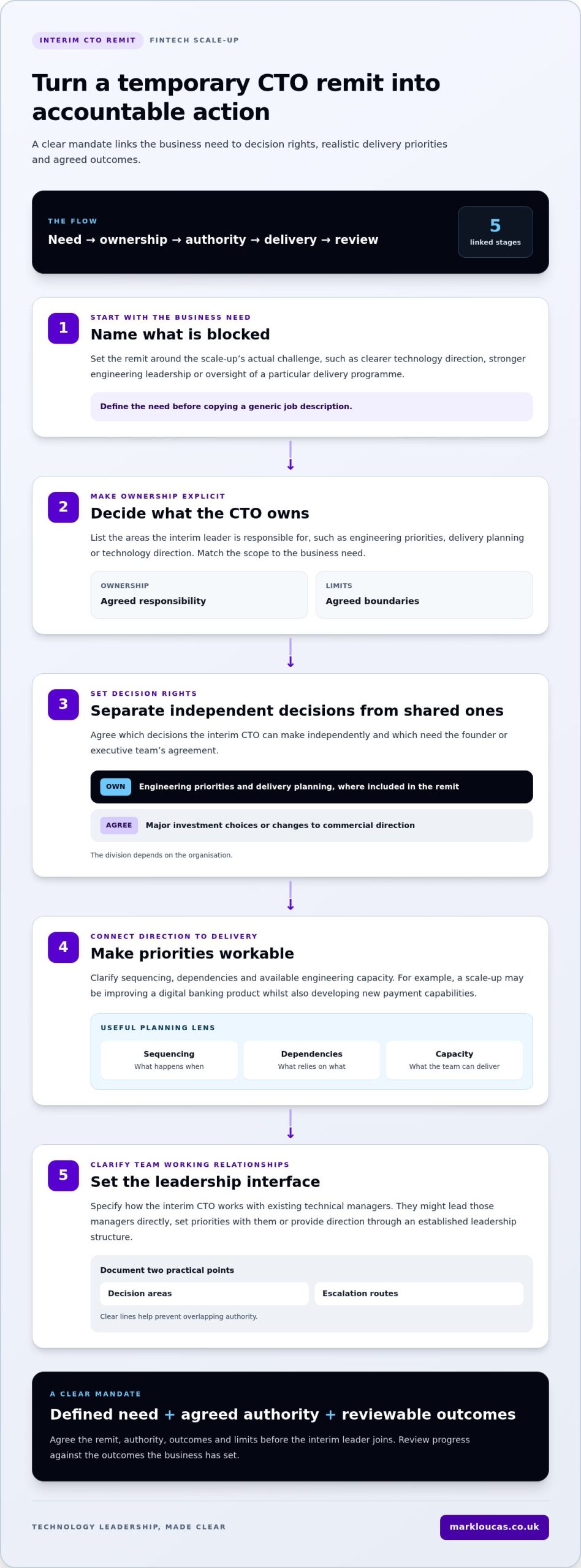
An interim CTO’s remit should be shaped by the business need, not copied from a universal job description. One scale-up may need clearer technology direction; another may require stronger engineering leadership or oversight of a particular delivery programme. The appointment works best when outcomes, authority and limits are agreed before the person joins.
A clear mandate turns temporary technology leadership into accountable action by linking defined decision rights to outcomes the business can review. For an interim cto for a scale-up, that clarity helps the founder, executives and technology team understand who is responsible for what.
Set boundaries around strategy, delivery and team leadership
Start by distinguishing decisions the interim CTO can make independently from those that need agreement from the founder or executive team. The remit might give them ownership of engineering priorities and delivery planning, while major investment choices or changes to commercial direction remain with senior leadership. The right division depends on the organisation.
Connect strategic direction to work the team can realistically deliver. If the business wants to improve a digital banking product while also developing new payment capabilities, the CTO should help clarify sequencing, dependencies and available engineering capacity. This is more useful than a broad instruction to “transform technology”, which offers little guidance on what should happen first or how progress will be judged.
Document how the interim leader will work with existing technical managers. Specify whether they lead those managers directly, set priorities with them or provide direction through an established leadership structure. A short list of decision areas and escalation routes can prevent overlapping authority and help experienced team members contribute effectively.
Account for fintech and payments context
The role profile should reflect the company’s products and technical environment. Relevant experience might include leading teams responsible for payment services, digital banking products or platforms that support financial technology. The aim is not to prescribe a particular architecture or assume every fintech has the same requirements. Identify where the candidate’s previous work is genuinely comparable to the scale-up’s priorities.
During assessment, ask candidates to explain the context of their experience. What did they own? Which teams did they work with? How did they handle competing delivery priorities or complex dependencies? Specific examples help distinguish direct leadership experience from familiarity with sector terminology. They also show how a candidate makes decisions and communicates trade-offs.
Where payments expertise is central to the mandate, specialist payments industry recruitment can help focus the search on relevant talent. The brief should reflect the business’s actual needs, whether that means payments, digital banking, wider platform leadership or a combination.
Keep the mandate practical: state the priorities, decision rights, relationships with existing leaders and evidence of progress expected. If you’re shaping an interim technology leadership brief for a fintech business, discuss your recruitment needs with Mark Loucas.
For guidance on the right technology leadership appointment, discuss your recruitment needs with Mark Loucas.
Interim, fractional or permanent CTO for a scale-up
The right appointment depends on the leadership need, not on which title sounds most suitable. An interim CTO generally takes sustained responsibility for a defined remit during a leadership gap or period of change. A fractional CTO provides part-time input, often for a narrower or continuing advisory need. A permanent CTO is an ongoing member of the leadership team.
Interim CTO
Continuity Sustained leadership for an agreed period.
Time commitment Typically a full-time temporary appointment.
Mandate Owns a defined set of technology priorities and decisions.
Likely need A leadership gap, transition or period of change.
Fractional CTO
Continuity Regular input without continuous executive ownership.
Time commitment Part-time, with the level of input shaped by the need.
Mandate Often focused on advice or selected strategic work.
Likely need The business needs experienced guidance, but has enough internal capacity to lead day-to-day work.
Permanent CTO
Continuity Ongoing leadership as part of the executive structure.
Time commitment A continuing executive role.
Mandate Long-term ownership of technology direction and leadership.
Likely need Technology leadership is a lasting requirement at the centre of the company’s plans.
When an interim appointment fits better than fractional support
Choose interim leadership when the business needs someone to carry responsibility consistently, rather than offer advice at set intervals. For example, a scale-up entering a period of change may need one leader to align teams, make agreed technology decisions and keep priorities moving. Fractional input may fit better when an established technology lead can deliver the work and needs occasional senior guidance. Neither model is automatically superior. Match the level of ownership to the company’s priorities, leadership capacity and expected transition.
Temporary leadership needn’t unsettle the team. Explain why the appointment is being made, what authority it carries and how existing leaders will work with the interim CTO. Agree a handover from the outset, including the decisions, relationships and work that need to pass to the next leader. Clear boundaries help teams understand that the role is temporary without leaving accountability uncertain.
When permanent CTO recruitment is the stronger route
If technology leadership is an ongoing part of the company’s structure, permanent recruitment may be more appropriate. A need to set long-term direction, build executive relationships and lead through successive stages of growth is different from a time-limited gap. An interim appointment can help the business understand the responsibilities and experience its eventual permanent role should require, but it doesn’t guarantee a particular hiring outcome.
Where permanent leadership succession is the decision, specialist fintech recruitment can support a search shaped around the company’s context. Define the role carefully, based on the leadership the business needs beyond the immediate transition.
For support identifying the right interim or permanent technology leadership talent, discuss your recruitment needs with Mark Loucas.
For help shaping a focused interim technology leadership search, discuss your recruitment needs with Mark Loucas.
How to define the interim CTO brief and measure progress
A useful brief turns a broad concern, such as slow delivery or unclear technical ownership, into a focused assignment. For an interim cto for a scale-up, it should give candidates enough context to assess the challenge and make clear how the business will judge progress. Keep it concise, specific and grounded in the company’s current position.
Use this process to move from diagnosis to a practical handover plan:
- 1. Diagnose the gap. Identify which decisions, responsibilities or outcomes lack an owner. Separate the root issue from its symptoms, such as delayed releases or competing priorities.
- 2. Set the business priorities. Choose the work the interim leader must advance during the assignment. For example, this could mean clarifying product and engineering priorities, improving delivery oversight or leading a defined period of platform change.
- 3. Define authority and relationships. State which decisions the CTO owns, which need executive agreement and how the role works with the founder, product leaders and existing technical managers.
- 4. Specify the candidate profile. Describe the company’s stage, technology context, reporting relationships and immediate objectives. Include relevant experience across fintech, payments or digital banking where the mandate calls for it. Separate essential capabilities from preferences so the search stays focused.
- 5. Agree reviews and handover. Set review points, name who will assess progress and decide how knowledge, open decisions and next steps will be transferred before the assignment ends.
Build a brief that attracts relevant interim candidates
Give candidates a clear picture of the work, rather than a long list of every possible CTO responsibility. Explain the scale-up’s current priorities, the teams involved and the authority that comes with the role. A brief for a payments-focused business, for instance, should describe the relevant product and team context rather than assume general technology leadership experience alone will be enough.
Use evidence-based criteria. If a particular fintech, payments or digital banking background matters, explain how it relates to the mandate. Keep desirable experience distinct from essential requirements, so the search can focus on candidates who have led comparable work without narrowing the field for unrelated reasons.
Agree outcomes, working relationships and handover
Choose measures that reflect the agreed remit, not generic industry benchmarks. If the assignment is intended to improve delivery oversight, review whether priorities are visible, decisions are made at the right level and teams understand dependencies. If the focus is technology direction, assess whether leaders have a shared view of options, trade-offs and next steps. Agree the starting point and review method with the interim CTO.
Make the transition part of the brief from the outset. Record key decisions, rationale, unresolved issues and ownership of follow-up work in accessible documents. Clarify who will receive this information and who takes responsibility after the interim leader leaves. A thoughtful handover helps preserve continuity without assuming that the next leader will follow the same approach.
To shape a focused interim leadership search for your fintech business, discuss your brief with Mark Loucas.
For a focused search for interim fintech technology leadership, discuss your recruitment needs with Mark Loucas.
Finding an interim CTO for a fintech scale-up
A senior technology title alone doesn’t show whether someone can lead effectively in your business. The right interim CTO should have experience that fits the scale-up’s stage, immediate priorities and decision-making environment. In fintech, that context may include payments, digital banking or products where several teams must coordinate closely. Relevant sector experience helps a candidate understand the work, while evidence of sound judgement shows how they may approach the assignment.
Specialist recruitment is a route to finding and assessing relevant interim talent. The appointed leader joins the business to carry the agreed remit, while the recruitment partner supports the search. A specialist recruiter can shape candidate assessment around the brief, rather than relying on a generic executive profile.
Assess relevant leadership experience for the assignment
Begin with the priorities already defined for the role. Look for evidence that candidates have led work at a similar stage of company growth, addressed comparable technology challenges and operated with the level of authority the appointment requires. Where the mandate calls for payments or digital banking experience, explore what the candidate was responsible for in that setting, rather than treating sector familiarity as a substitute for leadership.
Use structured discussions to compare candidates fairly. Invite each person to describe a relevant decision, how they explained trade-offs to non-technical stakeholders and how they worked with product and engineering teams. Listen for clear reasoning, practical communication and an ability to bring people with them. These conversations help show how experience may translate to your specific remit.
Connect interim hiring to wider fintech talent planning
Market mapping can give the hiring team a clearer view of the relevant talent landscape. It can help identify the kinds of backgrounds that align with the brief, inform candidate targeting and show where the role’s requirements may be too broad or too narrow. This insight can also support wider workforce planning, particularly if the interim CTO’s work highlights adjacent capability needs in engineering or delivery.
For example, an interim technology leader may clarify that the immediate gap concerns executive ownership, while a separate delivery priority calls for additional specialist team capacity. Those are distinct needs. Interim recruitment can address the leadership assignment, while a separate talent search can focus on relevant roles across fintech providers, payments or digital banking. Where technology leadership and team requirements intersect, fintech banking technology recruitment can help frame the search in its sector context.
The strongest search remains anchored to the mandate: what the interim CTO must own, which experience matters and how the business will assess progress. If you’re considering an interim cto for a scale-up, a measured discussion about the brief and the relevant interim recruitment need is a sensible next step.
To discuss your interim CTO search with Mark Loucas, get in touch with the team.
For help defining your interim CTO brief and search, speak with Mark Loucas.
Set your next stage of technology leadership in motion
The next step is to turn the leadership need into a clear hiring decision. For a UAE fintech scale-up, an interim cto for a scale-up should be appointed with a defined purpose, so the business can make progress now while keeping its longer-term leadership structure in view.
Mark Loucas Ltd is a specialist recruitment consultancy focused on fintech and digital banking. Its contract and interim staffing solutions support fintech providers and payments leaders, while market mapping and talent advisory can inform hiring decisions. This sector focus brings useful context to a search where leadership experience must match the company’s priorities.
You don’t need to have every detail settled before beginning a conversation. A clear view of the challenge, the responsibilities to be owned and the experience that matters is a strong place to start. From there, the brief can be shaped around the business and the interim talent it needs.
Discuss your interim CTO search with Mark Loucas Ltd and take a considered next step towards the right technology leadership for your scale-up.
Frequently Asked Questions
How is an interim CTO different from a technology consultant?
An interim CTO takes an executive leadership role, whilst a technology consultant is usually engaged to advise on a defined issue or deliver a specific piece of work. For example, a consultant might assess a platform and present recommendations, while an interim CTO may lead the team responsible for acting on them. Make the distinction clear in the brief, especially around decision-making authority and responsibility for implementation.
Can an interim CTO work alongside a founder who currently leads technology?
Yes. An interim CTO can work alongside a founder if both understand how responsibilities will be shared. The founder might retain input on product vision and commercial priorities, while the interim leader takes agreed responsibility for technical decisions or team leadership. Set out how disagreements will be resolved and which decisions need joint approval. This helps preserve the founder’s knowledge without leaving the interim leader’s authority unclear.
Should an interim CTO be expected to write code?
Not necessarily. The role should reflect the leadership gap, rather than assume that hands-on coding is a core duty. A scale-up may need the interim CTO to guide technical decisions, support engineering managers and keep delivery aligned with business priorities. In a small team, some direct technical contribution may be useful, but expectations should be agreed early so strategic leadership does not become an undefined mix of coding and management.
What happens when an interim CTO assignment ends?
The assignment should end with an agreed transfer of responsibilities, not a sudden loss of context. The interim CTO can leave a record of key decisions, active risks, work in progress and outstanding questions, then brief the person taking ownership. That may be a permanent CTO, an existing technology leader or another executive. Plan the transition early, so the business can preserve useful knowledge and maintain momentum after the appointment.
Can a fintech scale-up hire an interim CTO before a funding round?
Yes. A scale-up can appoint an interim CTO before a funding round if it has a defined technology leadership need and can support the assignment. The role might help leaders clarify priorities, explain technical decisions or coordinate work already in progress. It should not be framed as a guarantee of investment or a substitute for the company’s funding strategy. Keep the remit tied to business needs that exist regardless of the round’s outcome.
How should an interim CTO work with an existing engineering lead?
The interim CTO and engineering lead should have distinct, complementary responsibilities. For instance, the CTO may set direction and resolve cross-team priorities, while the engineering lead manages implementation and day-to-day technical coordination. Agree how decisions are shared, what the engineering lead can own independently and how concerns are escalated. Regular, direct communication helps avoid parallel instructions and allows the existing lead to contribute their knowledge of the team and systems.

Article by
Liam Henfrey
Liam Henfrey is a seasoned specialist in the payments and banking sectors with over two decades of experience. As the Founder and CEO of FINOPSIS and Managing Director at Mark Loucas Ltd, he advises organisations on complex financial operations and technology. His career includes senior roles at PwC, Deloitte, and Visa Europe.
Related Fintech Recruitment Guides
If you liked this guide then you may also like the following: