


Open Finance Recruitment Agency for Specialist Fintech Hiring
The strongest open finance candidate may not have “open finance” in their job title. For employers in the UAE, that makes choosing an open finance recruitment agency less about matching labels and more about identifying the capabilities behind them. Relevant experience may sit across fintech, payments, digital banking, data, product or risk, and a generalist search can miss the distinction between transferable skills and genuine domain knowledge.
That complexity is familiar to hiring teams. The role needs to be defined carefully before the search begins, particularly when the right person may use terminology from an adjacent sector or bring experience gained in a different type of organisation.
This article explains how to set clear capability and experience requirements, assess whether a recruitment partner understands specialist fintech hiring, and shape a focused search for permanent or interim talent. It also considers how market mapping can reveal relevant candidates whose titles do not neatly match the brief. The aim is a more considered search, built around what the hire must deliver rather than the wording on their CV.
Key Takeaways
- Frame the role around the business outcome and remit, rather than relying on a familiar job title.
- Set priorities for the capabilities and experience the hire needs, recognising that requirements vary between organisations.
- Assess an open finance recruitment agency on its sector understanding, search method, role calibration and communication.
- Prepare a clear brief by defining the need, agreeing assessment criteria and setting expectations for communication.
- Consider permanent, executive search, contract or interim recruitment routes according to the role and hiring need.
Discuss your open finance hiring needs.
Why open finance hiring calls for more than a familiar job title
Open finance recruitment is specialist hiring for organisations developing or operating financial services that use data sharing. The work can involve different business aims and technical contexts, so a job title alone may not reveal what a successful hire needs to know or deliver. A useful starting point is to define the capability required, then identify candidates whose experience supports it.
Open finance provides a broad context for the term, but hiring requirements depend on the organisation and role. One brief might centre on product development, another on technology, payments or risk. These are possible areas of focus, not a standard team structure. For employers in the UAE, setting out the specific remit helps keep the search relevant to the business rather than to a general idea of the sector.
What does an open finance recruitment agency do
An open finance recruitment agency should help clarify the role’s scope, the experience a candidate must bring and the priorities for the search. That means understanding what the person will be responsible for, which skills are essential from the outset, and where adjacent experience may be suitable.
The hiring route should reflect the need. Permanent recruitment may suit an ongoing position; executive search can support a senior appointment; contract or interim solutions may fit a defined period or requirement. Market mapping can help identify relevant talent pools and show where suitable experience sits across connected areas. Mark Loucas also works across payments industry recruitment, a related field that may be relevant to some search briefs.
Why open finance experience can appear under different labels
Some candidates may describe relevant work through fintech, digital banking or payments experience rather than using the words “open finance”. Their job title may reflect their employer’s structure, while their responsibilities reveal closer alignment with the role. This makes a title-only search easy to narrow too far.
Assess the evidence against the actual brief. A candidate with adjacent experience may bring transferable skills, but that doesn’t automatically mean they have handled the specific work the position requires. Ask what they delivered, which capabilities they used and how closely that experience matches the role’s priorities. There is no need to assume a universal set of open finance titles. Search by capability as well as terminology, then assess fit carefully.
Explore a focused approach to specialist hiring.
Which open finance capabilities should your hiring brief prioritise
Start with the outcome the hire is expected to support, not a list of fashionable skills. The role criteria should follow the organisation’s operating model. That gives candidates and recruiters a clearer basis for judging which experience matters and what success in the position will involve.
Separate essential experience from capabilities that could be developed after appointment. If a role requires a particular kind of product or technology experience from the outset, make that clear. If a skill is useful but can be learned, avoid turning it into an unnecessary barrier. A well-calibrated brief can widen the search without weakening its standards.
Map the role to product, technology and operational needs
Describe the product problem the hire will address, the team’s remit and the working relationships the role requires. Technology and data experience may be relevant, but only where they connect directly to the responsibilities. For instance, a role shaping a digital banking service may need experience that differs from a position focused on internal operations. Mark Loucas’ digital banking recruitment page outlines its work in this adjacent area.
The World Bank and partner institutions’ Key Considerations for Open Finance provides wider context on the subject. It can inform an employer’s understanding of the environment, but it isn’t a job specification. Translate the organisation’s own priorities into clear criteria for the role.
Assess adjacent fintech and payments experience carefully
Related sector experience can help identify candidates, but the label alone doesn’t prove fit. Ask candidates to explain:
- What they personally contributed, rather than what their wider team delivered.
- The organisation and operating context in which they worked.
- The responsibilities they held and the outcomes they were accountable for.
Payments experience may be relevant if the role genuinely touches payment services such as merchant acquiring. If it doesn’t, requiring it could narrow the search without improving the match. For roles where payments expertise is part of the brief, see payments industry recruitment.
A capable open finance recruitment agency can help turn these priorities into a focused search, while keeping essential requirements distinct from transferable strengths. If you’re refining a brief, discuss the capabilities your role needs.
Talk through your recruitment requirements.
How to evaluate an open finance recruitment agency
A specialist recruiter should be able to explain how they would approach your search before you commission it. Ask them to interpret the brief in their own words: which capabilities are essential, what adjacent experience might be relevant, and how they would identify candidates. A clear, considered rationale is useful evidence. Promises about guaranteed outcomes are not.
The Key Considerations for Open Finance paper offers context on the design of open finance ecosystems. A recruiter need not advise on ecosystem design, but should be able to discuss how your organisation’s specific needs shape the candidate profile and search.
| What to assess | What to ask | What a useful answer shows |
|---|---|---|
| Sector understanding | How do you understand our business and the role’s context? | They ask relevant questions and connect sector knowledge to your brief, rather than relying on broad claims. |
| Search method | Where would you look, including beyond familiar job titles? | They can explain how they will identify relevant talent pools and assess adjacent experience. |
| Role calibration | How would you turn our requirements into a candidate profile? | They distinguish essential criteria from desirable skills and explain how they will test them. |
| Communication | How will you share progress and respond to feedback? | They set out a clear, agreed approach without making unsupported claims about timing or results. |
Questions to ask before appointing a specialist recruiter
Ask the recruiter to talk through how they would translate your brief into a candidate profile and search strategy. Explore how they would check a candidate’s adjacent experience against your essential criteria, and what market mapping or talent intelligence could clarify before the search begins. Their questions should reveal whether they understand the distinction between a relevant background and evidence of the capability you need.
Compare specialist search with an internal or generalist approach
An internal search may be sufficient when the role is clearly defined, the team has capacity and the organisation already understands the relevant talent pool. Specialist support may add value when the remit is difficult to calibrate, titles vary across sectors or the search needs focused market knowledge. For roles centred on technical hiring, explore fintech and banking technology recruiters.
Choose an open finance recruitment agency based on the quality of its reasoning and the fit of its method to your brief. To discuss your requirements, talk with a specialist recruitment consultancy.
Discuss the role and search approach.
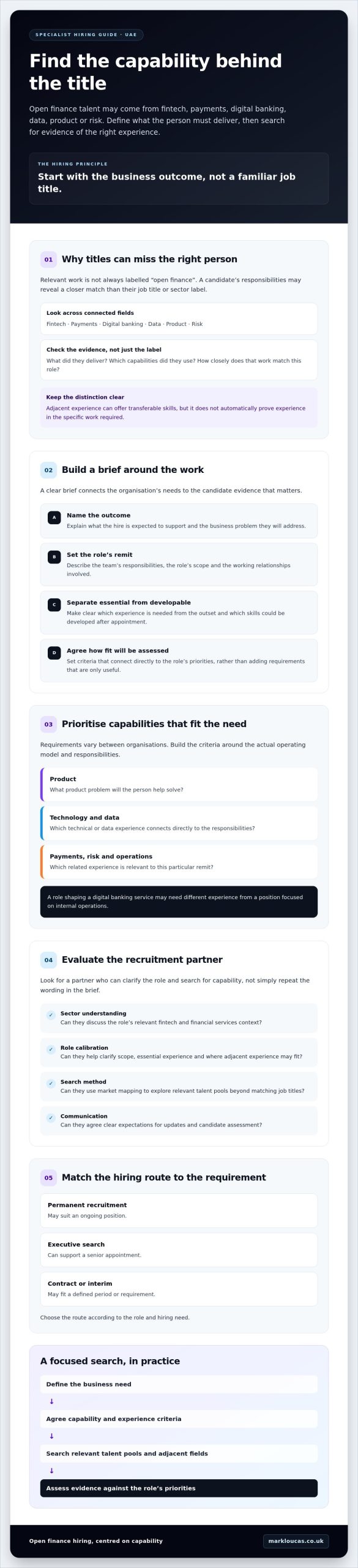
How to prepare an open finance recruitment brief
A clear brief gives the hiring team and recruiter a shared reference point. It should describe why the role is needed, what the new hire will own and how candidates will be assessed. Use this sequence to turn the business need into practical hiring criteria.
- Define the business need. State the outcome the appointment should support and why the role is required now. If you’re planning several hires, explain how each role fits into the wider team.
- Set out the role’s place in the organisation. Document reporting lines, key responsibilities and important working relationships. Be specific about decisions the person will own and where they will contribute alongside others.
- Separate essential capabilities from preferred experience. Identify what a candidate must demonstrate on appointment, then distinguish skills or sector experience that would be useful but could be learned. Stay flexible about adjacent backgrounds where the underlying capability is relevant, without relaxing requirements that are genuinely necessary.
- Choose the employment type and search scope. Decide whether the need is permanent, a senior appointment suited to executive search, or a contract or interim requirement. The right route depends on the role’s purpose and duration, not simply the market label.
- Agree how candidates will be assessed. Set criteria linked to the responsibilities, confirm who will interview candidates and decide how feedback will be gathered. Consistent assessment helps the team compare evidence against the same requirements.
- Set communication expectations. Agree who will provide updates, how feedback will be shared and who can make decisions at each stage. This keeps the search organised without assuming a particular timeframe or candidate supply.
Turn the business need into clear selection criteria
Selection criteria should reflect the work the successful candidate will actually do. For each essential requirement, consider what evidence would demonstrate it, such as relevant responsibilities or experience in a comparable operating context. An open finance recruitment agency should be able to use these details to shape a candidate profile, rather than treating every preference as a fixed requirement.
Before the search begins, make sure interviewers understand the criteria and how to record feedback. This reduces the risk of candidates being judged against different expectations by different people.
Choose the right hiring route and search scope
Permanent recruitment may suit a continuing role; executive search can support a senior appointment; contract or interim solutions may fit a defined project or temporary requirement. For a wider digital banking team, plan how each appointment supports the organisation’s operating needs, rather than treating the roles as interchangeable.
Prepare your brief with care, then discuss the role and search approach with Mark Loucas.
Speak with Mark Loucas about your hiring brief.
How Mark Loucas can support specialist open finance hiring
Mark Loucas Ltd is an independent specialist recruitment consultancy serving fintech, payments and digital banking organisations. Founded in 2011, it supports employers with permanent recruitment, executive search, contract and interim solutions, alongside market mapping and talent advisory. For open finance hiring, the first step is to understand the role and its requirements, rather than assume that every organisation needs the same profile.
Match recruitment support to the hiring requirement
The appropriate search route depends on the work to be done and the level of the appointment. Permanent recruitment can support continuing roles, whilst executive search is available for senior appointments. Contract and interim solutions may suit short-term or project-specific resource needs.
Where job titles vary across connected areas, market mapping and talent advisory can help employers gain a clearer view of the talent landscape and refine the search. This can be useful when deciding which experience is essential and where adjacent fintech, payments or digital banking backgrounds may be relevant. These services support a focused search; they don’t replace a clear brief or guarantee a particular outcome.
As an open finance recruitment agency, a recruitment partner should be assessed on how well it understands the role, explains its search approach and aligns that approach with the organisation’s needs. Mark Loucas Ltd’s experience is in specialist fintech recruitment across related sectors, rather than a claim that every open finance capability is an established placement specialism.
Start a focused conversation about your open finance search
Bring the role brief, relevant business context and essential criteria to an initial discussion. These details can help clarify the scope of the position, the experience you need and whether specialist recruitment support fits the requirement. If the brief is still taking shape, a conversation can help establish which points need further definition before a search begins.
There’s no need to have every detail settled. Contact Mark Loucas Ltd about specialist hiring to discuss the role scope and a suitable search approach.
Discuss your specialist fintech hiring needs.
Build your open finance search around capability
Open finance hiring is strongest when the brief reflects the work the person must deliver, rather than relying on a familiar title. Define essential capabilities, consider relevant experience from adjacent sectors and agree how candidates will be assessed. These steps give your search a clearer focus.
Choosing an open finance recruitment agency also means looking for a partner who can explain how they will interpret the brief, map relevant talent and keep communication clear. The right search route will depend on whether you need a permanent hire, a senior appointment, or contract or interim support.
Mark Loucas is an independent specialist consultancy founded in 2011, supporting fintech, payments and digital banking organisations. Its recruitment services include permanent recruitment, executive search, contract and interim solutions, with market mapping, intelligence and talent advisory to help inform a focused search.
Bring your role scope, business context and essential criteria to a conversation about the approach that may suit your requirement. Discuss your specialist fintech hiring needs and take a considered next step towards finding the right talent.
Frequently Asked Questions
How do I choose an open finance recruitment agency?
Choose an open finance recruitment agency that can explain how it would turn your brief into a candidate profile and search strategy. Ask how it distinguishes essential requirements from preferences, assesses adjacent experience and uses market mapping to identify relevant talent. Compare its sector understanding, role calibration, search method and approach to communication. Look for clear reasoning about the process, rather than unsupported promises about candidate numbers or hiring outcomes.
Which roles can an open finance recruitment agency help recruit?
The roles depend on the organisation’s goals and the specific responsibilities to be filled. A brief might focus on product, technology, payments, data or risk capabilities, but these are possible areas of need, not a standard team structure. Define what the person will own, the experience they must bring and who they will work with. This gives a recruiter a clearer basis for identifying suitable candidates, whatever their job title.
Can a fintech recruitment agency find candidates with open finance experience?
A fintech recruitment agency can search for candidates whose experience aligns with an open finance brief, even if their CV doesn’t use that exact label. Relevant work may be described through fintech, digital banking or payments roles. Ask candidates to explain their personal contribution, operating context and responsibilities, then compare this evidence with the role’s essential criteria. Adjacent experience can be transferable, but it should not be treated as proof of every capability required.
What should I include in an open finance recruitment brief?
Include the business need, role responsibilities, reporting lines, essential capabilities and employment type. Explain the outcomes the hire will support, which experience is genuinely required on appointment and what could be learned later. Also agree selection criteria, who will assess candidates and how interview feedback will be shared. A clear distinction between essential and preferred experience helps the hiring team and recruiter assess candidates consistently without narrowing the search unnecessarily.
When should a business use contract or interim open finance recruitment?
Contract or interim recruitment may suit a short-term resource gap or a project-specific requirement where experienced support is needed for a defined purpose. Permanent recruitment may be more appropriate for a continuing role, while executive search can support a senior appointment. Start by considering how long the need is expected to last, the responsibilities involved and whether the work is ongoing or project-based. The employment route should reflect the requirement.
How can market mapping support open finance hiring?
Market mapping helps employers build a clearer picture of relevant talent pools, particularly when job titles vary across fintech, payments and digital banking. It can show where adjacent experience may be found and help refine the candidate profile before the search begins. Used alongside talent intelligence and advisory, mapping can inform hiring decisions and workforce planning. It does not guarantee that particular candidates are available or suitable for the role.

Article by
Liam Henfrey
Liam Henfrey is a seasoned specialist in the payments and banking sectors with over two decades of experience. As the Founder and CEO of FINOPSIS and Managing Director at Mark Loucas Ltd, he advises organisations on complex financial operations and technology. His career includes senior roles at PwC, Deloitte, and Visa Europe.
Related Fintech Recruitment Guides
If you liked this guide then you may also like the following: