


Interim director of compliance for urgent skills gaps
An urgent compliance gap calls for experienced leadership, not a rushed permanent appointment. An interim director of compliance can provide focused oversight when a key role is vacant, a defined workstream needs senior ownership, or the organisation needs added expertise during a period of change. Shape the assignment around the specific risks, priorities and outcomes the business needs to address.
Before bringing in an interim leader, clarify what they will own, how success will be assessed and how interim hiring differs from permanent recruitment. This guide explains when interim support may be appropriate, what an assignment can cover and what experience to look for in a senior compliance professional. It also explains how contract and interim recruitment can help fintech and digital banking organisations address a skills gap with a carefully matched appointment.
For tailored support with an interim compliance appointment, contact Mark Loucas.
Key Takeaways
- Set clear responsibilities and success measures before the assignment begins, so the interim leader can focus on the organisation’s priority compliance work.
- Match the appointment to the role’s seniority and the organisation’s financial services needs, including the scale and complexity of its operations.
- Define the required experience carefully, with international expansion and multi-jurisdictional work relevant to some senior compliance roles.
- Recruitment can use targeted search and professional networks to identify candidates for time-sensitive interim appointments.
- Assess the cost by considering the assignment’s scope, duration, seniority and contracting arrangement.
If you are defining an interim compliance brief, discuss your hiring requirements.
Assignment responsibilities and success criteria
An interim compliance director gives a defined assignment senior ownership, whether the need is to cover a vacancy or lead a specific workstream. The brief should set out priorities, decision-making responsibilities and the evidence that will show progress.
Regulatory oversight duties
The applicable UAE laws and regulatory requirements depend on the organisation’s activities, permissions and operating jurisdictions. Before setting priorities, the director should map those requirements against the business’s products, processes and reporting responsibilities.
For example, a fintech business entering another market may need its compliance framework assessed across multiple jurisdictions. The director can identify accountable owners, record outstanding obligations and establish a process for reviewing regulatory developments.
Risk and liability exposure
An interim director may face professional and contractual exposure if responsibilities, authority or reporting lines are unclear. Define these boundaries in the assignment, including who approves decisions and who escalates material concerns.
Exposure can also arise when a known control weakness remains unaddressed or evidence of action is incomplete. A documented risk register, clear escalation route and agreed reporting schedule help the director and senior management track decisions.
Once the initial review is complete, the interim leader can turn findings into a practical work plan. First establish the current position, then rank urgent gaps, assign owners and agree review dates. This makes progress visible to senior management instead of leaving it within informal discussions in the compliance team.
Responsibilities may include reviewing policies, testing whether controls work as intended and improving how compliance issues reach decision-makers. If a customer onboarding process has unclear approval steps, for instance, the director can document the gap, identify its owner and propose a control change for management approval.
Freelance engagements can focus on defined projects and workstreams rather than ongoing departmental leadership. An assignment might cover a policy review, a control remediation plan or preparation for international expansion. Its scope should specify deliverables, internal stakeholders and dependencies that could affect completion.
Success measures should link completed work to practical evidence. The organisation might track whether priority policies have owners, identified actions have been assigned and reporting reaches the agreed decision-makers. Each measure needs a clear source of evidence, such as an approved policy, action log or management report.
Set a review schedule at the outset. At each review, compare completed actions with the work plan, record barriers and agree any changes to priorities. This keeps the interim director focused on material issues and gives executives a concise view of progress and unresolved decisions.
The appointment works best when the interim director can access relevant records and senior stakeholders. A carefully scoped brief, defined authority and measurable deliverables provide a clear operating framework.
If you are defining an interim compliance brief, discuss your hiring requirements.
Financial services compliance positions
In UAE financial services, the right compliance appointment depends on the organisation’s activities, structure and regulatory responsibilities. Senior roles may cover enterprise governance, risk and compliance, or focus on a defined area such as monitoring, remediation or international operations.
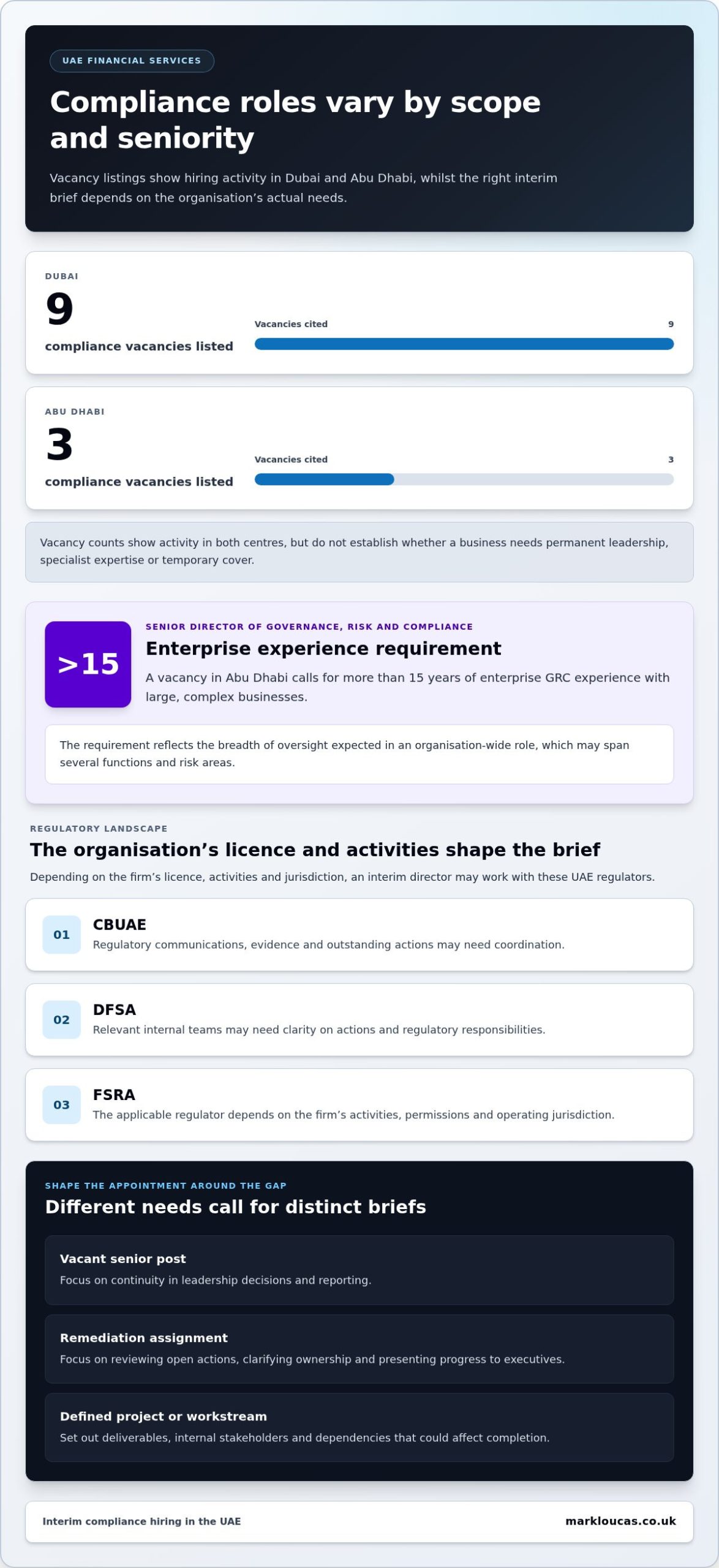
Depending on the firm’s licence, activities and jurisdiction, an interim director may work with CBUAE, DFSA or FSRA. Their responsibilities can include coordinating regulatory communications, organising evidence and ensuring relevant internal teams understand outstanding actions.
Current vacancy patterns illustrate the range of seniority and hiring needs across the Emirates. A Dubai Head of Compliance vacancy for a commodities and trading group is listed as permanent, indicating an ongoing leadership need rather than a time-limited project.
Search listings also show 9 compliance vacancies in Dubai and 3 in Abu Dhabi. These figures indicate activity in both centres, but the role titles and responsibilities differ. A vacancy count alone cannot show whether a business needs permanent leadership, specialist expertise or temporary cover.
For a broader governance remit, a Senior Director of Governance, Risk and Compliance vacancy in Abu Dhabi requires more than 15 years of enterprise GRC experience with large, complex businesses. That requirement reflects the breadth of oversight expected in an organisation-wide role, which may span several functions and risk areas.
Before defining an interim position, identify the gap it must address. A vacant senior post calls for continuity in leadership decisions and reporting. A remediation assignment may instead focus on reviewing open actions, clarifying ownership and presenting progress to executives. These are distinct briefs, even though both sit within compliance.
Build the role profile around the organisation’s actual operating model. A financial services group with several business lines, for example, may need a leader who can provide consistent oversight across separate teams. A firm focused on one product may place greater weight on relevant product experience and close cooperation with operational leaders.
Use these steps to sharpen the brief:
- Identify the reporting line and the decisions the role can make.
- Describe the compliance function’s priorities, such as leadership cover or remediation.
- Set out which teams, products and jurisdictions the post will cover.
- Define the outcomes executives need to see, such as clear reporting and accountable actions.
These details distinguish an interim appointment from a permanent search and guide candidate assessment.
Interim compliance recruitment
Recruitment works best when the appointment addresses a clearly defined business need. A precise brief helps distinguish temporary leadership from permanent hiring or project-based advice.
Interim and permanent role differences
An interim director takes on senior responsibilities for a defined period or business need. A permanent director fills an ongoing leadership role, while a compliance consultant typically provides advice or delivers a specified project. Freelance compliance experts may lead defined workstreams, such as a policy review or control remediation plan.
A fintech firm with a leadership vacancy, for example, may need an interim professional to maintain decision-making and reporting. A firm seeking an external review may need a consultant instead. The key distinction is whether the person will lead the function or provide targeted expertise.
Qualifications and experience
Assess candidates against the assignment, not just their job titles. Relevant experience may include leading compliance teams, improving controls and working with senior stakeholders in financial services. For an organisation expanding overseas, experience with international growth, overseas entities or multi-jurisdictional operations may be especially relevant.
In interviews, ask candidates to explain how they handled a comparable challenge. A strong example sets out the situation, their decisions, the people involved and the resulting work products. Assess how clearly they explain risk priorities and communicate them to executives.
Appointment duration
There is no single appointment length that suits every UAE organisation. An interim director may cover a vacancy, support a defined project or lead work until a permanent appointment is made. The duration depends on the purpose, agreed deliverables and the organisation’s internal capacity.
Include a planned review point in the contract, alongside the assignment’s intended end conditions. A vacancy-cover brief, for example, may end when the permanent leader takes responsibility. A remediation brief may conclude when agreed workstreams are delivered and handed over.
A structured recruitment process keeps the search focused. Start by documenting the role’s authority, reporting line, priorities and expected outputs. Then assess candidates against those criteria rather than relying on broad claims of seniority.
Shortlisting for a critical compliance role can draw on targeted search strategies and professional networks. Assess both technical judgement and the ability to work within the organisation’s structure. Candidates also need a clear understanding of the assignment’s scope, stakeholders and working arrangements.
Before appointment, agree practical details that shape delivery:
- The workstreams and outcomes the director will own.
- The senior stakeholders who will receive updates.
- The records and teams the appointee needs to access.
- The handover materials required at the assignment’s close.
This approach gives the candidate a precise remit and gives management a basis for reviewing progress. It also helps the organisation choose between interim leadership, permanent recruitment and specialist project support.
What qualifications and experience are required for an interim compliance director?
The role calls for senior compliance judgement suited to the organisation’s work. In the UAE, assess candidates against the firm’s activities, operating model and specific assignment, not their title alone.
Look for evidence that a candidate has led compliance work in a relevant financial services setting. For a fintech business, ask about experience with digital products, operational teams and senior decision-makers. A candidate should explain how they identified an issue, set priorities and carried agreed actions through to completion.
International experience can matter when an organisation operates across borders. Some senior compliance roles require experience supporting international expansion, overseas entities or multi-jurisdictional operations. Ask for a practical example, such as coordinating compliance work between an overseas entity and its parent organisation.
Technical knowledge should match the assignment. A director overseeing remediation needs to show how they assess control gaps, assign owners and monitor progress. For a leadership-cover appointment, ask how they maintained clear reporting and sound decision-making while a permanent role was vacant.
Use structured interview prompts to compare candidates consistently:
- Ask for an example of a compliance issue they assessed and how they prioritised it.
- Explore how they explained complex risks to executives and operational teams.
- Request a description of a policy or control improvement they led.
- Discuss how they manage competing requests and document decisions.
Strong answers identify the candidate’s own contribution, the stakeholders involved and evidence of completion. For example, a candidate discussing a control review should distinguish their assessment from management’s approval of resulting changes. This helps establish judgement and accountability.
Qualifications can support a candidate’s professional knowledge, but their relevance depends on the work. Review each alongside recent responsibilities, sector experience and examples of applied judgement. For a UAE appointment, establish how the candidate has handled work across the firm’s relevant locations and reporting lines.
Before selecting a candidate, map essential experience to the assignment brief. Separate must-have expertise from capabilities the existing team can support. Then test each essential requirement with a specific question and record the evidence. This gives senior management a clear basis for comparing candidates and selecting someone equipped to lead the work.
Organisations may use external expertise to benchmark compliance practices and keep up with regulatory developments. Compliance executive search uses targeted strategies and networks to identify highly qualified candidates for critical roles.
For freelance engagements, an independent lawyer or compliance expert delivers defined projects and workstreams, matching specialist support to a clearly scoped need.
How much does it cost to hire an interim compliance director in the UAE?
The cost depends on the assignment’s scope and the experience required. A quote is based on the role’s requirements and contracting arrangement.
Start by defining the work. A director covering a vacant leadership post may have a broader remit than an expert engaged for one compliance workstream. An organisation seeking temporary leadership, for example, may need oversight, stakeholder coordination and regular reporting. A focused remediation project may instead need specialist input on specific actions.
Several factors shape the proposed cost:
- Scope: The responsibilities, decisions and workstreams assigned to the director.
- Duration: The expected assignment period and any planned handover.
- Seniority: The level of leadership and judgement required for the role.
- Expertise: The relevant financial services, fintech or cross-border experience.
- Engagement structure: The agreed contract terms and working arrangement.
These factors are connected. A role requiring leadership across several teams may call for different experience from a defined policy review. Likewise, an assignment involving international operations may require experience with overseas entities and multi-jurisdictional work.
To make a quote useful, prepare a concise brief before requesting one. Set out the business need, reporting line, expected outputs and key stakeholders. State whether the appointee will cover an existing vacancy or deliver a specific project. Clear details help align the candidate profile and engagement terms with the work.
Compare proposals against the same brief. Check that each sets out responsibilities, expected deliverables, working arrangements and handover expectations. If one proposal covers leadership across the compliance function and another covers a single workstream, they are not directly comparable. Clarify the difference before weighing the commercial terms.
Factor in the organisation’s own capacity. If internal teams will manage data gathering and implementation, the interim director’s remit may focus on leadership and oversight. If the assignment requires more direct project delivery, define those tasks clearly. This helps prevent a mismatch between the agreed scope and the support the business needs.
For a practical estimate, document the assignment first, then request a quote based on its actual requirements. Avoid using a generic day rate as the sole comparison, since it does not show the scope or expertise included. To discuss a defined interim requirement, share your compliance hiring brief.
Mark Loucas Ltd and Permanent Fintech Recruitment
Mark Loucas Ltd supports fintech organisations with permanent recruitment, executive search, and contract and interim hiring. For an urgent compliance skills gap, its Fintech Providers Contract & Interim Solutions can shape a search around the assignment’s responsibilities, experience requirements and expected outcomes.
For an enduring leadership need, Permanent Fintech Recruitment or Fintech Executive Search may be more suitable. Market Mapping & Intelligence can also help organisations understand the talent landscape before defining a search. The right route depends on whether the priority is temporary cover, a specific interim workstream or a permanent hire.
To discuss a fintech compliance recruitment requirement, contact Mark Loucas Ltd.
Set the next step with confidence
Before appointing an interim director of compliance, turn the immediate concern into a clear decision for your organisation. Identify who will own the appointment, what information they need and how the role will support business priorities. A measured brief keeps recruitment aligned with the need, rather than letting urgency alone shape the choice.
Consider what continuity should look like after the assignment. A useful handover helps internal leaders retain decisions, actions and working knowledge when the interim appointment ends. This gives the organisation a stronger basis for deciding whether to seek further temporary support or make a lasting change to its compliance leadership.
If you are ready to discuss the requirement, contact Mark Loucas about interim compliance. A considered conversation can help you frame the brief and move towards a suitable next step.
Frequently Asked Questions
When do you need an interim compliance officer?
Interim support is useful when a compliance responsibility cannot wait for a permanent hire or a specific skills gap needs focused attention. A fintech business preparing to enter another market, for example, may need experienced oversight while its internal team builds local knowledge. Interim support can also maintain continuity during a leadership change, provided the assignment has a clear purpose and defined decision-making boundaries.
What does an interim director of compliance do?
An interim director of compliance provides senior leadership for the agreed assignment, helping the organisation make informed decisions about its compliance priorities. This may include advising executives on how a proposed product or business change affects existing controls. The director should explain complex issues in practical terms, identify decisions requiring management input, and maintain an accurate record of advice, actions and ownership.
When should an organisation hire an interim compliance director?
Hire an interim compliance director when there is a time-sensitive leadership gap, a major business change or a defined need for specialist oversight. A fintech firm planning a product launch, for instance, may need an experienced leader to assess whether its compliance resources and decision-making processes are ready. If the need is ongoing, consider whether a permanent appointment is more appropriate than temporary cover.
How do you hire an interim director of compliance in the UAE?
Begin with a role brief that explains the business need, required expertise, reporting line and authority. Identify the organisation’s activities and relevant operating jurisdictions, then assess candidates against those details. In interviews, ask for examples of comparable work and how candidates communicated decisions to executives. Before appointment, agree the scope, contract terms, access to internal stakeholders and handover expectations.
What should an interim compliance director deliver during their first 90 days?
During the first 90 days, the director should build a clear picture of the organisation’s priorities, relationships and existing compliance processes. They can then agree which issues require action, set out responsibilities and give executives a concise view of progress. By the end of the period, the organisation should have documented decisions, a prioritised forward plan and a clear handover or continuation proposal.

Article by
Liam Henfrey
Liam Henfrey is a seasoned specialist in the payments and banking sectors with over two decades of experience. As the Founder and CEO of FINOPSIS and Managing Director at Mark Loucas Ltd, he advises organisations on complex financial operations and technology. His career includes senior roles at PwC, Deloitte, and Visa Europe.
Related Fintech Recruitment Guides
If you liked this guide then you may also like the following: