


Fintech Hiring Challenges and the Strategic Search for Elite Talent in 2026
Nearly 71% of all UK fintech hiring in 2026 is now concentrated within London, creating a recruitment environment of unprecedented intensity. Whilst the sector enters a more disciplined phase of growth, many firms find that traditional methods fail to secure the niche expertise required for modern infrastructure. These fintech hiring challenges are no longer about the volume of applicants but rather the scarcity of individuals who understand the granular details of ISO 20022 migration or complex credit risk modelling. It is a landscape where the most distinguished candidates are rarely found on public job boards, preferring instead the discretion of a trusted intermediary who understands their specific career trajectory.
You likely recognise that the competition for elite talent has moved beyond simple salary wars into a realm of deep market intelligence and personal connections. Discover how to navigate this complex landscape with sophisticated recruitment strategies designed for senior leadership and technical roles that demand a meticulous eye for detail. We shall examine the shift towards infrastructure and compliance, the importance of accessing passive talent pools, and why a boutique, advisory approach provides the long term stability your workforce requires in an increasingly selective market.
Key Takeaways
- Understand why the 2026 market has shifted from generalist technical skills towards highly specialised financial expertise.
- Identify how to overcome fintech hiring challenges by targeting experts with niche knowledge in ISO 20022 and RTGS systems.
- Recognise the significant operational and financial costs associated with misaligned executive placements and how to avoid these pitfalls.
- Learn to use data driven market mapping to identify and engage the most distinguished passive talent within the global fintech landscape.
- Discover the long term benefits of a boutique advisory approach for securing elite leadership and ensuring sustainable organisational growth.
Securing the right leadership requires a discreet and highly connected approach that respects the privacy of all parties involved whilst ensuring a perfect alignment of values. You may reach out to us via our contact page to discuss your specific executive search requirements in more detail.
The Evolving Landscape of Fintech Talent in 2026
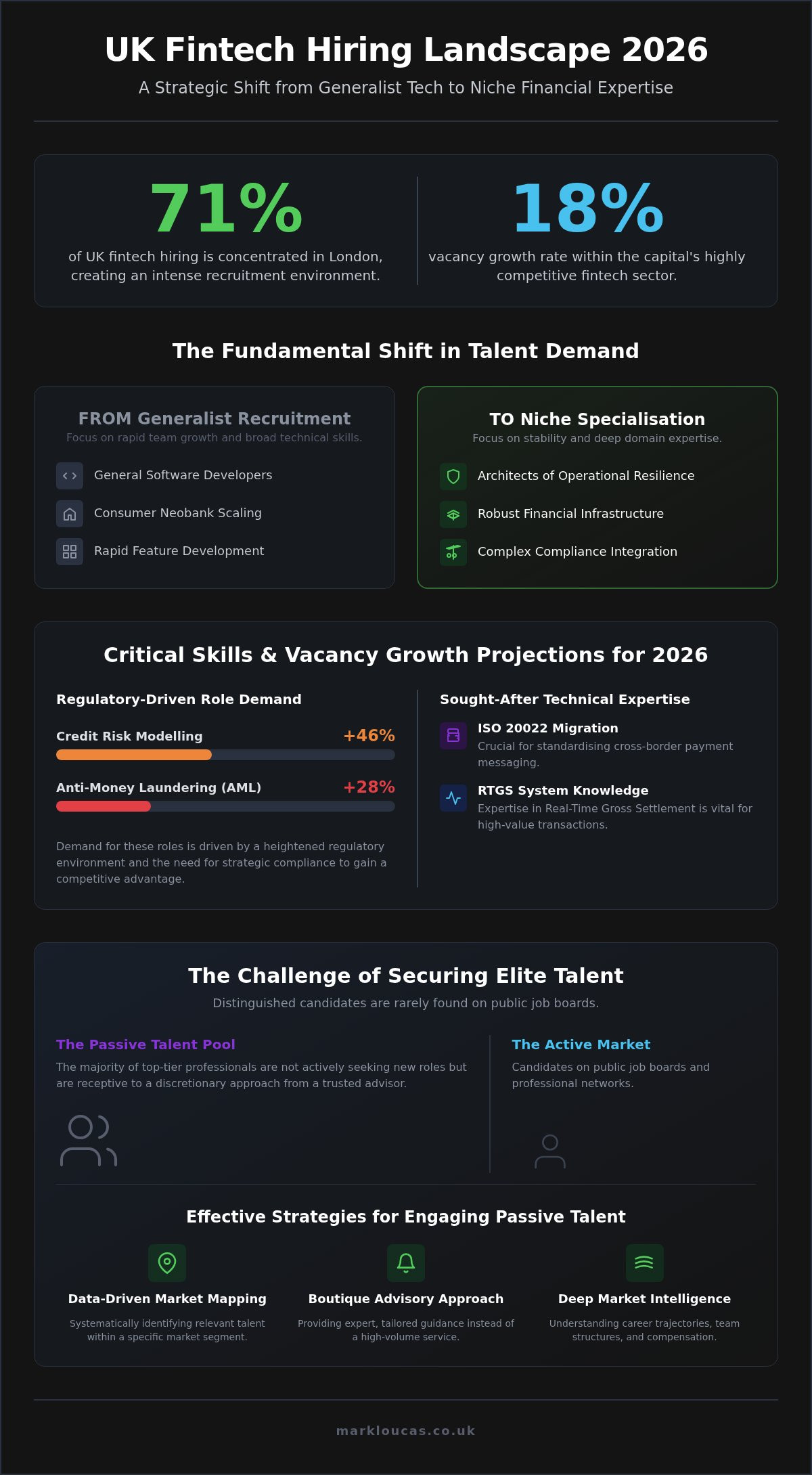
The UK fintech sector has entered a more disciplined and structurally selective phase of growth, moving away from the exuberant, volume driven recruitment of previous years. As we move through 2026, the focus has shifted from the rapid scaling of consumer neobanks towards the robust, intricate plumbing of financial systems. This transition has intensified fintech hiring challenges for many organisations. Firms no longer seek generalist developers but rather architects of operational resilience who can manage the weight of modern digital finance. London remains the undisputed centre of this activity, accounting for 71% of all UK fintech hiring this year with an 18% vacancy growth rate. This regional concentration creates a highly competitive atmosphere where only the most sophisticated firms can secure the talent they require for long term stability.
The Shift from General Tech to Niche Financial Expertise
General software engineers, whilst highly capable in their own right, often lack the nuanced understanding of financial instruments required for today’s complex infrastructure projects. The maturation of digital banking demands a rare breed of professional who can bridge the gap between legacy banking systems and modern innovation. Meticulous attention to detail is paramount when managing high value transactions and real time settlements. It is no longer enough to write clean code; one must understand the underlying financial architecture and the cultural history of the assets being managed. Consequently, the value of domain expertise has never been higher for fintech banking technology recruiters who must identify talent capable of navigating both worlds with ease. This expertise ensures that new digital layers integrate seamlessly with established banking frameworks without compromising security or performance.
How Regulatory Pressure Shapes Modern Recruitment Needs
The current regulatory environment has elevated the role of the Chief Compliance Officer to a position of strategic orchestration rather than mere oversight. With vacancies for Anti-Money Laundering (AML) and credit risk roles projected to rise by 28% and 46% respectively in 2026, the demand for specialists is acute. Professionals who possess specific experience in cross border payment standards, such as ISO 20022 and RTGS migration, are particularly sought after. Global scrutiny requires firms to hire for resilience and security rather than simple feature development. This shift ensures that compliance is no longer a secondary consideration but a core component of a firm’s competitive advantage. It is a time for specialists who can provide stability amongst increasing global scrutiny and ensure that every transaction meets the highest international standards.
If you require a bespoke approach to talent acquisition, you may wish to discuss your needs with our specialist advisors who understand the unique pressures of the current market.
Identifying the Most Pressing Fintech Hiring Challenges
Whilst the broader tech market often experiences cycles of rapid expansion and contraction, the hurdles within the financial sector have become increasingly nuanced. These fintech hiring challenges are no longer defined by a simple lack of volume but by a severe deficit of technical depth and institutional knowledge. The stakes are particularly high in 2026, as the plumbing of the global financial system undergoes a fundamental transformation. For many firms, the difficulty lies in identifying individuals who possess both the technical acumen to build resilient systems and the financial literacy to ensure they remain compliant and efficient.
The Scarcity of ISO 20022 and Payments Infrastructure Experts
The global transition to ISO 20022 is no longer a distant prospect but a critical operational reality that demands a meticulous eye for detail. This standardised messaging format is the lifeblood of modern cross border transactions, yet finding professionals who can navigate its intricacies is a significant undertaking. The challenge of securing talent for RTGS payment consulting and recruitment has intensified as every major institution competes for the same small pool of experts. Relying on generalist engineers for high stakes infrastructure migration projects introduces unacceptable levels of risk. A single error in payment architecture can lead to systemic failures, making the search for proven specialists a matter of organisational survival rather than simple preference.
Competition with Global Tech Giants for Senior Leadership
Senior leadership recruitment has become a sophisticated battleground where established financial institutions, nimble startups, and global tech giants vie for the same elite talent. The hiring behaviour of major tech firms often skews the market, as they offer aggressive compensation packages and prestigious brand names that act as a powerful allure. For boutique fintechs, the challenge is to articulate a value proposition that transcends purely financial rewards. High calibre leaders are often drawn to the autonomy and the ability to leave a lasting legacy within a more intimate, focused environment. Identifying these individuals requires a discreet and highly connected approach that values privacy and tailored solutions. Those who value craftsmanship and distinction are often found through private, non-public opportunities rather than traditional recruitment channels.
Ensuring that your leadership team is composed of the finest technical and strategic minds requires a recruitment partner who values precision above all else. You can connect with our boutique consultancy to explore how we manage sensitive executive searches with absolute discretion.
Why Generalist Recruitment Fails in High Stakes Finance
The landscape of 2026 demands more than just a filled seat. When firms rely on high volume, generalist agencies, they often find that the candidates presented lack the fundamental grasp of the financial intricacies discussed previously. These fintech hiring challenges are compounded when a recruiter treats a niche infrastructure role like a standard software engineering vacancy. The result is often a revolving door of talent that drains resources and slows progress. A sophisticated search requires a deeper network and a more nuanced understanding of the market’s current trajectory than a generalist can provide.
The Hidden Cost of Misaligned Executive Placements
Investing in the wrong leader at the executive level isn’t merely a recruitment failure; it’s a strategic setback that can have lasting consequences. In a market where investors demand operational stability and sustainable growth, a misaligned appointment can stall innovation for many months. The disruption ripples through the organisation, affecting morale and potentially damaging external reputations amongst a discerning clientele who value reliability. Adopting a first time right approach is essential for maintaining momentum. It ensures that the individual leading your digital banking or payments strategy possesses the rare blend of technical skill and financial wisdom needed to thrive in a high stakes environment where errors are costly.
Why Volume Driven Agencies Struggle with Niche Roles
Most generalist recruiters often fail to grasp the nuance of complex fintech job descriptions, which only serves to intensify existing fintech hiring challenges for the client. They typically rely on expansive databases and automated keyword matching, a method that frequently fails to capture the essence of specialised financial recruitment. Whilst they may provide a high volume of CVs, these candidates often lack the deep industry intelligence required for sensitive senior appointments. The search for elite talent is not a numbers game; it is a curated exercise in identifying individuals with a specific cultural and technical fit.
By contrast, a boutique advisor moves with a steady, reassuring pulse that reflects the patience required in high value transactions. They understand the granular details of the payments industry and the cultural history of the institutions they serve. This unhurried, meticulous approach identifies passive talent that generalist databases simply cannot reach. Privacy and tailored solutions are at the heart of this process, ensuring that every placement feels like a bespoke fit rather than a forced transaction. This level of care is what distinguishes a truly elite search from a volume driven exercise.
Securing a workforce that balances technical innovation with regulatory stability requires a partner who operates with the same level of precision as your own firm. You can reach out to our team to discuss how a tailored talent strategy can secure your firm’s future in the 2026 market.
Strategic Solutions for Securing Elite Fintech Professionals
To overcome the most persistent fintech hiring challenges, organisations must move away from reactive recruitment and embrace a more unhurried, strategic approach. In a landscape where London accounts for 71% of all UK vacancies, the competition for talent is concentrated and fierce. Success in this environment is not found through high volume outreach but through the diligent cultivation of relationships with passive candidates. These individuals, often the most distinguished in their fields, are rarely looking for work but are open to the right opportunity when presented with discretion and clarity. By aligning your search with a boutique advisor, you ensure that your firm remains the sole focus of a highly targeted acquisition strategy.
Leveraging Market Mapping and Intelligence for Better Hires
Detailed market intelligence allows firms to see beyond the active job market, providing a vivid picture of the talent landscape across premium urban centres. This process involves more than simple data collection; it is an exercise in identifying and engaging with elite talent before a vacancy even arises. By mapping the specific districts and institutions where niche expertise resides, such as those with deep knowledge of RTGS systems or AML compliance, you gain a significant competitive advantage. This foresight ensures that when a critical role opens, you already possess a curated shortlist of individuals whose skills and values align with your long term vision. It is a proactive method that values privacy and tailored solutions over the impersonal nature of database led searching.
Building a Compelling Value Proposition for Senior Talent
Senior professionals in 2026 are motivated by more than just aggressive compensation packages. They seek a vision of architectural and lifestyle impact where their work leaves a lasting legacy on the financial infrastructure of the future. To appeal to this calibre of candidate, your employer value proposition must be authentic, transparent, and deeply rooted in the specific challenges of your fintech niche. Whether you are scaling a digital banking platform or refining cross border payment standards, communicating the craftsmanship and distinction of the role is essential. Transparency during the executive search process builds the trust necessary for high value transactions. When an elite candidate understands the granular details of the opportunity and the autonomy they will be granted, they are far more likely to commit to a long term partnership. If you wish to refine your approach to executive acquisition, you may request a bespoke market mapping consultation to identify the passive talent your competitors are missing.
Utilising talent advisory services ensures that your workforce planning is not just a response to immediate needs but a reflection of your long term business goals. This steady, reassuring pulse of strategic growth allows your firm to navigate the complexities of 2026 with quiet confidence and expert care.
To discuss how a tailored recruitment strategy can support your firm’s specific objectives, you may reach out to our specialist consultants for a confidential conversation.
Partnering with Specialist Advisors for Sustainable Growth
Navigating the selective growth phase of 2026 requires more than a simple recruitment service; it demands a partnership rooted in unhurried diligence and expert care. Whilst larger entities often focus on the volume of transactions, a boutique approach ensures that your firm’s unique culture and technical requirements remain the central focus of every search. These fintech hiring challenges are best met with a level of personal attention that values the rarity of elite talent and the necessity of absolute privacy. By aligning with a dedicated advisor, you gain access to a depth of market intelligence that generalist agencies simply cannot replicate.
The Benefits of a Boutique Executive Search Approach
A discreet and highly connected advisor is indispensable for senior appointments where the pool of suitable candidates is exceptionally small and highly protected. Unlike database led agencies that rely on automated matching, a boutique consultancy maintains a steady pulse on the most prestigious districts and private talent pools. This personalised attention allows for the development of tailored solutions that respect the privacy of both the client and the candidate. This fintech executive search methodology prioritises craftsmanship and distinction, ensuring that every placement acts as a cornerstone for your leadership team. It is a process that moves at a pace reflecting the importance of the transaction, ensuring that no detail is overlooked in the pursuit of excellence.
Managing Interim and Contract Resource Gaps Effectively
Periods of rapid growth or systemic transition often create immediate resource gaps that cannot wait for a permanent search to conclude. The strategic use of interim directors and contract specialists allows firms to maintain operational resilience whilst searching for long term leadership with the necessary patience. These solutions provide an immediate impact for project specific infrastructure needs, ensuring continuity in high stakes environments where downtime is not an option. For instance, securing experts for RTGS payment consulting can be the difference between a seamless migration and a costly delay. This flexible approach to staffing ensures that your critical systems remain robust and compliant, providing the stability required to thrive amongst the complexities of the current financial landscape.
Ultimately, the long term benefits of a partnership based on expert care and unhurried diligence extend far beyond a single hire. It provides your firm with a sustainable foundation for growth, supported by a workforce that is as resilient as the infrastructure it manages. By choosing a partner who values quality over volume, you ensure that your interests are managed with the meticulous attention to detail they deserve.
To ensure your firm maintains its competitive edge through precise leadership acquisition, you may reach out to us for a private consultation regarding your executive needs.
Securing the Future of Financial Leadership
The landscape of 2026 has redefined the requirements for success within the financial sector, moving beyond simple growth towards a focus on structural resilience and technical mastery. As we have explored, the most significant fintech hiring challenges arise from a scarcity of niche expertise in areas such as ISO 20022 and RTGS infrastructure. Generalist approaches often fall short in this high stakes environment, where the cost of a misaligned appointment extends far beyond the initial recruitment fee. Success now belongs to those who utilise sophisticated market mapping and talent advisory services to identify passive candidates with the precision your firm demands.
Our boutique consultancy offers specialist expertise in payments infrastructure alongside a global executive search capability that values discretion above all else. We provide the unhurried, personalised attention required to manage your most sensitive senior appointments with expert care. Ensure your organisation is equipped with the elite talent it deserves by contacting our specialist consultants for a confidential discussion. With the right strategic partner, navigating the complexities of the modern talent landscape becomes an opportunity for enduring distinction and growth.
Frequently Asked Questions
What are the primary fintech hiring challenges in 2026?
The primary fintech hiring challenges in 2026 centre on the scarcity of talent with deep knowledge of advanced payment protocols. As the industry moves towards full ISO 20022 integration, finding individuals who understand both legacy systems and modern messaging standards is difficult. Additionally, competition from global technology giants for elite software engineers remains intense. Organisations must move beyond traditional recruitment methods to identify specialists who possess the rare combination of technical mastery and regulatory fluency required today.
How can our organisation attract senior fintech leaders in a competitive market?
Attracting senior fintech leaders requires a shift from high pressure tactics to a strategy of curated excellence. These elite professionals value privacy and tailored opportunities that align with their long term career visions. By partnering with a discreet advisor who has access to non public roles, you can present a more exclusive proposition. Emphasising your commitment to innovation and the specific impact a leader will have on your organisation’s legacy often proves more persuasive than compensation alone.
Why is niche expertise more important than general technical skills in the payments sector?
Niche expertise is vital because the payments sector is governed by intricate regulations and precise technical requirements that generalists often overlook. Whilst a general engineer might understand basic architecture, a payments specialist understands the nuances of cross border transactions and settlement liquidity. This level of detail is essential to avoid costly errors and ensure compliance with global standards. In a high value environment, the meticulous attention to detail provided by a specialist is an indispensable asset.
What role does market mapping play in the executive recruitment process?
Market mapping acts as a sophisticated intelligence tool that provides a clear vision of the talent landscape within specific prestigious districts and global hubs. It allows your organisation to identify passive candidates who aren’t actively seeking new roles but possess the exact craftsmanship your team needs. This unhurried, methodical approach ensures that every potential lead is evaluated against your bespoke requirements. It transforms a standard search into a strategic exercise in precision and local authority.
How do regulatory changes like ISO 20022 impact our hiring strategy?
Regulatory changes necessitate a fundamental shift in your hiring strategy towards candidates with specific technical and compliance backgrounds. The migration to ISO 20022 and RTGS systems requires professionals who can manage complex data structures and ensure seamless interoperability between global financial institutions. You’ll need to prioritise hiring experts who have navigated these transitions before. This ensures your organisation remains resilient and competitive whilst maintaining the highest standards of service for your discerning clientele.
What is the difference between a generalist agency and a specialist fintech recruiter?
The difference lies in the depth of industry knowledge and the level of personalised attention provided. Generalist agencies often focus on volume and impersonal metrics, whereas a specialist fintech recruiter acts as a discreet boutique advisor. We offer immediate access to a network of elite talent that is often invisible to the broader market. Our expertise in digital banking and payments ensures that we understand the granular details of your requirements, providing a more refined service.
How can we reduce the risk of a bad hire for a senior executive position?
Reducing the risk of a bad hire involves a commitment to a meticulous vetting process that goes beyond a simple CV review. It requires an intimate understanding of a candidate’s previous achievements and their ability to thrive within your unique corporate culture. By utilising a specialist executive search firm, you benefit from a deeper level of due diligence and market intelligence. This unhurried approach ensures that the final selection is an anchor of reliability for your firm’s future.
Why should we consider interim solutions for our digital banking projects?
Interim solutions offer a flexible and efficient way to inject high level expertise into specific digital banking projects without the long term commitment of a permanent hire. These professionals are often seasoned experts who can provide immediate stability during periods of transition or rapid growth. They allow your organisation to maintain its steady, reassuring pulse whilst you search for a permanent leader. This ensures that critical projects, such as system migrations, continue to move forward with expert care.

Article by
Liam Henfrey
Liam Henfrey is a seasoned specialist in the payments and banking sectors with over two decades of experience. As the Founder and CEO of FINOPSIS and Managing Director at Mark Loucas Ltd, he advises organisations on complex financial operations and technology. His career includes senior roles at PwC, Deloitte, and Visa Europe.
Related Fintech Recruitment Guides
If you liked this guide then you may also like the following: