


Securing Buy-In for a New Executive Role: Build Support Early
Securing buy-in for a new executive role starts with a clear business case, not a polished title. Set out what the role will own, which organisational barriers it will address, and the authority, people and budget it needs. Involve the leaders whose decisions will shape its effectiveness. That is the practical foundation for securing buy-in for a new executive role.
Support can be difficult to gain when senior leaders have competing priorities or are unsure what the position will change. A well-framed proposal makes the need clear and gives decision-makers a practical basis for discussion.
This article explains how to link the role to business priorities, identify the resources and sponsorship it needs, and involve executives early. It also covers how to address resistance and build a case grounded in organisational needs, so support extends beyond approving the position.
For support with a fintech leadership appointment, contact Mark Loucas Ltd.
Key Takeaways
- Define the business problem the role will address, then identify the authority, people and resources needed to solve it.
- Map stakeholders and organisational barriers early so the proposal reflects the realities of the business.
- Bring relevant executives into planning before decisions are settled, and connect the role to shared priorities.
- Make sponsorship practical by setting clear ownership, decision-making responsibilities and a way to resolve cross-functional blockers.
- Build the business case around measurable outcomes, and consider specialist executive search support when the right leadership profile is difficult to define or find.
If you’re preparing a leadership appointment, discuss the role’s requirements.
1. Securing resources and removing organisational barriers
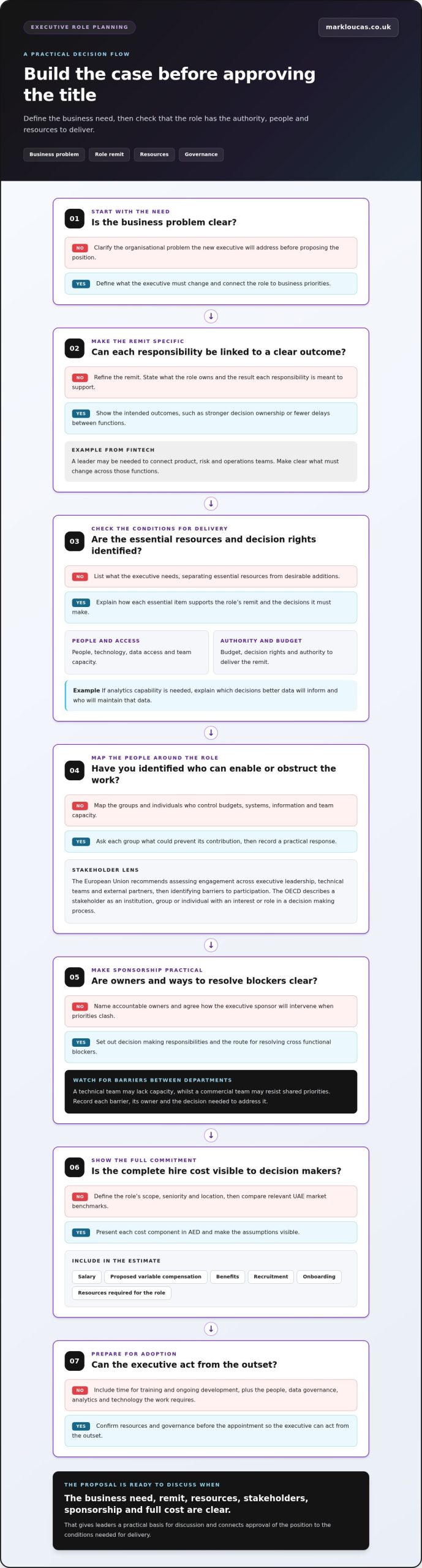
Start with the business problem, then define what the executive must change. A fintech business, for example, may need a leader to connect product, risk and operations teams. Link each responsibility to a clear outcome, such as stronger decision ownership or fewer delays between functions. This gives leaders a reason to commit resources, rather than approve a title without the conditions needed to deliver.
Set out the practical requirements alongside the role. Identify the people, budget, technology, data access and decision rights the executive will need. Separate essential resources from desirable additions, and explain how each essential item supports the remit. A proposal to strengthen analytics, for instance, should explain which decisions better data will inform and who will maintain that data. Governance should name accountable owners and show how leaders will resolve competing priorities.
Map who can enable or obstruct the role. The Európai Unió recommends assessing engagement across executive leadership, technical teams and external partners, then identifying barriers to participation. The OECD defines a stakeholder as an institution, group or individual with an interest or role in a decision-making process. Apply that lens to identify who controls budgets, systems, information and team capacity. Ask each group what could prevent its contribution, then record a practical response.
To estimate the salary and total cost of a new executive hire, define the role’s scope, seniority and location, then compare relevant UAE market benchmarks. Build a full estimate covering salary, any proposed variable compensation, benefits, recruitment, onboarding and the resources required for the role. Present each component in AED and make assumptions visible, so leaders can assess the full commitment.
Barriers often sit between departments rather than within a job description. A technical team may lack capacity, while a commercial team may resist shared priorities. Record each barrier, its owner and the decision needed to address it. Then agree how the executive sponsor will intervene if priorities clash. This turns general support into visible leadership.
Finally, connect resources to adoption. If teams must use new planning capabilities or follow revised decision processes, include time for training and ongoing development. Integrated Business Planning requires investment in people, data governance and analytics, as well as technology. A role tasked with improving planning cannot deliver if those foundations sit outside its authority. Confirm resources and governance before the appointment, so the new executive can act from the outset.
For a fintech leadership role, include the required capabilities in the planning brief and discuss the executive requirements.
2. Bringing in an expert to support the case
An external expert can test whether a proposed role addresses a genuine organisational need. Ask them to assess the remit, reporting line and decision-making authority. A fintech business, for example, may need a leader who can connect product, compliance and operations. An expert can challenge whether one position can own that brief or whether responsibilities need clearer boundaries first.
Choose an adviser with relevant sector knowledge and a clear method. In the UAE, experience across fintech and digital banking can help an adviser interpret the leadership requirements behind a proposed initiative. Ask how they assess senior roles, market capability and reporting structures. Their ability to distinguish essential skills from preferred ones can sharpen the case.
Give the expert a defined brief before the conversation. Share the business challenge, intended outcomes and constraints, then ask for an independent view of the role’s scope. A payments firm, for instance, might need to decide whether a new executive should lead a transformation or strengthen an existing function. This keeps the assessment tied to business needs.
Ask the adviser to test the proposed profile against the work itself. Which decisions will the executive make? Which teams must work with them? What experience would help them influence those teams? The answers can reveal where a job description asks for too much or misses a capability the organisation needs to deliver its plans.
Market mapping adds useful context without turning the business case into a list of names. An expert can examine how comparable leadership responsibilities are structured and where relevant capabilities sit. Use this insight to assess whether the proposed remit is realistic, how the organisation might attract suitable candidates, and what could make the role compelling to senior talent.
Use the expert’s findings to strengthen the evidence, not replace internal judgement. Present leaders with the business challenge, proposed remit, relevant market insight and decisions still required. A credible adviser should also flag assumptions for discussion. This creates a balanced conversation and gives a senior champion precise points to address.
Before engaging an adviser, agree what the work should produce, such as a refined role profile, market assessment or guidance on the candidate’s ability to meet the brief. Keep the final decision within the organisation.
Change planning should also account for relationships beyond the role itself. A supportive group of employees can help carry organisational change through the wider organisation. Stakeholder alignment sessions can bring executive roles and departments together to discuss cross-functional concerns and a product’s strategic value. A CEO-focused value proposition should explain how a product supports strategic growth, reduces risk, or strengthens competitive advantage.
CIS Controls v8 Control 1 concerns inventory and control of enterprise assets, for which executive sponsorship may support asset governance changes. Executive sponsorship helps organisations sustain security controls after deployment by supporting their ongoing adoption, maintenance and enforcement. People preparing for a new executive role are advised to involve their family and closest friends because their support is valuable.
3. Involving executives early in planning
Bring executive leadership into the discussion before the role’s scope is fixed. Early involvement lets decision-makers test the business case, raise competing priorities and agree shared outcomes. It also gives the proposed executive a clearer mandate from the outset.
Distinguish the new position from existing leadership roles by comparing responsibilities, decisions and reporting lines. If a fintech firm already has a chief technology officer, for example, clarify whether a proposed digital transformation executive owns delivery across departments or technology strategy itself. The new role should close a defined gap, not duplicate an existing remit.
Define the mandate in practical terms. State which outcomes the executive owns, which decisions they can make, when they must consult others, and who resolves disputes. If a payments business wants a leader to improve customer experience, specify how that leader will work with product, operations and risk. Clear boundaries help colleagues understand where accountability sits.
Involve the leaders whose teams will work with the new executive. A structured alignment session can surface concerns about authority, workload and priorities before they turn into resistance. Ask each participant to describe the outcome they need, the decisions they control and the support they can provide. Record agreements and unresolved differences.
Tailor the discussion to each executive’s responsibilities. A chief executive may need a concise view of strategic outcomes and financial projections. A technology or security leader will need detail on systems, integration and risk. This keeps the conversation relevant and helps leaders see how the role supports enterprise priorities, not just one department.
Risks include duplicated authority, unclear accountability and conflict between departmental targets. A new executive may also struggle to gain cooperation if existing leaders were not involved in shaping the remit. Address these risks by assigning decision rights, naming escalation routes and agreeing how executive leadership will support cross-functional work.
Measure success against outcomes agreed before recruitment. Choose indicators that reflect the role’s actual mandate, such as delivery of a named initiative, better coordination between functions or clearer decision ownership. Establish a baseline, assign someone to track each measure and set review points with the sponsor. This gives the organisation a reasoned way to assess progress and adjust expectations.
Early planning can also shape the leadership profile, ensuring the role’s authority and required capabilities match its objectives. For a fintech leadership appointment, discussing the executive search brief can help clarify the position before it reaches candidates.
4. Presenting best practices for executive buy-in
Present the proposal as a business decision, not a request for a senior title. Link the role’s strategy to enterprise priorities, define its outcomes and show what active sponsorship involves. Prosci research reports that projects with an extremely effective sponsor meet or exceed objectives nearly three times as often as projects with a very ineffective sponsor. The quality of sponsorship matters.
Use evidence that links the position to a business need. Relevant measures might include delivery delays, customer service, profitability, working capital or recurring operational issues. Choose indicators the organisation already tracks, explain how the role could influence them, and state who will assess progress. Avoid attributing every expected improvement to one appointment. The case should show a credible link between the remit and the intended result.
TeamStage research found that 62% of successfully completed projects had supportive sponsors. Turn that insight into a practical commitment: ask the proposed sponsor to communicate the reason for the role, attend key reviews and address barriers that cross departmental lines. Sponsorship should include ownership of decisions, not simply approval of the proposal.
Identify stakeholders by mapping who controls relevant budgets, teams, systems and decisions. Include leaders whose responsibilities may change and colleagues expected to work with the new executive. Discuss their concerns directly. A product director, for example, may fear losing decision authority, while an operations lead may question whether the role adds another approval step. Address each concern with clear boundaries and agreed decision routes.
Make expectations explicit before recruitment begins. Record the role’s mandate, reporting line, authority, success measures and sponsor. Explain how the executive will work with existing leaders, then invite those leaders to challenge assumptions. This reduces the chance that departments interpret the same appointment in conflicting ways.
Keep the decision process focused. A short briefing can set out the business problem, proposed remit, evidence and choices leaders must make. Give each executive information suited to their responsibilities: a chief executive may focus on strategic growth and risk, while technology leaders may need to understand systems fit and implementation. Close by naming owners for funding, decisions and cross-functional blockers.
Finally, build sponsorship into governance after approval. Schedule reviews around agreed outcomes, ask the sponsor to surface resistance early, and record actions with accountable owners. This keeps support visible as the role develops, rather than treating endorsement as a one-off milestone. Leaders can discuss changing needs using evidence and adjust the approach while keeping enterprise priorities in view.
5. How to develop a business case for creating a new executive position
Begin with a specific organisational problem, not a preferred job title. A UAE fintech business, for example, may struggle to coordinate product launches, risk decisions and customer operations. Describe where work slows, which decisions lack ownership and how the issue affects business priorities. This establishes why the organisation needs a new capability, rather than simply another senior voice.
Next, compare the proposed position with existing leadership responsibilities. Identify what current executives own, where accountability stops and which decisions remain unresolved. If a chief operating officer already manages delivery, explain how the proposed executive would complement that remit. A clear distinction helps decision-makers assess whether creating a position is more suitable than changing an existing role.
Build the case around evidence the organisation already uses. Choose measures that connect the problem to business outcomes, such as customer service, profitability, working capital, revenue growth or delivery delays. Explain the current position, the result the new executive is expected to influence and how progress will be reviewed. Keep the link credible and distinguish direct responsibility from wider factors outside the role’s control.
- Need: describe the business problem and its effect on a named priority.
- Mandate: set out decisions, teams and outcomes the role will own.
- Investment: show proposed resourcing and the assumptions behind it.
- Assessment: name the measures, data owners and review process.
Include the full investment picture in AED, using the organisation’s own compensation and planning assumptions. Consider salary, any proposed variable pay, benefits, recruitment, onboarding, team capacity and technology or data support. Explain which costs are essential to the mandate. Leaders can then compare the commitment with the expected value, rather than judging the role on salary alone.
Test the proposal against alternatives before requesting approval. Could a current executive take on the remit with adjusted priorities? Would a temporary appointment help assess the need? Could an existing team solve the problem with clearer authority? Set out the trade-offs for each option, including ownership, continuity and delivery capacity. This shows that creating a permanent position is a considered choice.
Close with a clear decision request. State the role’s purpose, reporting line, sponsor, required resources and first review measures. For a fintech organisation, link the proposed responsibilities to its strategic plans and explain what leadership must approve now. To shape a senior fintech appointment around a defined business case, discuss your executive search requirements.
Present the proposal in a form that helps senior decision-makers connect the role to organisational outcomes. CEO-focused materials can use case studies, industry insights and business-outcome projections to show long-term impact. Tie these materials to the stated problem, mandate and measures, so the position is assessed against organisational priorities rather than its title. Make clear what leaders are being asked to approve, including the resources and operational changes that accompany the mandate.
Where the role is linked to an IAM programme, distinguish support for the position from agreement on the programme itself. Executive buy-in for an IAM programme means senior leaders accept its business case, funding needs and operational changes. Use this definition to clarify the decision’s scope and whether approval covers the business case, funding and operational changes.
Mark Loucas Ltd and Permanent Fintech Recruitment
Mark Loucas Ltd provides Permanent Fintech Recruitment and Fintech Executive Search for organisations ready to appoint a senior leader with a defined mandate. Once the business case, authority and outcomes are clear, these services support the move from role design to a permanent appointment. Market Mapping & Intelligence can help organisations understand the relevant talent landscape, while Fintech Providers Contract & Interim Solutions can suit a temporary leadership need.
Turn to Mark Loucas Ltd when your organisation is preparing a fintech or digital banking appointment and needs recruitment support aligned with its objectives. A focused discussion can connect the role requirements to the search approach. For a considered conversation about your hiring needs, contact Mark Loucas Ltd.
Turn an approved role into a clear next step
Once leaders agree that a new position is needed, keep its purpose visible throughout the appointment process. A concise role brief helps preserve the agreed mandate, decision rights and outcomes as discussions move from approval to hiring. This continuity is central to securing buy-in for a new executive role, since confidence can weaken if the position changes shape after leaders endorse it.
Mark Loucas Ltd supports fintech organisations through Permanent Fintech Recruitment, Fintech Executive Search and Fintech Providers Contract & Interim Solutions. These options can support different hiring needs, whether you’re appointing a permanent executive or considering interim expertise. The next step is a focused conversation about the role, its objectives and the leadership capability the organisation needs.
Contact Mark Loucas Ltd to discuss your case and consider a thoughtful route from role approval to appointment. A clear brief gives your search a strong foundation.
Frequently Asked Questions
Struggling to get buy-in and support from senior leaders?
Securing buy-in for a new executive role is easier when you identify the concern behind each objection. A finance leader may question the ongoing commitment, while a functional director may worry about losing influence. Ask what evidence would help each person assess the proposal, then address those specific points. If support remains divided, invite a neutral facilitator to guide a focused discussion about the decision required.

Article by
Liam Henfrey
Liam Henfrey is a seasoned specialist in the payments and banking sectors with over two decades of experience. As the Founder and CEO of FINOPSIS and Managing Director at Mark Loucas Ltd, he advises organisations on complex financial operations and technology. His career includes senior roles at PwC, Deloitte, and Visa Europe.
Related Fintech Recruitment Guides
If you liked this guide then you may also like the following: