


Fintech Skills in Demand 2026 and the Future of Global Banking Talent
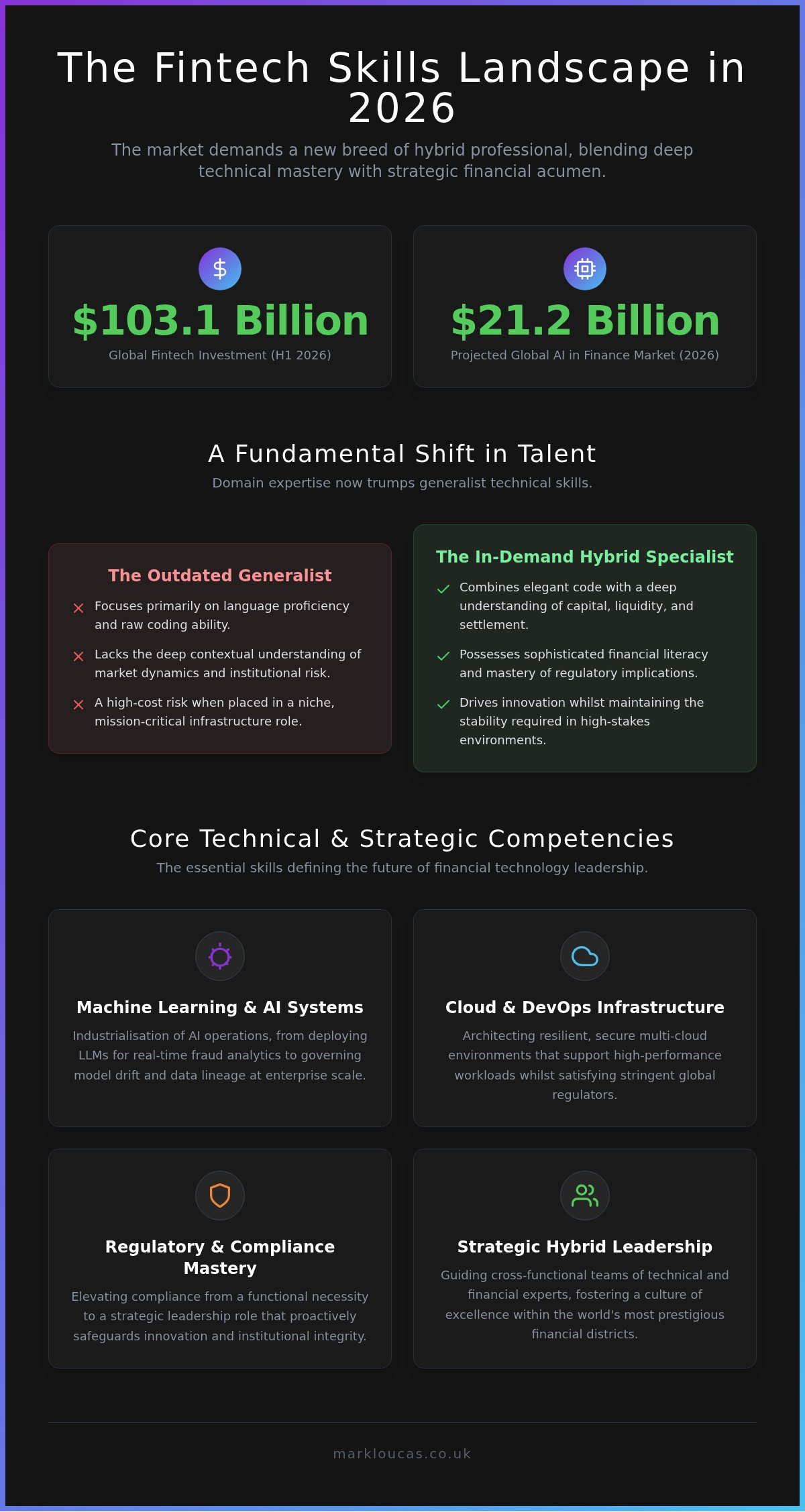
The notion that a traditional background in finance or a standard computer science degree suffices for the current era is rapidly becoming a relic of the past. In a market where global fintech investment reached $103.1 billion in the first half of 2026 alone, the specific fintech skills in demand 2026 have shifted towards a rare fusion of artificial intelligence mastery and deep regulatory understanding. You likely recognise the quiet anxiety that stems from a landscape where technology moves faster than the talent pools can replenish; it’s a challenge that requires a more nuanced approach to recruitment. Expert precision is now the only way forward.
This article provides a curated look at the technical and strategic competencies you need to lead within this sophisticated environment. We’ll offer a roadmap for those looking to master the hybrid roles that now define the global banking sector. From the nuances of ISO 20022 migration to the strategic deployment of AI agents, you’ll gain the insights necessary to attract top tier talent and secure your position at the forefront of financial innovation.
Key Takeaways
- Gain a refined understanding of how the fusion of intelligent systems and traditional finance defines the fintech skills in demand 2026.
- Identify why Machine Learning operations and multi cloud infrastructure are now the non negotiable foundations for resilient financial systems.
- Recognise the evolution of compliance from a functional necessity to a strategic leadership role that safeguards innovation.
- Discover the nuanced leadership qualities required to guide hybrid teams whilst maintaining excellence within the world’s most prestigious financial districts.
- Learn how to leverage bespoke recruitment expertise to identify and attract the rare specialists who define the future of the industry.
If you are seeking to secure the future of your leadership team with the highest calibre of talent, please reach out to our specialist consultants for a private discussion.
Defining the Fintech Skills in Demand 2026 Landscape
The 2026 market is no longer defined by simple digitisation; it is characterised by the seamless integration of intelligent systems within the very core of financial infrastructure. Global providers are increasingly moving away from generalist developers in favour of niche specialists who can navigate the complexities of modern banking. This shift has redefined the fintech skills in demand 2026, placing a premium on those who can bridge the gap between abstract technology and concrete fiscal strategy. To understand what is fintech in this new era, one must view it as a discipline where technical prowess is inseparable from market intelligence. Leading fintech recruitment agencies in London are already witnessing this pivot, as the city’s unique position as a global hub demands a higher calibre of talent to manage increasingly complex systems.
The Rise of the Hybrid Professional
Senior positions now require a sophisticated blend of technical engineering and deep financial literacy. A candidate who can write elegant code but fails to grasp the implications of liquidity risk or settlement cycles is no longer considered a viable lead in a high stakes environment. The modern professional must understand both code and capital. This hybrid profile is rare, yet it’s essential for driving innovation whilst maintaining the stability that discerning clients expect. Pure software engineering, whilst valuable, lacks the contextual depth needed to manage the intricate architecture of contemporary financial platforms where every transaction has regulatory weight.
Why Domain Expertise Trumps Generalist Tech Skills
Hiring a generalist for a niche infrastructure role is a risk that few firms can afford to take. Sector specific knowledge is the primary filter used to reduce the cost of a bad hire, which can be astronomical when dealing with sensitive global systems. Whilst general tech recruitment might focus on language proficiency, specialised financial recruitment looks for a profound understanding of market dynamics and institutional behaviour. With the global AI in finance market expected to reach $21.2 billion in 2026, the demand for specialists who can integrate these models into existing frameworks is paramount. The fintech skills in demand 2026 landscape rewards those who have spent years mastering the granular details of the industry, ensuring that every line of code serves a strategic business purpose.
To discuss your specific requirements for elite technical talent, please get in touch with our team for a confidential consultation.
Core Technical Engineering and AI Infrastructure Skills
The industrialisation of Machine Learning and AI operations forms the foundation of 2026 infrastructure. Global institutions no longer content themselves with isolated proof of concept projects; instead, they demand enterprise scale systems that integrate seamlessly with legacy cores to drive efficiency. This shift has elevated the fintech skills in demand 2026 to include architects who can deploy and govern these complex models at scale. As fintech and banking technology recruiters, we observe that the most sought after professionals are those who combine deep engineering prowess with an understanding of institutional risk.
Machine Learning and AI Systems Architecture
Machine Learning and AI systems are now the primary drivers of revenue enablement. Large Language Models (LLMs) are being repurposed from simple conversational tools into sophisticated engines for real time fraud analytics and tailored recommendation systems. Deploying these at scale requires a nuanced understanding of model drift and data lineage. Specialists who can manage these workflows are essential for maintaining a competitive edge in a market where data is the most valuable asset.
Cloud Infrastructure and DevOps for Modern Banking
Multi cloud deployments provide the resilience needed to satisfy both internal risk committees and external regulators. These environments must support high performance compute workloads whilst maintaining the stringent security protocols required by global regulators. This alignment with broader fintech trends for 2026 highlights how technical infrastructure must support business continuity. Professionals who can integrate AI operations within standard DevOps workflows are increasingly rare and highly valued.
Low Latency Engineering and Specialised Hardware
In the high frequency trading centres of London and Singapore, the demand for low latency engineering remains insatiable. C plus plus and Python continue to be the bedrock of these systems. However, the niche role of FPGA engineers has become even more critical. These specialists, who programme hardware for microsecond execution, represent some of the rarest talent in the global market. Managing high speed data systems requires a level of precision that few possess. If you are looking to secure this level of expertise, you may find it beneficial to consult with a specialist advisor who understands the nuances of this exclusive talent pool.
If you require a discreet advisor to help you manage the complexities of senior level talent acquisition, please contact our specialist team today.
The Regulatory and Compliance Skillset Revolution
Compliance has long been misunderstood as a secondary, administrative function, yet it has evolved into a cornerstone of strategic innovation. The most critical fintech skills in demand 2026 now include a profound understanding of how regulatory frameworks can be used to safeguard growth rather than merely restrict it. Professionals who grasp the strategic role of a compliance officer are highly sought after by firms that value stability and long term viability. This shift requires a rare combination of legal literacy and technical fluency, ensuring that every new product aligns with global standards from its inception.
Modern banking providers are increasingly reliant on RTGS payment consulting to manage the intricacies of real time settlement. This expertise is no longer optional; it is a fundamental requirement for any institution operating within the global payments ecosystem. By integrating compliance directly into the development lifecycle, organisations can avoid the costly delays that often accompany regulatory scrutiny. This proactive approach is particularly relevant following the Executive Order signed on 19 May 2026, which aimed to integrate financial technology innovation more deeply into regulatory frameworks.
Navigating ISO 20022 and Global Payment Standards
The global migration to ISO 20022 has created an unprecedented demand for specialists who can manage the standardisation of payment data. This transition involves significant technical challenges, as legacy systems must be adapted to handle richer, more structured data sets. Key areas of focus for these specialists include:
- Mapping legacy data fields to the new XML based message structures.
- Ensuring interoperability between domestic and international payment rails.
- Optimising data richness to improve fraud detection and liquidity management.
Those with the expertise to oversee this migration are essential for facilitating seamless cross border transactions. Their work ensures that global providers can maintain excellence whilst meeting the stringent requirements of international financial authorities.
AI Governance and Model Risk Management
Following the release of the Financial Services AI Risk Management Framework by the US Treasury in February 2026, the focus on AI governance has intensified. Firms now require specialists in AI ethics and regulatory design to oversee the deployment of intelligent systems. These professionals manage model risk and ensure that automated decisions remain transparent and fair. With the SEC proposing Regulation Crypto Assets (Reg CA) on 18 August 2026, the need for regulatory literacy has never been more apparent. This level of oversight is vital for protecting fintech firms from systemic failure and maintaining the trust of a discerning clientele.
Data Privacy and Cybersecurity in a Decentralised World
Managing data within open banking frameworks presents unique challenges that demand advanced information security skills. Technical compliance within digital banking is no longer just about firewalls; it involves a holistic approach to data privacy that spans the entire decentralised ecosystem. Specialists must be able to protect sensitive information whilst allowing for the fluid data exchange that modern consumers expect. This delicate balance is a key component of the fintech skills in demand 2026, requiring constant vigilance and a deep understanding of emerging cyber threats.
Finding the individuals who possess the rare blend of vision and technical literacy requires a discreet, meticulously managed approach, and we invite you to connect with our boutique advisors to discuss your executive needs.
Strategic Leadership and Soft Skills for Modern Banking
Leadership in 2026 has moved beyond simple technical oversight. It’s an era where the ability to interpret complex data must be matched by the wisdom to apply it ethically. This requires a level of strategic judgement that simply cannot be automated. Through fintech executive search, we curate a selection of visionary leaders who understand that their role is to provide stability whilst fostering innovation. The fintech skills in demand 2026 for senior roles are less about hands-on coding and more about the orchestration of high calibre talent. Elite leadership is quiet. It’s confident. It’s decisive.
Leading through Technological Transformation
Guiding a team through the rapid digital shifts of 2026 requires a steady hand. With 65% of financial services firms actively using AI by the start of the year, leaders must foster a culture of continuous upskilling to prevent talent obsolescence. It’s about maintaining operational stability whilst simultaneously encouraging the experimentation that leads to breakthroughs. This delicate equilibrium is the hallmark of an elite banking executive. They don’t just react to change; they organise their teams to anticipate it. They value precision over haste.
Ethical Decision Making and Corporate Responsibility
The growing importance of ESG and ethical AI has made corporate responsibility a non negotiable priority for the modern C suite. Leaders are now tasked with managing public and regulatory expectations that are more stringent than ever before. In this context, the Chief Compliance Officer has moved from the periphery to the very centre of strategic planning. They ensure that every innovative leap is grounded in a framework of integrity. This ethical awareness protects the brand’s reputation and ensures its longevity in a discerning global market. Integrity is the ultimate currency.
Effective Communication in a Global Remote Landscape
Managing high calibre talent across multiple regions, from London to Dubai and Singapore, demands a refined and sophisticated communication style. Transparency and directness are essential for maintaining trust in a remote or hybrid environment. The fintech skills in demand 2026 landscape rewards those who can communicate complex visions with absolute clarity. Executives must provide tailored solutions for complex resource management, ensuring that every team member feels the focus of their attention. This unhurried, steady pulse of leadership is what keeps global organisations aligned. It’s a skill that requires patience, diligence, and a genuine commitment to personalised engagement. Excellence is never rushed.
To ensure your organisation is led by the finest visionary talent available in the global market, we suggest you speak with our executive search specialists for a tailored solution.
To ensure your organisation is supported by a bespoke strategy that identifies and secures the finest talent, please reach out to our boutique advisors for a confidential consultation.
Building High Calibre Teams with Specialist Recruitment Expertise
Acquiring the rare individuals who possess the fintech skills in demand 2026 requires more than a simple search of public databases. It demands a sophisticated, intelligence-led approach that respects the privacy of both the institution and the candidate. In a market where global fintech investment continues to reach record levels, the competition for niche specialists is intense. Success in this environment is found through specialised financial recruitment that prioritises quality over volume. We understand that your requirements are unique. Our role is to act as a discreet extension of your brand, ensuring that every placement strengthens your strategic position.
The Strategic Advantage of Market Mapping
Data-driven intelligence provides a clear picture of the talent landscape before a single approach is made. Market mapping allows firms to understand where the most sought-after expertise resides, often revealing private, non-public opportunities for growth that are invisible to generalist agencies. This unhurried process of identification ensures that when we do move, it is with absolute precision. Long-term workforce planning depends on this level of granular detail, allowing you to anticipate shifts in the 2026 market rather than reacting to them. Knowledge is the foundation of confidence.
Talent Advisory and Workforce Planning
Bridging the skills gap in a landscape defined by rapid AI integration requires a tailored staffing solution. Our advisory services move beyond simple placement to help you organise your internal structures for maximum resilience. Whether your project requires permanent leadership or interim solutions to manage specific infrastructure migrations, we provide the expertise to guide those decisions. We focus on the granular details of your context. This personalised approach ensures that your resource management is as agile as the technology you deploy, maintaining a steady pulse of innovation across your global operations.
Partnering with a Boutique Recruitment Consultancy
Working with a knowledgeable local insider in hubs like London, Dubai, or Singapore offers an immediate advantage. We deliberately shun the impersonal nature of large corporate entities, opting instead for an intimate service that suggests your firm is the sole focus of our attention. This commitment to curated excellence allows us to identify the most distinguished talent in the sector, from ISO 20022 migration specialists to visionary C-suite executives. Our reputation is built on the meticulous attention to detail required in high-value transactions. We don’t just find candidates; we secure the future of your banking talent.
If you are ready to secure the high calibre talent your organisation requires for the coming years, please reach out to our specialist advisors for a private consultation.
Securing Your Position in the Future of Global Finance
The transition towards the 2026 landscape is defined by a shift from simple automation to a sophisticated fusion of intelligence and domain expertise. Navigating this environment requires more than just technical proficiency; it demands a strategic understanding of how AI and regulation intersect to create resilient financial systems. Mastering the fintech skills in demand 2026 is the surest way to ensure your organisation remains at the forefront of the industry’s evolution. It’s a journey that rewards precision and foresight above all else.
Since 2011, Mark Loucas Ltd has operated as a discreet advisor specialising in permanent fintech recruitment. We provide deep expertise across the payments and digital banking sectors, offering a global reach whilst maintaining the intimate, personalised service of a boutique consultancy. To discuss your specific hiring needs or career progression within the sector, you may contact us at Mark Loucas to speak with a specialist consultant. The future of banking belongs to those who prepare with diligence and we’re here to help you lead the way.

Article by
Liam Henfrey
Liam Henfrey is a seasoned specialist in the payments and banking sectors with over two decades of experience. As the Founder and CEO of FINOPSIS and Managing Director at Mark Loucas Ltd, he advises organisations on complex financial operations and technology. His career includes senior roles at PwC, Deloitte, and Visa Europe.
Related Fintech Recruitment Guides
If you liked this guide then you may also like the following: