


Interim Head of Financial Crime for Fintech and Payments Organisations
What can an interim head of financial crime do beyond covering a leadership gap? For fintech and payments organisations in the UAE, the right appointment can bring experienced direction to urgent priorities. The key is to give the role a clear mandate, rather than simply filling a vacant title.
A leadership change, critical programme or need for specialist expertise without an immediate permanent commitment can leave teams uncertain about priorities and decision-making. A well-matched interim leader can provide continuity, assess what needs attention and guide progress while the organisation considers its longer-term needs.
The value lies in getting the brief right. Define the scope of responsibility, the authority the role requires, the expected outcomes and how progress will be reviewed. Choose someone whose experience fits the organisation’s fintech or payments environment, not simply someone with a senior title.
This article explains when interim financial crime leadership may be the right response, what the role should deliver and how to plan an appointment and handover that support continuity. It offers a practical framework for setting expectations and making an interim appointment count from the outset.
Key Takeaways
- Consider an interim head of financial crime when temporary senior leadership is needed for a defined organisational priority.
- Shape the brief around the work to be delivered, the role’s authority and reporting line, and the experience that is essential.
- Assess whether an interim, permanent or project-based appointment best fits the purpose, continuity needs and scope of the work.
- Plan a structured handover so decisions, priorities and open work are clear when the interim appointment ends.
- A specialist search focused on fintech, payments and digital banking can help align the appointment with the organisation’s mandate.
Considering temporary financial crime leadership for your organisation? Discuss your recruitment brief with Mark Loucas.
When an interim head of financial crime is the right response
Illustrative scenario: A UAE payments organisation has a gap in senior financial crime leadership while preparing for a major internal programme. The team still needs clear priorities and oversight, but the organisation has not decided what its permanent leadership structure should be. An interim appointment can provide continuity while that decision is considered.
An interim head of financial crime is a temporary senior leader appointed to deliver a defined mandate. The role is shaped around the organisation’s priorities, existing structure and period of need. It is not simply a permanent vacancy filled for a short time. The broad scope of financial crime means the remit may touch several areas, but its precise scope should reflect the organisation’s needs and agreed responsibilities.
What does an interim head of financial crime do?
The interim leader focuses on agreed priorities, provides oversight within the organisation’s structure and helps maintain continuity during a defined period. Depending on the brief, this may mean stabilising leadership, guiding a specific programme or supporting preparation for a permanent appointment. The mandate should state what the leader can decide, who they report to and which responsibilities remain with other teams.
That clarity matters. Without it, an interim leader may be held responsible for outcomes they cannot influence or asked to take on work outside the agreed scope.
When might an organisation need interim leadership?
A leadership absence, team change, increased workload or time-sensitive business need may prompt an organisation to consider interim support. These circumstances do not, by themselves, indicate regulatory failure. The appointment may maintain day-to-day direction, lead a defined programme or give the organisation time to conduct a considered permanent search.
The distinction is one of purpose. A permanent executive search is designed to appoint a lasting leader. A contract regulatory reporting specialist may suit a bounded piece of reporting work without wider leadership responsibility. Interim leadership combines senior oversight with a temporary, clearly scoped mandate. Fintech and payments organisations weighing these options can explore fintech contract and interim solutions as part of their workforce planning.
Planning an interim leadership search? Discuss your financial crime recruitment brief.
How to define the interim financial crime leader’s mandate
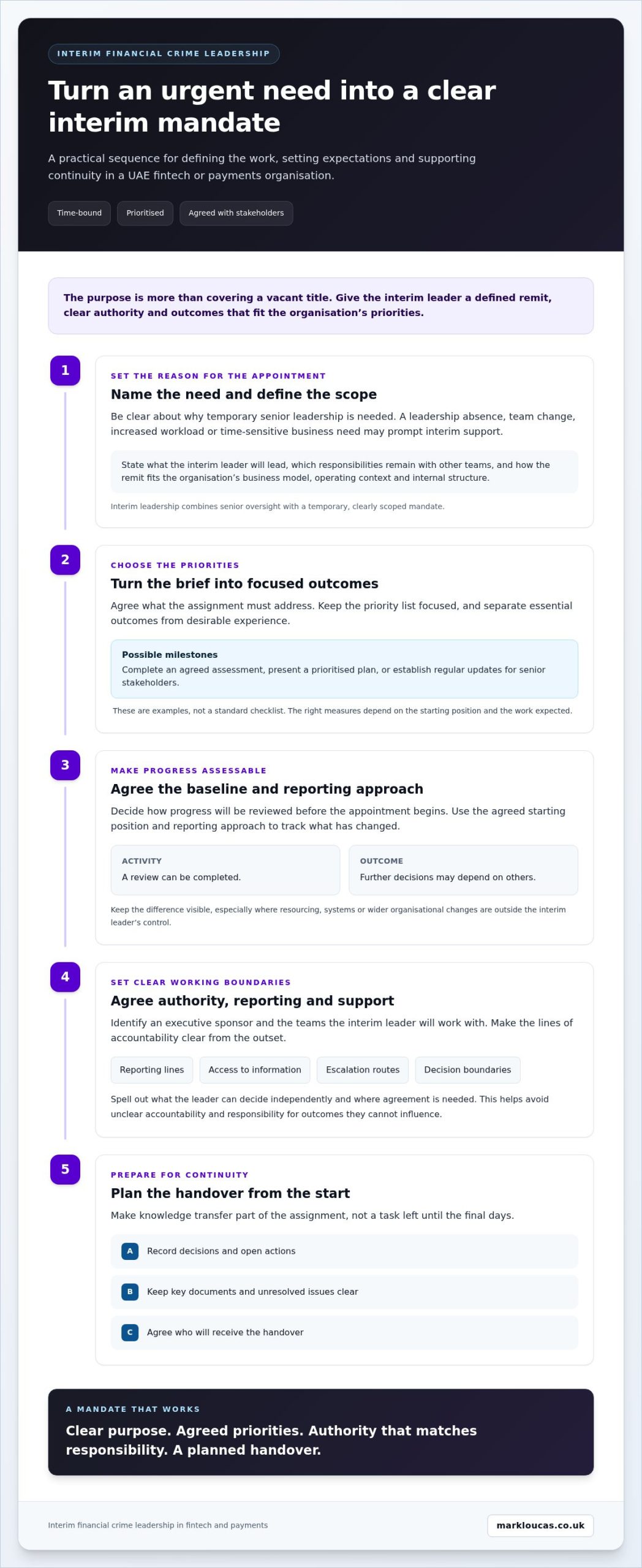
A clear mandate turns an urgent staffing need into a focused leadership brief. Before appointing an interim head of financial crime, agree why the role is needed, what it must address and how its contribution will be assessed. Separate essential outcomes from desirable experience, and identify responsibilities that sit with other functions.
An effective interim mandate is time-bound, prioritised and agreed with the stakeholders who will support and assess the role. For an organisation operating in the UAE, the brief should reflect its business model, operating context and internal structure. Set priorities for the assignment without assuming the remit is the same across fintech and payments organisations.
Set priorities and evidence of progress
Choose a small set of observable milestones tied to the organisation’s stated priorities. These might include completing an agreed assessment, presenting a prioritised plan or establishing regular updates for senior stakeholders. Treat these as examples, not a standard checklist. The right measures depend on the starting position and the work the organisation expects the interim leader to lead.
Agree the baseline and reporting approach before the appointment begins. This helps the organisation track what has changed without relying on unsupported industry benchmarks. Separate activity from outcomes: a review can be completed, while decisions about resourcing, systems or wider organisational changes may depend on others.
Agree authority, stakeholders and handover
Name an executive sponsor and identify the teams the interim leader will work with. Set out reporting lines, access to relevant information, escalation routes and decision boundaries. A concise brief should state where the interim leader can act independently and where they need agreement, helping prevent delays and unclear accountability.
Plan knowledge transfer from the outset. Agree how decisions, open actions, key documents and unresolved issues will be recorded, and who will receive them. This makes the eventual transition part of the assignment, rather than a task left until the final days.
For a considered search, Mark Loucas can help align the mandate with relevant fintech, payments and digital banking experience. Discuss an interim financial crime leadership search as your priorities and scope take shape.
How to assess candidates and address concerns about interim leadership
Assess each candidate against the mandate, not a generic checklist of seniority or technical knowledge. The right interim head of financial crime should bring leadership experience that fits the organisation’s priorities, structure and operating context. For a UAE fintech or payments business, relevant sector experience may help a candidate understand the pace of change and the relationships involved. Test that experience against the actual brief.
Choose the hiring route that fits the need
Compare the options by purpose, continuity and scope. A permanent appointment is designed to provide lasting leadership and shape the function over time. An interim leader can provide senior direction for a defined period, such as during a vacancy or while a specific priority is addressed. A project-based hire is more suitable when the need is a bounded piece of work rather than wider leadership responsibility.
The distinction also helps set expectations. If the organisation needs someone to lead people, align stakeholders and make decisions within agreed boundaries, a project specialist may not meet the need. If the requirement is narrowly defined, a broad interim leadership remit may be unnecessary.
Prioritise evidence relevant to the brief
Explore how candidates have led teams and delivered work through change, ambiguity or competing priorities where those qualities matter to the assignment. Ask for examples that show how they established context, worked across functions and communicated progress. The Association of Certified Financial Crime Specialists discusses the importance of leadership in a compliance programme, including its effect on a team. Use this perspective to consider how a candidate’s approach may fit your organisation, rather than assuming one leadership style suits every setting.
Interview questions should reflect the responsibilities and outcomes in the brief. The guide to interview questions for a compliance expert candidate can help shape a focused discussion.
Reduce the time needed to build organisational context
A temporary leader may need time to understand the organisation, but a planned induction makes that process more deliberate. Provide access to relevant stakeholders, existing processes and current priorities early in the assignment. Agree regular progress reviews and decision points so issues can be raised and resolved without waiting for a formal end-of-assignment review.
Build continuity in from the start. Keep a record of decisions, open work and ownership, then use it to support a practical handover. To discuss a search aligned with your mandate, speak with Mark Loucas about interim leadership recruitment.
Planning an interim leadership search? Discuss your financial crime recruitment brief.
A practical appointment plan for interim financial crime leadership
A considered appointment starts with a clear account of the need, then carries that clarity through selection, onboarding and handover. For an organisation seeking an interim head of financial crime, a structured process helps decision-makers assess candidates against the same priorities without assuming a particular search timeline or outcome.
- Define the need. Record why the appointment is interim and what the organisation needs addressed. State whether the focus is maintaining leadership continuity, supporting a defined programme or another agreed priority.
- Prepare the brief. Describe the role’s scope, organisational context, reporting line, decision boundaries and intended outcomes. Separate essential experience from desirable attributes, and identify responsibilities that remain with other functions.
- Align the decision-makers. Agree who will take part in selection and what evidence they need to see. Set consistent assessment criteria before reviewing candidates, so preferences do not shift during the process.
- Assess and appoint. Use structured conversations to explore examples relevant to the mandate. Discuss how candidates have approached comparable priorities, worked with stakeholders and reported progress, then compare their evidence with the agreed expectations.
- Prepare the transition. Arrange onboarding, regular review points and a practical handover. Record decisions, open work, changes in priority and ownership so knowledge is retained beyond the assignment.
From hiring brief to informed selection
A useful brief gives candidates a realistic picture of the work, rather than a broad list of every possible responsibility. Include the immediate challenge, existing structure, key stakeholders and how progress will be reviewed. This context helps candidates explain how their experience applies, while allowing the hiring team to distinguish relevant evidence from general claims.
Keep the conversation consistent. Ask each candidate to respond to the same core priorities, then use follow-up questions to understand their judgement, communication and approach to delivery. Selection should reflect the mandate, not an assumed universal profile for financial crime leadership.
Prepare onboarding and review points
Before the appointment begins, organise access to relevant stakeholders, information and internal decision routes. Early check-ins can test whether the agreed priorities remain aligned with the organisation’s needs and give the sponsor a clear opportunity to raise issues or agree changes.
Set out how progress and handover information will be recorded. This creates a practical reference for the organisation and the next person responsible for the work, whether the interim assignment concludes as planned or priorities change.
Planning an interim financial crime leadership search? Discuss your recruitment requirement.
How Mark Loucas supports an interim head of financial crime search
A well-defined search starts with the organisation’s need, not a generic job description. Mark Loucas Ltd provides contract and interim staffing solutions for fintech providers and payments industry leaders, with a specialist focus that also includes digital banking. This sector focus can help shape discussions about the mandate, the experience that matters and how candidates’ backgrounds relate to the organisation’s priorities.
A specialist approach shaped around the brief
Before a search begins, clarify the organisation’s context, the interim leader’s remit, reporting arrangements and intended outcomes. These details keep assessment focused on the actual requirement, rather than an expansive list of credentials that may not be needed. Candidate conversations can then explore relevant leadership experience and how it applies to the agreed priorities.
For a payments organisation, sector insight can help frame the search and the role’s context. Mark Loucas Ltd’s payments industry recruitment work sits alongside its wider fintech and digital banking focus. Market mapping and talent advisory can also inform how the organisation defines the role and considers the talent landscape.
The aim is alignment between the business need, the leadership remit and the criteria used to assess candidates. A clear brief gives the search a considered direction while leaving room to discuss relevant experience in the context of the organisation’s structure and priorities.
Move from leadership gap to considered next step
To begin a discussion, outline the organisation, why interim support is being considered and the priorities the appointment is expected to address. It is also useful to share the intended scope, reporting line and transition expectations. These points provide a practical foundation for a focused search and help establish shared expectations before candidate conversations begin.
Mark Loucas Ltd provides specialist contract and interim staffing support for fintech organisations. The search is centred on the defined requirement, with the mandate guiding the assessment of relevant experience and fit.
Contact Mark Loucas Ltd to discuss your interim financial crime leadership requirement and the experience your organisation needs.
Make your interim appointment count
An effective interim appointment starts with a defined need. Set out the priorities, scope, reporting line and decision boundaries, then agree how progress will be reviewed and how knowledge will be transferred. This gives the interim leader a clear basis for action and helps the organisation maintain continuity.
Choose an interim head of financial crime when temporary senior leadership fits the need better than a permanent appointment or project-based hire. Assess candidates against the agreed mandate, looking for relevant leadership experience and an understanding of the organisation’s fintech, payments or digital banking context.
Mark Loucas supports contract and interim staffing for fintech providers and payments industry leaders. Its specialist recruitment focus across fintech, payments and digital banking, alongside market mapping, intelligence and talent advisory, can help structure the hiring decision and align the search with the requirement.
With a considered brief, the organisation can approach its leadership gap with greater clarity. Discuss your interim financial crime leadership requirement and take the next step towards a well-scoped search.
Frequently Asked Questions
When should a fintech hire an interim head of financial crime?
A fintech may consider interim leadership when a senior role is vacant, priorities have changed, workloads have increased or a time-sensitive business need requires focused oversight. The appointment might support stability, a defined programme or preparation for a permanent hire. These circumstances do not, on their own, indicate regulatory failure. The organisation should first establish why temporary leadership is needed and what it expects the person to address.
How do you choose an interim head of financial crime?
Choose a candidate whose leadership experience and sector context match the agreed mandate. Set out essential criteria, then use structured conversations to test relevant examples of working through change, ambiguity or cross-functional priorities. For a fintech or payments business, experience in those environments may be relevant, but it should be assessed against the actual role. Consider how the candidate would build organisational understanding, communicate progress and work within decision boundaries.
Is an interim head of financial crime right for a temporary leadership gap?
Yes, an interim appointment can suit a temporary leadership gap when the organisation needs senior oversight for a defined period. It can help maintain direction while a permanent search is considered or the business reviews its longer-term structure. If the requirement is limited to a specific task without wider leadership responsibility, a project-based appointment may be more suitable. The choice depends on the scope, continuity needs and intended outcomes.
What should an interim financial crime leadership brief include?
A clear brief should explain why the appointment is interim, the organisation’s context and the priorities to be addressed. Include the role’s scope, reporting line, decision boundaries, key stakeholders and intended outcomes. Separate essential experience from desirable attributes, and identify work that remains with other functions. Agree how progress will be reviewed and what information should be recorded for handover. This gives candidates and decision-makers a shared basis for assessing fit.
How can a company ensure a smooth handover after an interim appointment?
Plan the handover from the start of the assignment, rather than leaving it until the final days. Agree how to record decisions, open actions, changes in priority and ownership, and identify who will receive that information. Regular progress reviews can keep records current and surface changes to the mandate. A structured transfer of knowledge supports continuity for the team and the person taking responsibility for the work.
Can an interim head of financial crime support a fintech or payments business?
Yes. An interim leader can provide temporary senior support to a fintech or payments business where the need and remit are clearly defined. Mark Loucas Ltd provides contract and interim staffing solutions tailored to fintech providers and payments industry leaders, with a specialist focus across fintech, payments and digital banking. The search can be shaped around the organisation’s context, agreed priorities and relevant leadership experience.

Article by
Liam Henfrey
Liam Henfrey is a seasoned specialist in the payments and banking sectors with over two decades of experience. As the Founder and CEO of FINOPSIS and Managing Director at Mark Loucas Ltd, he advises organisations on complex financial operations and technology. His career includes senior roles at PwC, Deloitte, and Visa Europe.
Related Fintech Recruitment Guides
If you liked this guide then you may also like the following: