


Contract Regulatory Reporting Specialist Hiring for Fintech in 2026
A reporting deadline can expose a skills gap when a fintech team has little capacity to absorb extra work. A contract regulatory reporting specialist can add focused support, but their experience needs to match the firm’s reporting environment and the assignment’s priorities.
For fintech businesses in the UAE, defining that match starts with the work itself. The role may require regulatory knowledge, data skills and systems experience. A brief that simply asks for a reporting specialist can make it harder to identify someone ready to contribute.
This article explains how to define the assignment, assess relevant experience and prepare a brief around your reporting processes, data flows, systems and deadlines. It also considers when contract hiring can help with immediate delivery and how to connect that decision to longer-term resourcing needs.
Key Takeaways
- Define the reporting work, deadlines and systems before writing the contract brief.
- Separate essential experience from desirable knowledge, and link each requirement to the assignment.
- Assess a contract regulatory reporting specialist against your reporting environment, data handling needs and stakeholder expectations.
- Compare contract hiring with internal workload changes and permanent recruitment, considering both immediate delivery and future capability.
- A focused brief helps align specialist fintech recruitment with your organisation’s reporting priorities.
For a defined contract or interim recruitment need, speak with Mark Loucas about specialist fintech hiring.
What a contract regulatory reporting specialist contributes to fintech
A contract regulatory reporting specialist supports the preparation, checking and delivery of reports within a regulated organisation. Depending on the assignment, their work may include tracing information to its source, reviewing data for accuracy, managing reporting processes and working with colleagues to resolve gaps or inconsistencies. The remit should reflect the organisation’s needs and the results expected from the contract.
In fintech, reporting can draw on several systems, teams and data sources. A specialist can bring focused experience to a defined reporting activity or project, adding capacity to the existing team. The role may also involve reporting tools and processes associated with Regulatory technology (RegTech), the use of technology to support regulatory and compliance processes.
How the role differs from broader compliance positions
A reporting specialist usually focuses on the data, processes, checks and delivery involved in reporting. A broader compliance position may include wider oversight, policy and risk responsibilities, although duties can overlap. This distinction helps when scoping a hire: an assignment centred on reporting delivery may call for a different background from one focused on compliance leadership. For adjacent leadership context, read about the strategic role of a compliance officer.
When a contract reporting specialist may be useful
Contract support can suit a defined reporting workstream, a temporary gap in specialist capacity or a period of increased delivery pressure. Rather than shifting the whole reporting function, the organisation can set a focused assignment around the work that needs attention and the experience required.
Scope the work around your reporting obligations, systems, team structure and delivery pressures. One assignment might focus on checking data and improving a reporting process. Another might require coordination between reporting, technology and compliance colleagues. These are examples, not fixed role boundaries.
Clear scope helps the specialist complement existing expertise rather than duplicate it. It also gives the team a shared understanding of priorities, responsibilities and handover arrangements. Use that scope to assess candidates against the actual reporting environment, not just a job title.
For help shaping a focused fintech contract brief, speak with Mark Loucas.
For help defining the work and outcomes, discuss your reporting assignment with Mark Loucas.
Define the reporting assignment before you hire
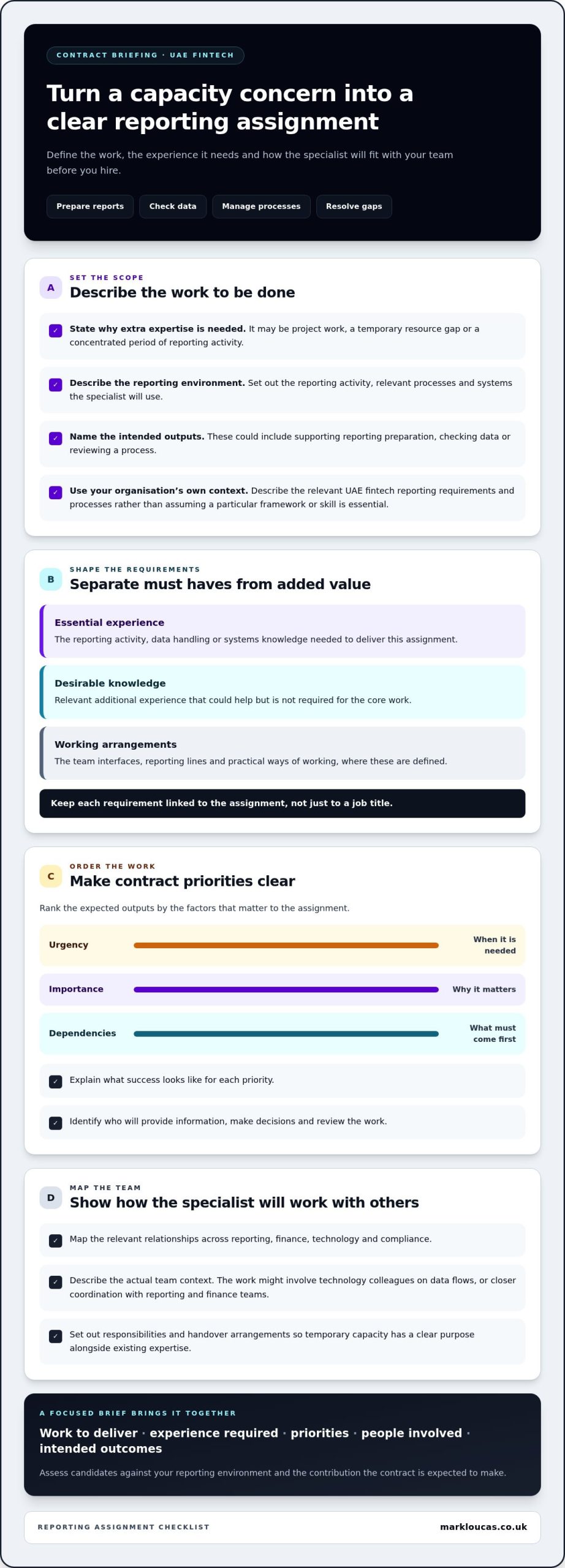
A precise brief turns a general capacity concern into a defined piece of work. Before recruiting a contract regulatory reporting specialist, identify why extra expertise is needed, what the contractor will address and how the work fits with the existing team. Candidates can then explain their relevant experience against the requirements, and you can assess their fit on the work itself.
Turn the business need into a clear brief
Start with the reason for hiring, such as project work, a temporary resource gap or a concentrated period of reporting activity. Describe the reporting environment and the expected contribution. Include the systems the specialist will use, the teams they will work with and any defined outputs, such as reviewing a process or supporting reporting preparation. Base the requirements on your organisation’s needs rather than assuming a particular framework or technical skill is essential.
Separate the brief into clear priorities:
- Essential experience: the reporting activity, data handling or systems knowledge needed to deliver the assignment.
- Desirable knowledge: relevant additional experience that could help but is not required for the core work.
- Working arrangements: the expected team interfaces, reporting lines and practical ways of working, where these are defined.
This distinction keeps the brief focused and separates requirements specific to your organisation from assumptions about every reporting role. For a UAE-based fintech, describe the relevant reporting context using your organisation’s own requirements and processes.
Set priorities for the contract period
Rank expected outputs by urgency, operational importance and their dependencies on other work. A specialist may need to understand existing processes before supporting a review or helping to address a data issue. For each priority, explain what success looks like and identify who will provide information, make decisions and review the work.
Map the key working relationships across reporting, finance, technology and compliance. The balance will depend on the assignment. The specialist might work closely with technology colleagues on data flows, or coordinate mainly with reporting and finance teams. Describe the actual team context, priorities and intended outcomes in the brief.
A well-defined contract brief supports a considered hiring decision and gives temporary capacity a clear purpose. For tailored fintech contract and interim recruitment support, discuss your resourcing brief with Mark Loucas.
For support with a specialist fintech hire, discuss your recruitment needs with Mark Loucas.
Assess a specialist’s experience against your reporting environment
A job title can suggest relevant experience, but it does not show what a candidate has delivered. Assess each contract regulatory reporting specialist against the assignment. Look for clear examples of their contribution to preparing, reviewing or improving reporting work. Practical evidence is more useful than familiarity with a list of terms.
Explore how candidates have worked with reporting data, systems and control processes. Ask what they handled personally, how they checked information and how they worked with colleagues when issues arose. Candidates can explain their contribution without sharing confidential information from a previous employer.
Experience and technical fluency to explore
Focus on the requirements in your brief. If the assignment involves investigating data differences, ask candidates to describe their approach, the checks they used and how they recorded or escalated findings. If it involves a particular system or process, explore how they used it and what they were responsible for. Where their previous environment differs, assess which skills transfer and what they would need to learn.
Demonstrated experience
Examples of preparing or reviewing comparable reports, working with relevant systems and applying checks within a reporting process.
Transferable skills
Experience with similar data, controls or workflows, with a clear explanation of the similarities and differences that matter to this assignment.
Areas to discuss
Limited exposure to a system, process or stakeholder group that is central to the brief. Explore how the candidate would build familiarity and where support may be needed.
For a role in the UAE, assess experience against your organisation’s reporting environment and requirements. A candidate’s experience in another market may be transferable, but its relevance depends on how closely the previous work matches the assignment.
Interview questions that reveal practical fit
Use scenarios drawn from the assignment. For example, ask, “How would you investigate a discrepancy between two data sources?” or “How would you keep stakeholders informed if a dependency could affect delivery?” Listen for a structured approach, sound judgement and clear communication, rather than a rehearsed answer. You can adapt these interview questions for a compliance expert candidate to the reporting responsibilities in your brief.
Comparable reporting work is a stronger indicator of fit than a familiar job title because it shows how a candidate has handled the data, controls and working relationships the assignment requires.
For a focused search based on your reporting environment, discuss the role with Mark Loucas.
Choose a contract hiring approach that fits the need
The right resourcing choice depends on the work, how long the need is likely to continue and what capability the organisation wants to retain in-house. A contract regulatory reporting specialist may suit a defined project or temporary capacity gap. Internal workload changes or permanent recruitment may fit other situations. Match the approach to the need rather than treating one route as the default.
Contract support or a permanent appointment
Contract support can suit a clear, time-bound requirement, such as a project-specific reporting task or a concentrated period of delivery. It adds specialist capacity to an existing team while the work is under way. Set out responsibilities, team interfaces and handover expectations so the assignment works alongside existing roles.
Redistributing work internally may be suitable if the team has the relevant skills and capacity to take it on without compromising other priorities. But moving tasks between colleagues does not add capacity and may shift pressure elsewhere. Consider a permanent appointment when the organisation needs sustained reporting expertise as part of its ongoing capability. That requires a longer-term view of the role and its place in the team.
Consider the duration and nature of the work, the expertise available internally and whether the need is likely to continue after the assignment ends. These factors can help determine whether to bring in contract support, reorganise current responsibilities or plan for a permanent hire. No one approach suits every situation.
A focused search for specialist talent
A specific brief keeps a search focused on relevant fintech, payments or digital banking experience, as well as the reporting work and systems involved. It gives the hiring team a consistent basis for assessing candidates and distinguishing essential experience from skills that could transfer from a comparable environment.
Market mapping can help an organisation understand the talent landscape and inform its resourcing decisions. It can clarify the experience required and how that need relates to wider workforce planning. Mark Loucas Ltd provides market mapping and talent advisory services, alongside contract and interim solutions tailored to short-term resource gaps and project-specific needs.
For a defined contract requirement, discuss your fintech resourcing needs with Mark Loucas and consider the hiring approach that best fits the work and longer-term plan.
For help with a contract reporting assignment, speak with Mark Loucas about fintech contract recruitment.
Engage a contract regulatory reporting specialist with Mark Loucas
A clear assignment brief, careful assessment of relevant experience and a hiring route suited to the work support a more informed recruitment decision. Define what the role must deliver, how the specialist will work with the team and whether contract support fits the organisation’s wider resourcing plans.
Mark Loucas Ltd is an independent specialist recruitment consultancy focused on fintech, payments and digital banking. It provides contract and interim staffing solutions tailored to short-term resource gaps and project-specific needs. For an organisation seeking a contract regulatory reporting specialist, the brief should connect the reporting requirement with relevant sector experience and the practical demands of the assignment.
What to prepare for a recruitment discussion
A concise outline of the work helps establish the key requirements. Consider preparing:
- Assignment purpose: why additional expertise is needed and what work the contractor will address.
- Responsibilities and priorities: the expected contribution and the deliverables that matter most.
- Team and systems context: relevant working relationships, reporting systems and stakeholder groups.
- Candidate profile: essential capabilities, alongside areas where comparable or transferable experience may be suitable.
Share the details that are appropriate for the recruitment discussion. A clear view of the working environment helps distinguish candidates whose experience is directly relevant from those whose skills may transfer with support.
Connect the immediate hire to wider resourcing
The assignment may address a defined short-term gap or form part of a wider workforce or transformation requirement. Clarifying that context helps keep the immediate hiring decision aligned with longer-term capability needs, including when considering an interim CTO for a scale-up. For example, an organisation may need temporary project support while considering the expertise it will require on an ongoing basis.
When the question extends beyond a single vacancy, market mapping and talent advisory can support informed workforce planning. Mark Loucas provides these services alongside contract and interim recruitment, helping employers consider the talent landscape in relation to their needs.
A well-scoped brief gives the recruitment discussion a practical foundation. With the purpose, priorities and required experience set out, employers can make a considered decision about the specialist support their reporting environment calls for.
Discuss your contract hiring requirements with Mark Loucas.
To connect your immediate hiring need with wider resourcing plans, talk to Mark Loucas about contract recruitment and talent advisory.
Build reporting capacity with a considered hiring decision
A strong hire starts with a clear assignment. Define the work, systems and team context, then assess candidates against evidence of relevant reporting experience rather than relying on job titles alone. Consider whether contract support, internal resource changes or a permanent appointment best fits both the immediate need and longer-term capability plans.
Mark Loucas Ltd is an independent specialist recruitment consultancy focused on fintech, payments and digital banking. Its contract and interim solutions are tailored to short-term resource gaps and project-specific needs. A carefully scoped brief can help identify a contract regulatory reporting specialist whose experience aligns with your reporting environment and delivery priorities.
With the right expertise in place, your team can approach its reporting demands with greater focus. Discuss your contract hiring requirements with Mark Loucas and take a considered next step.
Frequently Asked Questions
Is a contract regulatory reporting specialist different from a compliance officer?
Usually, the roles differ in focus. A reporting specialist works on preparing, reviewing or supporting reporting activity, including relevant data checks and process controls. A compliance officer may have wider oversight across compliance priorities and risks. The distinction is not absolute, however. Responsibilities can overlap in some organisations, while others separate them more clearly. The employer’s brief, team structure and reporting needs determine how each role is defined.
What does a contract regulatory reporting specialist do?
A contract regulatory reporting specialist supports reporting work within a regulated organisation. Depending on the assignment, this may include preparing or reviewing reports, checking data, following defined controls, investigating discrepancies and coordinating with colleagues who provide or use reporting information. The specialist may also contribute to a project or process review. Duties depend on the organisation’s reporting environment, systems, team structure and the outcomes set for the contract.
When should a fintech hire a contract regulatory reporting specialist?
A fintech may consider contract support when it has a temporary gap in specialist capacity or a defined project that needs focused reporting expertise. A contractor can add resource to an existing team for a particular piece of work or concentrated delivery period. The decision depends on the assignment, available internal skills and expected duration. Contract hiring may not suit an ongoing need that calls for lasting in-house capability.
How do I assess a contract regulatory reporting specialist’s experience?
Ask candidates for specific examples of reporting work related to your assignment. Explore what they personally did, how they handled data and controls, which systems they used and how they worked with stakeholders. Scenario-based questions can show how they would investigate a discrepancy or manage a dependency. Focus on evidence and transferable experience rather than relying on a job title. Candidates can explain their approach without disclosing confidential information from previous employers.
Can a contract specialist work with an existing compliance team?
Yes. A contractor can complement an existing compliance or reporting team by taking on a defined assignment or adding specialist capacity. Set out how the role connects with current responsibilities, who the specialist will work with and how priorities will be agreed. Clear interfaces help reduce duplicated effort and support effective collaboration. Define responsibilities before the assignment begins to reflect the team structure and work required.
What should a contract regulatory reporting specialist job brief include?
A useful brief explains why the assignment is needed, what responsibilities it covers and what outputs are expected. Describe the relevant reporting environment, systems, stakeholder groups and working arrangements. Separate essential experience from desirable knowledge, and note where comparable or transferable experience may be suitable. Keep the requirements tied to the employer’s actual needs so candidates understand the work and can show how their experience fits.
How can specialist recruitment support a contract reporting hire?
Specialist recruitment can turn a defined reporting need into a focused search, with emphasis on relevant fintech, payments or digital banking experience. A clear assessment approach can compare candidates against the work, systems and team context rather than relying on job titles alone. Mark Loucas Ltd provides contract and interim staffing solutions for short-term resource gaps and project-specific needs, supporting a considered hiring process.

Article by
Liam Henfrey
Liam Henfrey is a seasoned specialist in the payments and banking sectors with over two decades of experience. As the Founder and CEO of FINOPSIS and Managing Director at Mark Loucas Ltd, he advises organisations on complex financial operations and technology. His career includes senior roles at PwC, Deloitte, and Visa Europe.
Related Fintech Recruitment Guides
If you liked this guide then you may also like the following: