


In-house vs agency recruitment for startups in the 2026 fintech sector
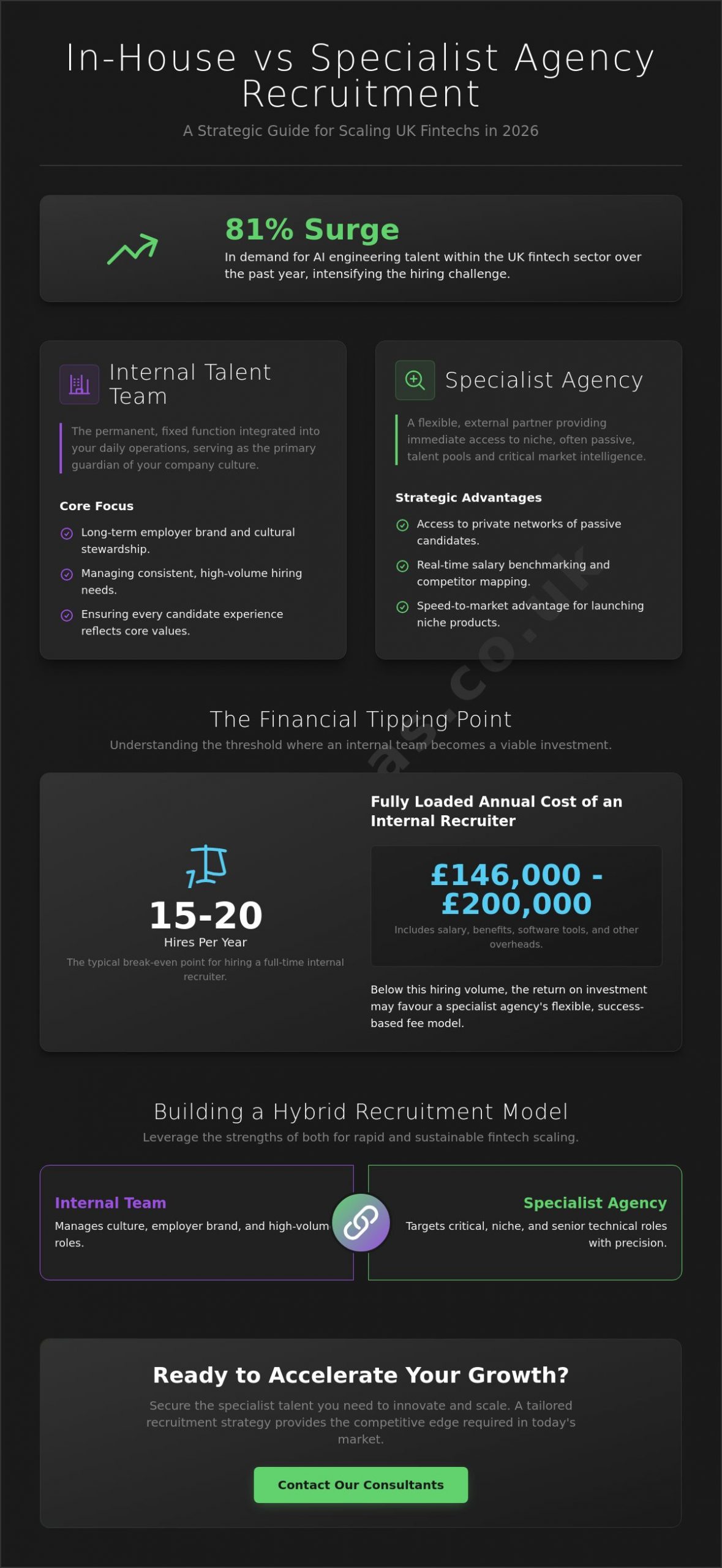
Could the decision to hire a dedicated internal recruiter actually be the most expensive strategic error your fintech makes during this pivotal scaling phase? As the demand for AI engineering talent in the UK fintech sector has surged by 81 per cent over the past year, the debate surrounding in-house vs agency recruitment for startups has moved beyond simple cost comparisons to a question of curated expertise and market agility. You likely feel the weight of finding rare specialists in payments and digital banking whilst managing the pressure to scale without eroding the high standards of your founding team. It is a delicate balance where the wrong choice can lead to prolonged vacancies or, perhaps worse, a compromise in hire quality that stalls innovation.
We understand that your time is best spent on the grand vision of your firm rather than the granular details of a complex hiring funnel. This guide will help you discover whether an internal team or a specialist boutique agency offers the best strategic value for your organisation in 2026. We shall examine the hidden financial implications of fixed salaries, the impact of the new Employment Rights Bill on your onboarding processes, and the specific scenarios where a discreet, highly connected partner provides the necessary edge in a competitive market.
Key Takeaways
- Identify the fundamental distinctions between internal talent functions and boutique agencies to determine which model aligns with your current scaling velocity.
- Discover the specific hiring volume thresholds where the fully loaded cost of a dedicated internal recruiter becomes a viable investment for your organisation.
- Learn how specialist agencies provide a distinct speed-to-market advantage when launching niche products within the competitive digital banking and payments sectors.
- Evaluate the strategic nuances of in-house vs agency recruitment for startups by looking beyond upfront fees to focus on long term return on investment.
- Understand how to implement a sophisticated hybrid model that utilises internal teams for culture whilst leveraging external experts for the most challenging technical roles.
If you would like to explore how a tailored search can accelerate your growth, please contact our consultants today.
The fundamental differences between in-house and agency recruitment
The choice between in-house vs agency recruitment for startups is rarely a binary one; it’s a strategic decision based on the maturity and complexity of your firm. In-house recruitment acts as a permanent, fixed function within your business. It’s often deeply integrated into your daily operations, focusing on maintaining a consistent volume of hires and protecting the delicate cultural fabric of a growing team. Conversely, an agency partnership represents a flexible, external extension of your brand. These specialists provide immediate access to niche talent pools that are often invisible to internal teams.
In the 2026 fintech landscape, simply sourcing CVs is no longer sufficient. The market has become remarkably sophisticated. Candidates now demand deeper insights into a firm’s technical roadmap and regulatory stance before they even consider an initial conversation. Whilst an internal team understands the internal mechanics of your company, a specialist partner understands the broader movements across the wider industry. They offer a perspective that is both objective and deeply informed by current market shifts.
Defining the internal talent acquisition function
An internal recruiter serves as the primary guardian of your company culture. Their focus is often on the long term health of the employer brand, managing your presence on social platforms—a strategy that often involves the expertise of digital specialists like cornerstone-ms.co.uk—and ensuring that every candidate experience reflects your core values. This model is particularly effective for managing high volume needs, such as entry level positions or non-specialised roles where the candidate pool is broad. They provide a steady, predictable pulse to your hiring efforts, ensuring that the internal machinery of growth continues to turn without interruption.
The role of the specialist fintech recruitment partner
A specialist fintech partner offers a level of specialised financial recruitment expertise that is difficult to replicate internally. Unlike a general Employment agency, these boutique advisors maintain a private network of passive talent. These are the individuals who aren’t actively seeking roles on public platforms but who may be moved by the right, discreetly presented opportunity.
Modern agencies have transitioned from simple headhunters to strategic advisors. They provide critical market intelligence, such as real-time salary benchmarking and competitor mapping. This allows your startup to move with precision, securing the specific skills required for launching complex payments products or digital banking features without the delay of a standard search. It’s a curated approach that prioritises quality over mere headcount.
p>To discuss how to balance your internal resources with external expertise, you may reach out to our team through our contact page.
When to prioritise internal talent acquisition teams
Determining the precise moment to transition from external search to an internal function is a matter of scale and velocity. For most fintech firms, the break-even point for hiring a full-time in-house recruiter occurs when you anticipate making between 15 and 20 hires within a single year. Below this threshold, the fully-loaded cost of an internal professional, which often ranges from $146,000 to $200,000 annually when accounting for benefits and software tools, may not yield a favourable long-term ROI. However, once you reach this volume, the benefits of having a dedicated guardian of your culture become undeniable.
The debate of in-house vs agency recruitment for startups often centres on immediate costs, but the true value of an internal team lies in their proximity to the pulse of the business. An internal talent specialist understands the subtle team dynamics and internal politics that an external partner might miss. They are present for the quiet victories and the strategic pivots, allowing them to represent your firm with a level of intimacy that is difficult to replicate from the outside
If you are looking to scale your leadership team with precision and discretion, you may learn more about our tailored solutions on our contact page.
The strategic advantages of specialist recruitment agencies for startups
Speed is often the most critical factor when launching a new payments product or digital banking feature. Whilst an internal team may spend months building a pipeline from the ground up, a specialist partner can often present a curated shortlist of qualified candidates within days. This agility is vital in a sector where being first to market can define your trajectory. The debate regarding in-house vs agency recruitment for startups often ignores the opportunity cost of a vacant technical seat. A delayed hire does not just represent a missing employee; it represents stalled innovation and lost revenue.
Senior appointments require a level of discretion and reach that few internal teams can maintain. Through a refined process of fintech executive search, a boutique advisor can engage with the 70 per cent of the workforce that remains passive. These individuals are not browsing job boards. They are successfully leading teams at rival firms, only open to a move if the proposition is presented with the right level of sophistication and care. This model allows you to scale your leadership team with precision, unburdened by the fixed salary overheads of an expanded internal HR department.
Accessing niche fintech and payments expertise
Generalist recruiters often struggle with the granular technical requirements of the current market. Identifying a candidate with a deep understanding of ISO 20022 migration or real-time gross settlement requires more than just a simple keyword search. Our focus on payments industry recruitment ensures that we speak the same language as your engineering leads. Whether you need RTGS experts or compliance specialists, a specialist partner bridges the gap between technical complexity and talent acquisition.
Leveraging market mapping and intelligence
A significant advantage of an external partnership is access to real-time market intelligence. We provide detailed mapping of competitor talent movements, allowing you to understand which teams are expanding and which are being reduced. This data informs your strategic resource management, ensuring you are not just hiring in a vacuum. By knowing where the most talented professionals are moving, you can position your startup as the most attractive destination for the industry elite. This level of insight is a core component of the in-house vs agency recruitment for startups decision, providing a depth of knowledge that internal functions rarely have the time to cultivate.
To ensure your next appointment delivers the strategic value your firm deserves, you may consult with our boutique advisors for a tailored search proposal.
Evaluating the true cost of your hiring strategy
The financial debate surrounding in-house vs agency recruitment for startups often suffers from a narrow focus on immediate outgoings. Whilst a contingency fee may seem substantial at a glance, it’s a modest investment when contrasted with the silent erosion of capital caused by a prolonged vacancy. In the high-stakes world of fintech, a vacant seat in your engineering or compliance department is not a neutral state. It’s a daily drain on your momentum. The cost of vacancy includes lost innovation, delayed product roadmaps, and the overextension of your existing team, which can lead to further turnover amongst your most valued staff.
Sophisticated founders recognise that the role of fintech recruitment agencies in London is to act as a safeguard against these financial leaks. By providing immediate access to a pre-vetted network, a specialist partner reduces the time to hire significantly. This allows your startup to maintain its velocity and hit investor milestones with precision. Moving the conversation beyond simple fee percentages allows you to focus on the long term return on investment that a high-calibre hire brings to your organisation.
The financial impact of a bad hire
A bad hire in a regulated banking environment is more than a mere inconvenience; it’s a significant financial and reputational risk. The cost of re-recruiting, combined with the lost productivity during a notice period, can easily double the initial hiring expense. If a compliance hire lacks the necessary depth of expertise, the potential for regulatory fines or operational errors becomes a looming threat. To mitigate this, we recommend a meticulous screening process. You may find our guide on the best interview questions for compliance experts a useful resource for ensuring technical competency from the outset.
Calculating the opportunity cost of slow hiring
Delayed hires frequently stall critical product launches, causing you to miss market windows that your competitors will gladly exploit. Whilst an internal team works to build a database from scratch, a specialist agency leverages an existing ‘black book’ of elite talent. This speed-to-market advantage is often the difference between leading the sector and playing catch-up. The hidden cost of founder time spent on first-stage screening is a significant distraction from grander strategic goals. Your time is a finite and precious resource. Entrusting the granular details of candidate sourcing to a professional allows you to remain focused on the grand vision of your firm.
If you are ready to secure the niche talent required to scale your fintech operations with confidence, please contact our specialist team to discuss your requirements.
To discuss how a bespoke talent strategy can support your next funding round, please get in touch with our specialist team.
Building a hybrid recruitment model for rapid fintech scaling
The hybrid model represents a sophisticated evolution in the in-house vs agency recruitment for startups debate. Rather than viewing these two functions as competing forces, the most successful fintech firms treat them as complementary layers of a singular, refined talent strategy. In this architecture, your internal team manages the high volume, repeatable hires that define your operational core. They focus on the cultural integration of junior to mid-level roles, ensuring that the founding spirit of the firm remains intact as the headcount grows. Simultaneously, you engage a specialist partner to navigate the difficult 20 per cent of roles that require deep market reach and technical nuance, such as niche payments engineering or regulatory risk leadership.
Using interim staffing solutions can be a masterstroke during periods of intense transition or rapid expansion. These interim professionals bridge the gap, ensuring that your regulatory obligations and technical roadmaps remain on track whilst the search for a permanent leader continues with the necessary diligence. This approach reflects the patience and precision required in high-value transactions, allowing you to secure the right leadership without the pressure of an empty chair.
Integrating agency expertise with internal processes
A smooth knowledge transfer is essential for this model to flourish. Regular strategy sessions between the founder and the specialist recruiter ensure that every search remains aligned with the grand vision of the firm. By utilising agency market mapping, your internal HR department can set realistic hiring targets based on actual talent availability rather than optimistic projections. In this scenario, the agency functions as a discreet, highly connected extension of your internal team. They provide the executive search capabilities and niche industry insights that a generalist function might lack, ensuring a seamless experience for every high-calibre candidate.
When to switch between models as you grow
The signal to shift from a pure agency model to a hybrid approach often coincides with your Series A or Series B funding rounds. As your headcount growth becomes more predictable, the need for a permanent internal guardian of your employer brand increases. However, even as you build your internal team, the value of fintech banking technology recruiters remains constant for niche appointments. These boutique advisors help you transition through different funding rounds by providing the market intelligence necessary to stay competitive.
A curated approach to recruitment is the hallmark of a mature fintech organisation. It suggests a brand that is never in a rush to fill a seat at the expense of excellence. By balancing the intimate knowledge of an internal team with the elite reach of a specialist partner, you ensure that your organisation is always positioned to attract the finest talent in the 2026 landscape. This balanced architecture provides the reliability and directness needed to scale with quiet confidence.
If you wish to explore how a bespoke search can secure the leadership your organisation requires, please reach out to our consultants for a private discussion.
Strategic talent acquisition for the next era of fintech growth
The decision regarding in-house vs agency recruitment for startups ultimately rests on the complexity of your technical roadmap and the velocity of your scaling ambitions. We have seen that whilst internal teams offer vital cultural continuity, the elite reach of a specialist partner is indispensable for navigating the most challenging technical and executive searches. Strategic clarity is the hallmark of a mature firm. By adopting a hybrid architecture, you ensure that your organisation remains agile, unburdened by excessive overheads whilst maintaining access to the industry finest talent.
With over a decade of experience in the London fintech market, our boutique firm specialises in payments infrastructure and ISO 20022 requirements. We provide a level of market intelligence and discreet executive search for digital banking leaders that generalist functions simply cannot match. If you are ready to secure the rare talent required to lead the next phase of your journey, please contact our specialist team today to discuss your fintech hiring strategy. Your vision deserves the support of a partner who values craftsmanship and excellence as much as you do.
Frequently Asked Questions
Is an in-house recruiter cheaper than using a fintech agency
An internal recruiter is only more cost effective when your hiring volume is consistently high, typically exceeding fifteen to twenty roles per year. Below this threshold, the fixed costs of a full time salary, benefits, and software tools often outweigh the variable fees of an agency. The debate of in-house vs agency recruitment for startups should always account for these fully loaded costs.
How long does it take for a specialist agency to find a fintech executive
A specialist partner can often produce a curated shortlist of qualified candidates within a matter of days. Whilst the entire process from initial search to final offer may take several weeks, the speed of access to passive talent is significantly faster than building an internal pipeline from scratch. This agility allows your firm to maintain its momentum during critical growth phases.
Can a startup use both internal recruiters and external agencies at the same time
Yes, many mature fintech firms adopt a hybrid model to balance cost and expertise. In this arrangement, your internal team focuses on high volume roles and cultural alignment, whilst a specialist agency handles niche technical requirements or senior executive searches. This approach ensures that the most challenging positions are managed by those with the deepest market reach.
What are the main benefits of using a specialist payments recruiter for a startup
Specialist recruiters possess a granular understanding of technical requirements like ISO 20022 migration and real time gross settlement systems. They navigate the specific regulatory nuances of the payments industry with ease, ensuring that candidates have the precise skills required for your technical roadmap. This expertise reduces the risk of a bad hire in high stakes infrastructure roles.
How do I know when my startup is ready to hire its first internal recruiter
You are likely ready when your hiring needs become predictable and exceed the capacity of your founding team to manage. If you are planning more than fifteen hires in the coming twelve months, a dedicated internal function can help protect your culture and manage the employer brand. Until that point, a variable agency partnership often provides better strategic value.
What is market mapping and why is it useful for fintech startups
Market mapping is the process of gathering intelligence on competitor talent structures, salary benchmarks, and movement within specific districts. It provides a grand vision of the talent landscape, allowing you to identify where the best specialists are currently situated. This data informs your resource management and ensures your offers remain competitive amongst the industry elite.
Do boutique recruitment agencies understand startup culture better than large firms
Boutique advisors often mirror the agile and personalised nature of the startups they serve. They shun the volume driven approach of large corporate entities in favour of an intimate service that prioritises your specific needs. This alignment allows them to represent your founder’s story with a level of sincerity that resonates with high calibre talent.
What happens if an agency hire does not work out for my startup
Most reputable specialist agencies provide a replacement or rebate period as part of their terms of business. This acts as a safeguard for your investment, ensuring that the interests of your firm are protected if a hire does not meet expectations within the first few months. It is a commitment to quality that reinforces the reliability of a professional search.

Article by
Liam Henfrey
Liam Henfrey is a seasoned specialist in the payments and banking sectors with over two decades of experience. As the Founder and CEO of FINOPSIS and Managing Director at Mark Loucas Ltd, he advises organisations on complex financial operations and technology. His career includes senior roles at PwC, Deloitte, and Visa Europe.
Related Fintech Recruitment Guides
If you liked this guide then you may also like the following: