


Remote fintech roles for engineering and product professionals
A remote fintech role depends on more than where you work. Recruiting for remote fintech roles means matching technical or product skills and seniority with an employer’s location requirements and preferred employment arrangement. In the UAE, these details help you decide whether an opportunity fits your experience and working preferences.
It is natural to focus first on the flexibility of remote work. But recruiting for remote fintech roles also means balancing expertise, responsibility and working arrangements. A role that suits your software engineering, data or product experience should also match how you want to work.
This article explores which remote fintech roles may suit your skills, how seniority shapes opportunities and why location still matters when a vacancy is described as remote. It also compares permanent, contract and interim options, helping you assess opportunities in the UAE and consider your next career move with greater clarity.
Use these points to clarify your priorities, then discuss your fintech hiring needs with Mark Loucas.
Key Takeaways
- Compare roles by seniority and employment type to focus on opportunities that suit your experience and preferred way of working.
- Assess the location behind a remote vacancy, as employers may still have specific regional hiring needs.
- Match your skills and experience to the role’s requirements, rather than relying on the job title alone.
- Distinguish engineering roles from product roles by the work, responsibilities and expertise each calls for.
- Consider permanent, contract and interim routes, and utilise specialist recruitment support from Mark Loucas Ltd when you want a more focused search for remote fintech roles.
For a focused UAE fintech search, discuss your hiring requirements with a recruitment specialist.
Fintech roles by seniority and employment type
Seniority shapes a fintech role’s scope, from hands-on delivery to strategic ownership. An engineer may build payment integrations, while a senior manager sets technical priorities. Product professionals may progress from managing features to directing product strategy. Define the level of responsibility before comparing employment arrangements.
Remote roles appear on professional networks, specialist fintech job boards and remote-work platforms. LinkedIn and Working Nomads are examples of platforms with remote listings. Use them to discover opportunities, then compare each vacancy’s requirements with your skills, seniority and preferred employment arrangement. No single platform suits every search.
Demand spans software, product, data, programme management and commercial leadership. Examples include Square’s Data Scientist, Payments role, listed six days ago, and Stripe’s Technical Program Manager, Money-as-a-Service role, listed one month ago. Read the responsibilities carefully: titles alone rarely reveal a position’s full scope or level.
Remote recruitment differs from local hiring because location and working arrangements can affect the candidate pool. An employer of record may support hiring across jurisdictions, while direct local recruitment focuses on candidates in the employer’s market. The right route depends on where the worker lives and the intended employment relationship.
For UAE hiring, first identify the worker’s location, employing entity, employment or contractor status, and payroll arrangement. These details shape which obligations apply. A remote label does not resolve them. Record the proposed arrangement clearly, then seek advice on the relevant UAE requirements before agreeing terms.
Fintech screening should reflect each role’s access and responsibilities. Employers commonly assess identity, employment history, qualifications and relevant experience, often utilising pre-employment screening services such as elevatedcheck.com to streamline verification. A payments engineer may complete a technical assessment, while a product lead may discuss roadmap decisions. Apply consistent criteria, handle candidate information carefully and distinguish internal checks from legal requirements.
To attract candidates, make job adverts specific about seniority, duties, location expectations and employment type. State whether the vacancy is permanent, contract or interim, and describe the team’s product and technical environment. Clear details help applicants judge fit before applying and reduce confusion during interviews.
Remote team recruitment can bring challenges, including skills assessment, time-zone coordination and differing expectations about location or employment status. Fintech work may also involve sensitive systems or data. Use role-relevant screening, a structured interview plan and clear decision criteria to manage these concerns and compare applicants fairly.
Before opening a search, define the work, seniority and arrangement required. A platform migration may need interim expertise, while ongoing product ownership may suit a permanent hire. Specific criteria make candidate comparisons more useful and help keep recruitment aligned with the team’s actual needs.
For UAE employers, defining eligible locations and team time-zone coverage is a useful first step. Discuss these requirements for your fintech search.
Job locations and global hiring hubs
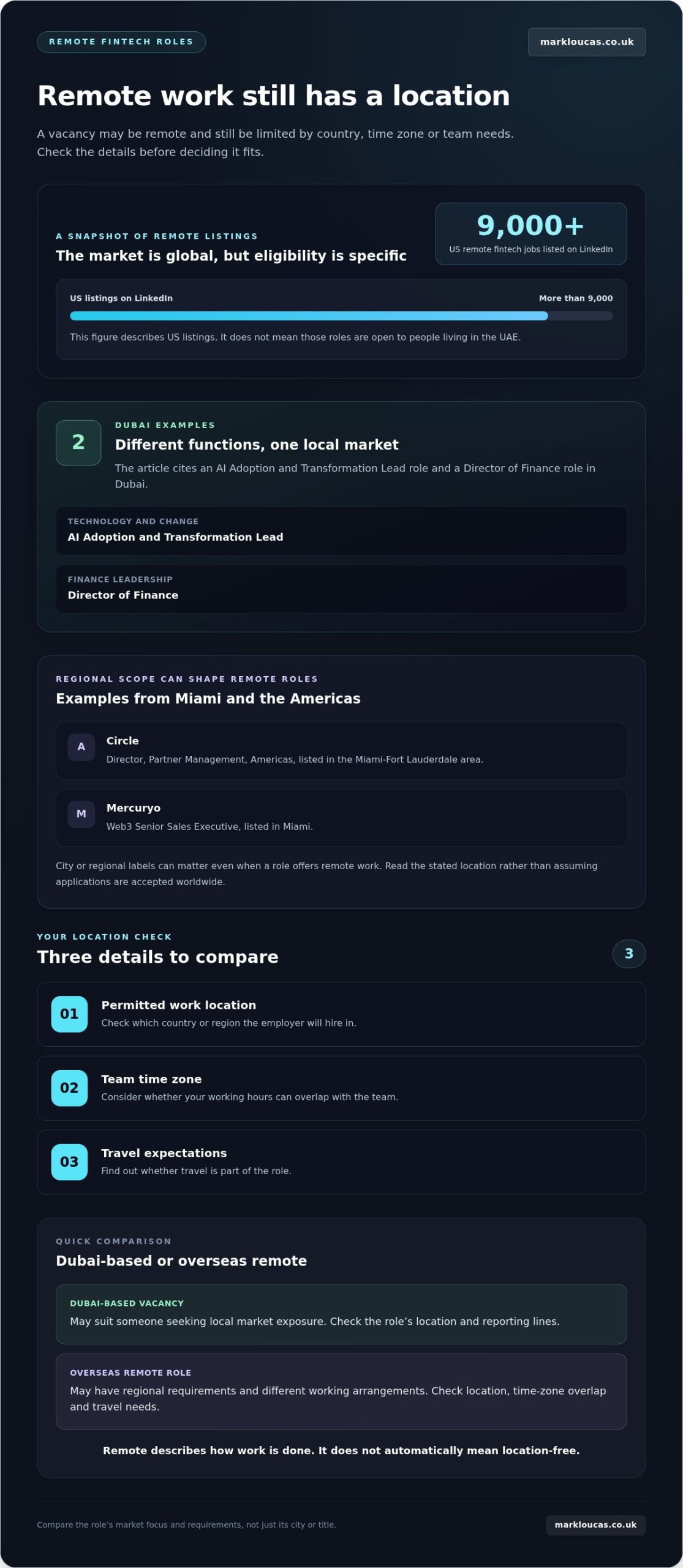
Remote does not always mean location-free. Employers may restrict hiring by country, time zone or team needs. For UAE professionals, a Dubai-based vacancy and an overseas remote role can differ in reporting lines and working arrangements. Read the stated location alongside the duties before deciding whether a role fits.
The UAE has visible fintech hiring activity in Dubai. Mark Loucas Ltd noted an AI Adoption and Transformation Lead role listed there on October 9, 2026, alongside a Director of Finance role in Dubai on August 26, 2026. These examples show varied functions within the local market.
Remote vacancies also span international markets. LinkedIn lists more than 9,000 remote fintech jobs in the United States. That figure describes US listings, not roles open to UAE residents. Treat the advertised location as a condition to understand, rather than assuming remote work means applications are accepted worldwide.
Some postings name a city or region despite offering remote work. A Director, Partner Management, Americas role at Circle appeared in the Miami-Fort Lauderdale area one day ago. Mercuryo listed a Web3 Senior Sales Executive role in Miami four weeks ago. Both examples show how regional scope can accompany remote arrangements.
For candidates, compare each vacancy against three practical details: permitted work location, the team’s main time zone and any travel expectations. A Dubai-based role may suit someone seeking local market exposure. An Americas-focused position may require substantial overlap with colleagues across that region.
For employers, location affects the candidate pool and recruitment process. Define eligible locations before advertising, then align interview times with candidates’ working hours. If a role serves customers across markets, specify the region and collaboration needs. Clear details help applicants assess fit before investing time in interviews.
Global hubs can also indicate which functions employers are building. Dubai’s listed AI transformation and finance roles point to distinct needs, while US listings include sales and partner management examples. Compare responsibilities, not just city names. A role’s market focus, reporting structure and required expertise matter as much as its remote label.
For UAE searches, map candidates by current location, relevant market knowledge and ability to work with the intended team. A focused location brief can clarify whether to prioritise Dubai-based professionals or consider a wider remote pool.
Successful recruitment relies on identifying candidates whose location and experience align with the stated market. Mercuryo listed a Web3 Senior Sales Executive role in Miami, Florida, four weeks ago, an example to assess by its sales remit and regional scope rather than by the remote label alone. For any listing, candidates can ask whether the location is an eligibility limit, a preferred base, or simply a reference point for the team. Employers can reduce uncertainty by stating those expectations plainly and explaining how work will be coordinated. Applicants should also check whether the responsibilities match the customers and markets they are expected to serve. This makes comparison more useful than treating remote vacancies as interchangeable, and helps both sides identify fit before progressing.
Matching candidates to roles based on individual requirements
Strong matching starts with the work itself, not a polished CV. Define the role’s essential skills, level of responsibility and practical outcomes before reviewing candidates.
Skills and qualifications screening
For fintech recruiters, screening should connect technical ability with the role’s daily tasks. A payments engineer may need experience integrating APIs, while a product manager may need evidence of prioritising a roadmap. Check qualifications against the work rather than treating a degree as a universal requirement. For a financial research role, candidates needed advanced Stata and MATLAB programming skills, and at least intermediate Python and/or R skills, according to Európai Unió.
Separate essential criteria from skills that can be developed. For a data role, assess programming, analytical reasoning and experience explaining findings. For a senior product position, look for examples of customer research, trade-off decisions and delivery ownership. Ask candidates to describe their contribution, the context and the result. This helps distinguish direct experience from broad claims.
Remote candidate assessment
Companies can assess remote candidates through a consistent sequence. Begin with a structured interview, then use a role-related exercise to see how each person approaches realistic work. A software candidate might review a sample integration problem, while a product candidate could explain how they would prioritise competing payment features.
Keep each exercise proportionate to the role. Share the task, expected format and assessment criteria in advance. During the interview, ask candidates to talk through their decisions, including assumptions and trade-offs. This reveals their reasoning, not just the final answer. A consistent scorecard helps interviewers compare evidence across applicants.
Remote assessment should also test communication relevant to the role. For example, ask an engineering candidate to explain a technical choice to a non-technical colleague. Ask a product candidate how they would align design, engineering and commercial teams. These examples show how candidates present complex information across distributed teams.
- Define the outcome: name the task the successful hire must own.
- Set core criteria: separate essential expertise from useful additional skills.
- Use consistent evidence: ask candidates the same key questions and score responses against agreed criteria.
For UAE employers, also assess whether candidates can work with the intended team’s location and communication practices. A technically strong applicant may still need a different working arrangement. State the role’s expectations clearly, then compare candidates against the same requirements. This keeps decisions focused on relevant evidence and the actual needs of the fintech business.
Fintech engineering and product roles
Engineering and product titles can conceal very different responsibilities. A software engineer may build payment integrations, while a product manager decides which customer problem the team should address. In UAE fintech hiring, compare the work, decision-making scope and required expertise rather than relying on the title alone.
Engineering roles often centre on building, maintaining or improving financial technology. For example, a Software Development Manager role at SALT Lending in Denver was listed two months ago. The title signals leadership alongside technical delivery. Candidates should assess whether a vacancy expects hands-on development, team management, architecture decisions or a combination of these.
Product roles require a different balance. Affirm listed a Senior Product Manager, Consumer Payments role in San Diego two weeks ago. It also listed a Senior Product Manager, 1: Many Merchant Growth role there one week ago. These titles suggest distinct product areas. A candidate should look for the customer group, product scope and growth responsibilities in each description.
For engineers, match your experience to the systems and outcomes named in the vacancy. Payment processing, digital banking platforms and data tools each call for different strengths. A useful application explains the system you worked on, your contribution and the problem you solved. Avoid listing technologies without showing how you applied them.
Product professionals can make their fit clearer by describing decisions and results. Explain how you identified a user need, set priorities and worked with engineering or design. For example, a payments product manager might describe balancing a smoother customer journey with operational requirements. Keep examples precise, and distinguish your decisions from the team’s wider work.
Use this simple comparison when reviewing a vacancy:
- Engineering: identify the systems, tools and delivery responsibilities involved.
- Product: identify the customers, roadmap ownership and measures of success.
- Leadership: establish whether the role manages people, technical direction, or both.
Fin, for example, listed a Product Manager role in New York ten months ago. The listing illustrates why candidates should read beyond a familiar title. Compare its responsibilities with the UAE role you are considering, including product ownership, customer type and team structure. Similar titles can describe different levels of authority and delivery expectations.
For employers, write separate criteria for engineering and product vacancies. An engineering brief should name the technical outcomes and decision rights. A product brief should describe the customer problem and roadmap remit. Then assess each applicant against those criteria using role-specific examples. This keeps interviews focused and helps candidates understand what success in the position requires.
Full-time and freelance opportunities
A remote vacancy may be permanent, fixed-term, contract or freelance. These arrangements differ in continuity, responsibilities and how work is organised. For a UAE candidate, identify the employment type before comparing the role with your priorities. “Remote” describes location, not the relationship with the employer.
Permanent roles suit professionals seeking an ongoing position within a fintech team. They may involve long-term ownership of a product, platform or function. A senior engineer, for example, could lead continuing improvements to payment infrastructure. A product manager might manage a roadmap as customer needs and business priorities evolve.
Contract and interim roles usually centre on a defined business need. A fintech might need temporary expertise for a platform change, product launch or team transition. Before applying, identify the expected deliverables, reporting line and project context. Clarify how the role’s duration and scope fit your next career step.
Freelance work can offer more control over project selection and working patterns. It can also require professionals to manage changing assignments and communicate their availability clearly. For example, a freelance product specialist could support a defined discovery phase, then move to another engagement. Consider whether this variety suits your working style.
Fintech Careers included a remote Head of Marketing role for Forex / Prop Trading, dated October 11, 2026. The listing illustrates why candidates should distinguish remote status from employment type. Read the vacancy for its stated arrangement, deliverables and location conditions. Then compare these with your preferred level of continuity and autonomy.
- Permanent: consider ongoing ownership and integration into a team.
- Contract or interim: focus on the project remit and expected outcomes.
- Freelance: assess assignment scope, independence and your preferred workload.
Employers should make the arrangement clear in each advert. State whether the role is permanent, contract, interim or freelance. Describe the responsibilities, expected outcomes and team relationships. For a remote engineering project, explain whether the person will maintain a platform or deliver a defined change. Clear wording helps attract relevant applicants and supports informed decisions.
For candidates, compare the full offer rather than the title alone. Ask how work is assigned, how success is assessed and how the role fits the team. For employers shaping a permanent or project-based search, discuss your fintech recruitment requirements.
A Strategic Enterprise Sales Executive (Remote) role at Snap Finance in West Valley City, Utah, was listed 16 hours ago. The listing is a reminder that a remote sales title does not, by itself, establish whether work is permanent, contract or freelance. Candidates can use the vacancy details to check the employment arrangement, expected responsibilities and how success will be assessed. For sales work, it is also useful to understand the scope of the role, the team or business relationships involved and how work is organised remotely. Employers can reduce uncertainty by stating the arrangement alongside the role title and location conditions. Candidates should seek clarification where those details are not clear, and consider whether the stated terms match their preferred continuity, independence and working pattern before deciding whether to apply.
Mark Loucas Permanent Fintech Recruitment
Mark Loucas Ltd supports fintech employers seeking permanent engineering and product professionals through Permanent Fintech Recruitment. For senior appointments, Fintech Executive Search can help define the leadership profile and focus the search. For project-based hiring, Fintech Providers Contract & Interim Solutions support contract and interim staffing needs.
Market Mapping & Intelligence helps employers understand the talent landscape before opening a search, including where relevant skills sit and how role requirements align with the candidate pool. This can help organisations building a remote team or refining a specific vacancy for the UAE market.
To discuss a fintech hiring requirement, contact Mark Loucas Ltd.
Shape your next fintech hiring move
A considered approach to recruiting for remote fintech roles starts with a precise brief. Define the contribution you need, the level of ownership involved and the working arrangement that suits your team. This gives candidates a clear basis for judging the opportunity and keeps the search aligned with your priorities.
Mark Loucas Ltd offers Permanent Fintech Recruitment, Fintech Executive Search and Fintech Providers Contract & Interim Solutions. These options support different hiring needs, from building an ongoing team to appointing senior talent or filling a project requirement. A focused conversation can clarify the search brief and appropriate recruitment route.
Discuss your remote fintech hiring needs with Mark Loucas Ltd, and take a considered next step towards the right appointment.
Frequently Asked Questions
How do fintech companies recruit internationally and manage time-zone coverage?
Fintech companies recruit internationally by defining eligible locations and the hours candidates must overlap with their teams. For example, a UAE-based team serving customers in several regions can identify essential handover points, then assess applicants’ ability to work within that schedule. Document core collaboration hours, meeting expectations and asynchronous handover practices in the role brief. This helps candidates understand how international collaboration will work before accepting the position.
What compliance and background checks are required when hiring fintech employees?
Employers commonly assess identity, employment history, qualifications and relevant experience, with checks tailored to the role. Handle candidate information carefully and distinguish internal screening from legal requirements.

Article by
Liam Henfrey
Liam Henfrey is a seasoned specialist in the payments and banking sectors with over two decades of experience. As the Founder and CEO of FINOPSIS and Managing Director at Mark Loucas Ltd, he advises organisations on complex financial operations and technology. His career includes senior roles at PwC, Deloitte, and Visa Europe.
Related Fintech Recruitment Guides
If you liked this guide then you may also like the following: