


The Role of a Fintech Engineer in a Growing Startup
In an era where digital infrastructure serves as the new gold standard for global finance, the distinction between a standard developer and a true fintech engineer has never been more pronounced. It’s a role defined by a rare synthesis of architectural rigour and financial agility. You likely recognise the immense pressure of managing high value transactions whilst navigating the intricate maze of legacy banking systems and modern APIs. It’s a world where a single line of code carries the weight of regulatory compliance and the absolute trust of a discerning clientele.
This exploration provides a curated look at the essential skills and strategic value that a fintech engineer brings to a growing startup within the sophisticated financial landscape of 2026. As London continues to account for over 70% of UK fintech hiring, the demand for such meticulous talent has reached an all-time high. We shall examine the unique technical stack required for modern finance, the nuanced soft skills needed to manage elite stakeholders, and why specialist recruitment remains the only reliable path to securing such rare, non-public opportunities. By the end, you will understand how these specialists act as the cornerstone of institutional excellence.
Key Takeaways
- Understand how a modern fintech engineer acts as a strategic bridge between financial services and sophisticated software architecture.
- Identify the essential technical standards and regulatory knowledge required to maintain secure, high-stakes payments infrastructure.
- Recognise the fundamental differences in risk tolerance and precision between traditional software development and financial engineering.
- Trace the professional trajectory from senior technical roles towards executive leadership positions such as Chief Technology Officer.
- Learn why specialist recruitment and market mapping are essential for uncovering elite talent within private, non-public networks.
To ensure your organisation attracts the highest calibre of technical leadership, please contact our specialist consultants for a confidential discussion regarding your requirements.
Defining the Modern Fintech Engineer
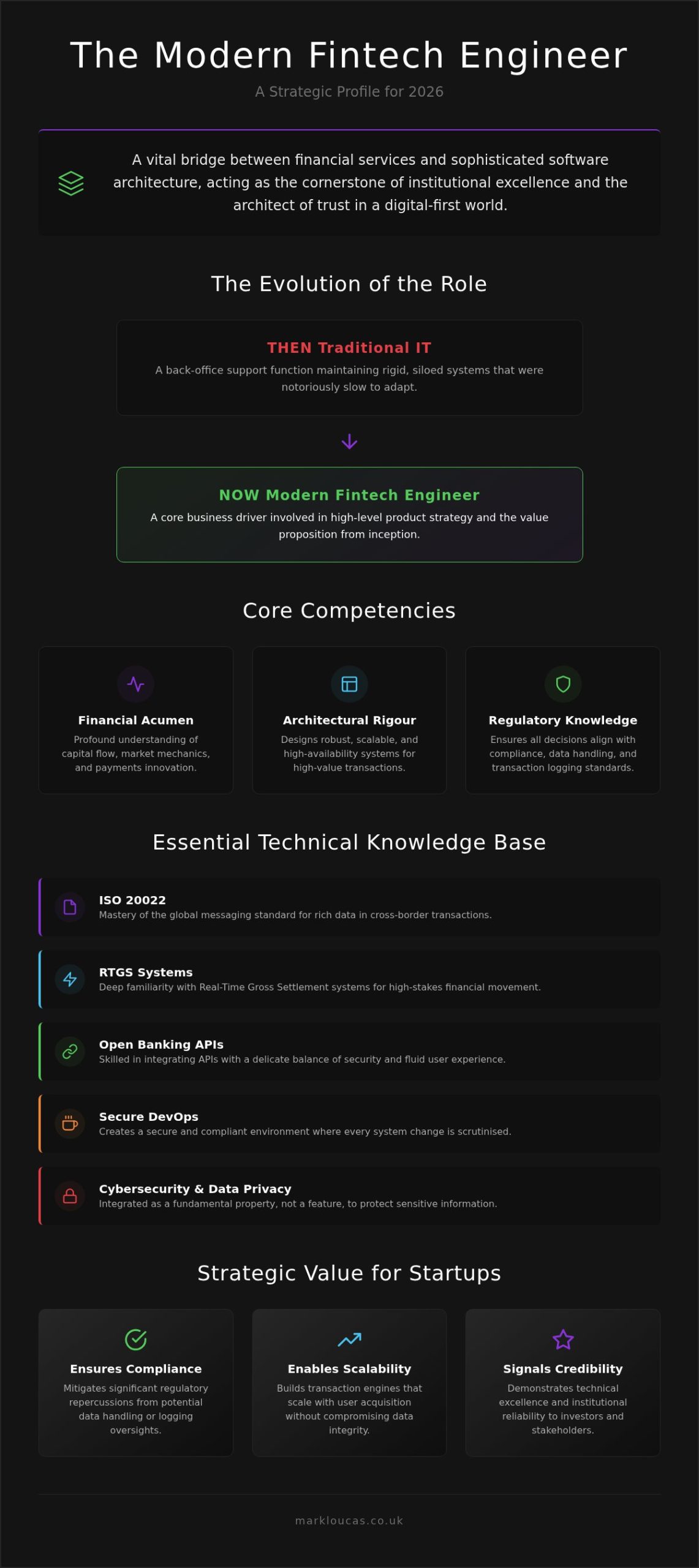
The role of a fintech engineer has transitioned from a supporting function to the very heartbeat of modern financial architecture. It’s a position that demands more than just proficiency in code; it requires a profound understanding of how capital flows through digital systems. These professionals act as a vital bridge, translating the complex requirements of Financial engineering into robust, scalable software that powers the global economy. In the fast paced environment of 2026, where London remains a dominant hub for fintech banking technology, these engineers ensure that high availability systems remain impervious to security threats whilst facilitating seamless transaction flows. They are the architects of trust in a digital first world, managing the immense pressure of high value transactions with a level of meticulous care that mirrors the highest standards of professional service.
The Evolution of Financial Technology Roles
Traditional banking IT often operated within the shadows of back office support, tasked with maintaining rigid, siloed systems that were notoriously slow to change. The modern fintech startup model has dismantled this hierarchy, placing technology at the forefront of the value proposition. Today, the fintech engineer is a core business driver, often involved in high level product strategy from the inception of a project. This evolution has birthed the full stack financial professional who possesses a deep intuition for market mechanics. These individuals don’t just build APIs; they understand the nuances of payments innovation and the delicate balance between fluid user experience and stringent security protocols. Their work ensures that digital banking platforms remain both elegant and resilient under the weight of global demand.
Why Every Growing Startup Needs a Specialist Engineer
For a burgeoning startup, every engineering decision is effectively a compliance decision. A specialist fintech engineer understands that a minor oversight in data handling or transaction logging can lead to significant regulatory repercussions that could jeopardise the entire venture. They build transaction engines that aren’t just fast, but are also designed to scale alongside rapid user acquisition without compromising data integrity. Beyond the technical benefits, having a seasoned specialist in your team acts as a powerful signal to investors. It demonstrates a commitment to technical excellence and institutional reliability. In an environment where precision is paramount, these engineers provide the architectural certainty that discerning stakeholders demand, ensuring the startup is prepared for the rigours of the global financial market.
To secure the technical leadership required for complex financial transitions, one must engage with advisors who understand the nuances of the current market. You may reach out to our team to discuss your specific hiring needs.
Technical Architecture and the Regulatory Knowledge Base
The architecture of a modern financial platform is a testament to meticulous craftsmanship. Every component must be designed with the understanding that security is not a feature but a fundamental property of the system. A skilled fintech engineer integrates DevOps practices that do more than just automate deployment; they create a secure and compliant environment where every change is scrutinised. This involves a sophisticated intersection of cybersecurity and financial data privacy, ensuring that sensitive information remains protected whilst maintaining the fluid performance expected in high performance banking. It’s about building a fortress that feels like a concierge service. Reliability is the silent partner of every successful transaction.
Mastering Payments Infrastructure and Protocols
In 2026, the migration to ISO 20022 has become a critical benchmark for technical excellence. This global messaging standard provides the rich data required for modern cross-border transactions, demanding that engineers possess a deep familiarity with its structure. Mastery of Real Time Gross Settlement (RTGS) systems is equally vital, as these represent the pinnacle of high-stakes financial movement. Integrating Open Banking APIs requires a delicate touch, balancing accessibility with the rigorous security implications of third-party data sharing. For firms seeking specialists in these high-stakes areas, our RTGS recruitment expertise offers access to a private network of vetted professionals who understand these protocols intimately.
Compliance as Code and Regulatory Technology
The concept of compliance as code has revolutionised how startups approach the Financial Conduct Authority (FCA) guidelines. Rather than treating regulation as a hurdle, the elite fintech engineer automates compliance checks directly within the development lifecycle. This proactive approach ensures that every release adheres to the highest standards of financial conduct without slowing down the pace of innovation. Central to this is the creation of immutable audit trails, providing a transparent and undeniable history of every transaction and system change. This level of detail is essential for building the long-term trust required to succeed in a competitive landscape. Finding engineers who can navigate these regulatory waters requires a tailored recruitment strategy that prioritises niche expertise over generalist skills.
To ensure your technical team is composed of the finest talent in the industry, please contact our consultants for a personalised consultation.
Comparing Fintech Engineering and Traditional Software Development
The fundamental divergence between general consumer technology and financial systems lies in the tolerance for failure. Whilst a glitch in a social media application might result in a minor inconvenience for users, a single bug within a financial ledger can lead to catastrophic financial loss and irrevocable damage to a brand’s reputation. This reality dictates a technical architecture focused on immutability and correctness rather than mere feature velocity. A professional fintech engineer understands that the “move fast and break things” ethos, popularised in certain tech circles, is fundamentally incompatible with the stewardship of private capital. In this environment, excellence is measured by the absence of errors rather than the frequency of updates.
The Culture of Precision and High Stakes
Successful engineering in this sector requires a “measure twice, cut once” mentality that prioritises architectural integrity over rapid deployment. The psychological profile of an elite engineer is defined by a meticulous attention to detail and a calm temperament when managing high pressure environments. Coding proficiency, whilst essential, must be matched by a deep understanding of the financial domain. This dual expertise allows the engineer to anticipate edge cases that a generalist might overlook, such as complex currency rounding errors or subtle race conditions in transaction processing. It is this rare combination of technical skill and financial intuition that defines the most sought after professionals in the market.
Performance Metrics and Technical Excellence
Within the world of payments and high frequency trading, latency is not merely a performance metric; it is a high stakes indicator of system health. To achieve the necessary low latency, many startups are turning to languages like Rust or Go, which offer the memory safety and concurrency required for high performance financial kernels. These languages provide the precision needed to handle thousands of transactions per second with absolute reliability. Maintaining such sophisticated environments requires specialised DevOps roles that focus on building resilient, self-healing infrastructure. Finding the individuals capable of operating at this level requires a recruitment partner who understands the rarity of these skills and can navigate the private networks where such talent resides.
If you are a senior professional seeking to transition into a leadership role within the financial sector, please get in touch with our executive search team to explore exclusive, non-public opportunities.
Building a Successful Career in Fintech Engineering
A career in this sector is as much about strategic foresight as it is about technical mastery. For a senior fintech engineer, the professional trajectory often leads towards the boardroom, where technical decisions are weighed against commercial risks and regulatory demands. Continuous learning is essential, particularly as we move through 2026, where the integration of AI and evolving FCA guidelines require constant vigilance. A successful professional must build a portfolio that reflects not just their ability to write clean code, but their capacity to solve complex financial problems with precision and elegance. This evolution requires a shift from being a hands on developer to becoming a strategic advisor who understands the broader business context.
From Senior Developer to Technical Leader
The transition from a senior technical role into the territory of executive search requires a fundamental shift in perspective. As a technical leader, you are no longer merely building the infrastructure; you are shaping the very roadmap of the business. This involves a deep understanding of the competitive landscape, often achieved through meticulous market mapping to identify emerging trends and talent gaps. Soft skills, particularly stakeholder management and clear communication, become your primary tools as you translate technical complexities into actionable business strategies for non-technical founders and investors. Your value lies in your ability to provide architectural certainty whilst aligning with the commercial goals of the startup.
The Importance of Networking and Niche Expertise
Networking remains a cornerstone of professional growth within the prestigious London ecosystem. Industry events offer invaluable opportunities to connect with peers and stay abreast of innovations in areas such as Insurtech or digital banking. However, the most exclusive roles are rarely advertised on public job boards. Engaging with a boutique advisor who understands your specific niche is the most effective way to access these private opportunities. By focusing on a specialised area, you distinguish yourself as a rare expert in a sea of generalists. This focused expertise, combined with a reputation for meticulous care, ensures you remain a sought after figure for high stakes leadership positions. If you are ready to elevate your career, our specialist recruitment consultants are available to guide you through the next stage of your professional journey.
To secure the elite talent required for your organisation’s next phase of growth, please contact our specialist advisors for a private consultation regarding your requirements.
Strategic Talent Acquisition for High Performance Engineering Teams
Sourcing a senior fintech engineer is an exercise in discretion and architectural precision. In the competitive landscape of 2026, where London remains the epicentre of financial innovation, the most exceptional individuals are rarely actively seeking new roles. They are often deeply embedded in high stakes projects, making them invisible to the standard, volume driven methods of generalist agencies. Finding these professionals requires a sophisticated approach that combines deep market intelligence with a refined understanding of technical architecture. It is about identifying the specific individual whose expertise aligns perfectly with your startup’s unique challenges, ensuring they possess both the technical rigour and the financial intuition necessary for institutional success.
The Limitations of Traditional Recruitment
Generalist recruitment firms often lack the technical depth to distinguish between a standard developer and a high performance specialist. When the stakes involve high value transactions and complex regulatory frameworks, a superficial assessment is simply insufficient. Elite engineers value their privacy and tend to engage only with specialist fintech technology recruiters who can speak their language with authority. These recruiters understand the nuances of payments infrastructure and the immense pressure of managing immutable ledgers. They provide a level of curated service that respects the time and expertise of the candidate whilst delivering precise, vetted results for the client. This bespoke approach ensures that only the most qualified individuals reach your interview process.
Finding Your Next Lead Engineer with Mark Loucas
Mark Loucas Ltd specialises in the discreet, senior level executive search required to build world class engineering teams. Our approach is unhurried and meticulous, focusing on quality over quantity to ensure a perfect match. Through comprehensive market mapping, we identify the best talent currently in post, often within non public networks that remain inaccessible to the broader market. This intelligence allows us to act as a boutique advisor, providing talent advisory services that support your long term growth and stability. We ensure that every placement is a perfect cultural and technical fit, providing the architectural leadership necessary for your startup to thrive in an evolving landscape. A strategic partnership with a specialist ensures that your interests remain the sole focus of our attention.
To secure the technical leadership required for your organisation’s next phase of growth, please contact our specialist advisors for a private consultation regarding your requirements.
The Future of Institutional Excellence in Fintech
The financial landscape of 2026 demands a professional who understands that every line of code is a commitment to regulatory compliance. We have seen how the modern fintech engineer acts as the vital bridge between sophisticated financial services and robust software architecture. These specialists don’t merely maintain systems; they build the foundational trust required for high value transactions. From navigating the complexities of ISO 20022 to mastering RTGS protocols, their expertise remains the primary driver of institutional stability.
Mark Loucas Ltd has provided specialised fintech recruitment since 2011, offering a boutique approach to executive search that prioritises quality and discretion. Our deep knowledge of RTGS systems ensures we identify only the most meticulous talent for your leadership team. We invite you to contact our specialist team today to discuss your senior fintech engineering requirements and discover how a tailored partnership can elevate your business. The right technical architect is the key to your enduring success.
Frequently Asked Questions
What is the typical salary for a senior fintech engineer in London in 2026?
Senior fintech engineer salaries in London remain amongst the most competitive in the European technology market, reflecting the specialist knowledge required to operate within regulated financial environments. Exact figures shift with market conditions, the specific discipline involved, and the seniority of the role, so it’s always worth consulting a specialist recruiter who monitors live compensation data across payments, digital banking, and broader fintech infrastructure to get an accurate picture.
Do I need a finance degree to become a fintech engineer?
No, a finance degree is not a prerequisite for becoming a fintech engineer. Most hiring teams prioritise demonstrable engineering ability, relevant technical experience, and a genuine understanding of financial systems over formal finance qualifications. A degree in computer science, mathematics, or a related discipline is far more commonly seen. What matters most is your ability to build reliable, compliant, and scalable systems within a fast-moving financial context.
Which programming languages are most in demand for fintech roles?
Python, Java, and Go are consistently sought after across fintech engineering roles, particularly in payments infrastructure and digital banking platforms. Scala also carries strong demand in data-intensive environments. The precise language requirements vary by company and product, so it’s sensible to review role specifications carefully. Engineers who combine core language proficiency with an understanding of API design, cloud architecture, and security principles tend to be the most competitive candidates.
How does ISO 20022 affect the work of a fintech engineer?
ISO 20022 is the global messaging standard reshaping how financial institutions exchange payment data, and it has a direct and practical impact on a fintech engineer’s daily work. Engineers involved in payments infrastructure must understand its richer data structures and ensure their systems can process, validate, and route messages that conform to the standard. Migration projects have created significant demand for engineers with hands-on ISO 20022 experience across both established institutions and growing startups.
What is the difference between a fintech engineer and a bank developer?
A fintech engineer typically operates within a faster-moving, product-led environment where deployment cycles are shorter and the expectation to own outcomes end-to-end is considerably higher. A bank developer often works within larger, more structured organisations with established legacy infrastructure and more defined change management processes. The core engineering skills overlap substantially, but the pace, the tooling, and the cultural expectations can differ quite markedly between the two settings.
Can a software engineer from a different industry transition into fintech?
Yes, and it happens regularly. Engineers from sectors such as e-commerce, telecommunications, or enterprise software often bring highly transferable skills in distributed systems, API development, and cloud infrastructure. The most successful transitions tend to involve candidates who invest time in understanding financial regulation, payment flows, and data security requirements. Demonstrating that contextual awareness, even through self-directed learning or side projects, can make a meaningful difference when competing for senior fintech engineering roles.
Why should a startup use a specialist recruiter for engineering roles?
A specialist recruiter with deep roots in the fintech talent market can access candidates who aren’t actively browsing job boards, which is particularly valuable when hiring for senior or niche engineering positions. Firms like Mark Loucas combine market mapping intelligence with an established network built since 2011, giving growing startups a meaningful advantage. Generic recruiters rarely hold the domain knowledge needed to assess whether a candidate’s experience genuinely maps to the demands of payments or digital banking engineering.
What are the most important soft skills for a fintech engineer?
Beyond technical ability, the most effective fintech engineers tend to communicate clearly with non-technical stakeholders, understand the commercial implications of their architectural decisions, and adapt quickly when regulatory or product requirements shift. Intellectual curiosity and a disciplined approach to risk are equally important, given the compliance-sensitive nature of financial systems. Engineers who can balance speed with rigour, and who take ownership of outcomes rather than simply completing tasks, consistently stand out in this sector.

Article by
Liam Henfrey
Liam Henfrey is a seasoned specialist in the payments and banking sectors with over two decades of experience. As the Founder and CEO of FINOPSIS and Managing Director at Mark Loucas Ltd, he advises organisations on complex financial operations and technology. His career includes senior roles at PwC, Deloitte, and Visa Europe.
Related Fintech Recruitment Guides
If you liked this guide then you may also like the following: