


Measuring the ROI of a Key Hire in Fintech
A senior payments specialist joins a UAE fintech, but months later the leadership team still disagrees about whether the appointment has paid off. The recruitment spend is clear; the value created is harder to separate from wider business results. That is the challenge at the heart of measuring the roi of a key hire, an area where specialists at Mark Loucas Ltd frequently advise growing firms.
Salary and recruitment costs matter, but they tell only part of the story. A specialist may improve a critical process, strengthen risk oversight or help a team deliver a strategic priority. Without agreed measures, stakeholders may judge the same hire by very different standards.
This guide explains how to assess a key hire’s business impact, account for the full investment and use the findings in future hiring decisions. Set role-specific measures before someone joins, consider financial and operational outcomes together, and review evidence over a period suited to the expected contribution. The result is a clearer basis for workforce planning in the UAE fintech market.
Key Takeaways
- Start with the business problem the role is meant to solve, then agree expected outcomes, a baseline and evidence sources before recruitment begins.
- When measuring the roi of a key hire, compare attributable results with the full investment, rather than relying on salary or one headline metric.
- Pair early signs of progress, such as delivery milestones, with later business outcomes to build a balanced view of contribution.
- Make comparisons fair by assessing the hire against the role’s own baseline and objectives, with a review period suited to the expected contribution.
- Use role definition, market mapping and talent advisory to support considered hiring decisions across fintech, payments and digital banking.
If you’re weighing the impact of a pivotal appointment, discuss a key hire with Mark Loucas.
What measuring the ROI of a key hire really means
Leaders need evidence that a significant appointment is advancing business priorities, not simply filling a vacancy. In a UAE fintech, that could mean building the capability to improve payment operations, supporting a digital banking initiative or strengthening risk oversight. Clear measures help decision-makers assess whether the role is delivering the contribution it was created to make.
At its simplest, Return on investment (ROI) compares the value of outcomes with the investment required to achieve them. For a hire, the useful question is which results can reasonably be linked to the role, and how they compare with the full cost of recruiting and employing that person. Agreeing this before recruitment gives stakeholders a shared basis for review.
Time to hire and source of hire describe the recruitment process. They can show how quickly a vacancy was filled or where a candidate came from, but not whether the person improved a business outcome. Quality of hire can be more relevant, but it still needs role-specific evidence. Measuring the ROI of a key hire means connecting the person’s contribution to agreed objectives, while recognising that colleagues and market conditions can also affect results.
What counts as a key hire in a fintech business
A key hire is someone whose remit connects directly to a significant strategic, operational or specialist objective. This could be a payments professional tasked with improving a critical process, a digital banking specialist supporting a platform change, a risk expert strengthening oversight, or a technology hire responsible for a core system. Seniority alone doesn’t determine importance. The role’s objectives do.
Define the expected contribution in practical terms before assessing candidates. Clarify which business process, capability or delivery goal the role will affect. This makes it easier to distinguish the value of the appointment from general team activity once the person is in post.
Why salary alone is not the investment
The investment may include recruitment costs, onboarding, employment costs, equipment and training. Internal time spent defining the role, interviewing and supporting the new hire can also be relevant if it is recorded. If reliable data is available, consider delayed contribution too, such as work that remains outstanding while the role is vacant or the person is getting established.
For a UAE-based assessment, record relevant monetary inputs consistently in AED. Separate one-off recruitment and onboarding items from recurring employment costs. Include internal time or delayed contribution only where there is a reasonable basis for estimating it, and avoid implying precision when the evidence is incomplete.
Cost tells you what the appointment required; ROI considers what the role returned against that investment. This keeps the review focused on business impact, rather than treating a lower hiring cost or faster recruitment process as proof of a successful appointment.
If you’re planning a pivotal appointment, discuss a key hire and the business outcomes the role needs to support.
For help defining a specialist fintech role, talk to Mark Loucas about the objectives behind your search.
How to measure the ROI of a key hire step by step
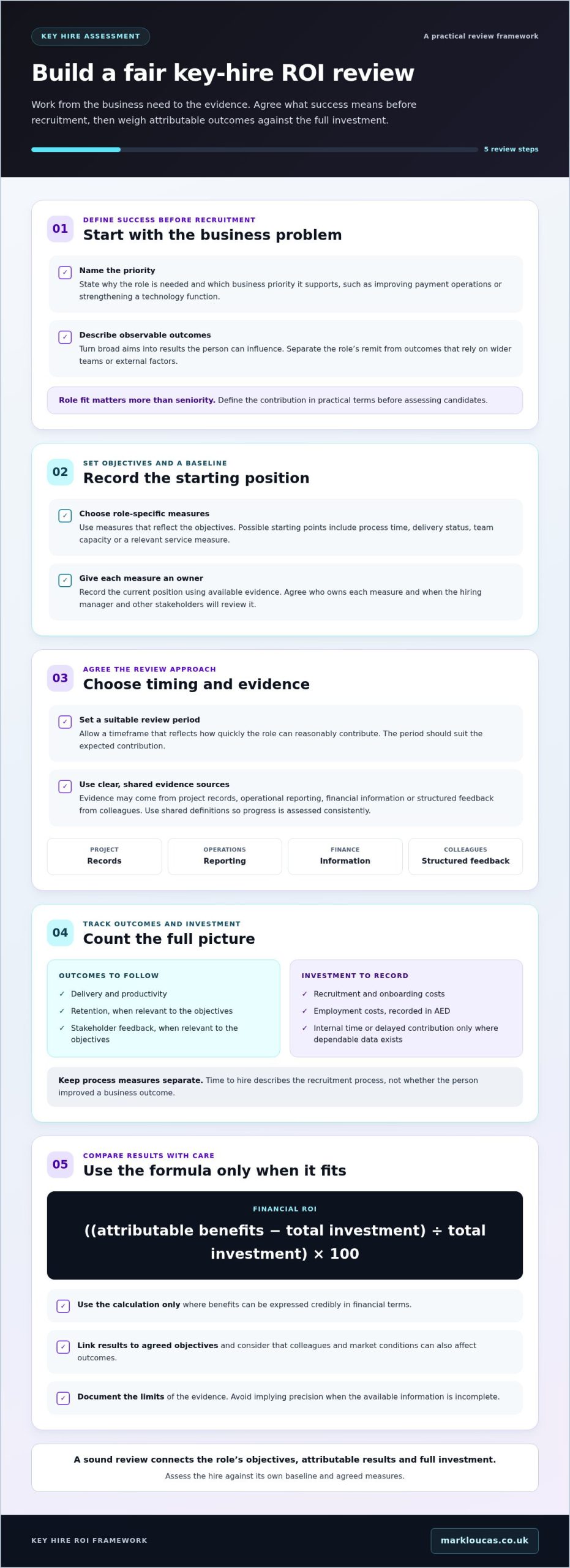
A useful review starts before recruitment, when leaders can still define what the role is expected to change. Measuring the roi of a key hire then becomes a structured comparison, rather than a judgement made after the event. Use these steps to agree what success means, gather evidence consistently and make the limits of the analysis clear.
- Define the business problem. State why the role is needed and which business priority it supports. Translate broad aims, such as improving payment operations or strengthening a technology function, into observable outcomes the person can influence. Be clear about what sits within the role’s remit and what depends on wider teams or external factors.
- Set objectives and a baseline. Choose measures that reflect the role, then record the current position using available operational or commercial evidence. This might include an existing process time, delivery status, team capacity or a relevant service measure. Assign an owner to each measure and agree when the hiring manager and other stakeholders will review it.
- Agree the review period and evidence sources. Set a timeframe that reflects how quickly the role can reasonably contribute. Identify where evidence will come from, such as project records, operational reporting, financial information or structured feedback from colleagues. Use shared definitions and data sources so stakeholders assess progress consistently.
- Track outcomes alongside the full investment. Record relevant recruitment, onboarding and employment costs in AED, together with internal time or delayed contribution where dependable data exists. Track delivery and productivity, and consider retention or stakeholder feedback when they relate to the role’s objectives. Keep process measures, such as time to hire, separate from the business outcomes being assessed.
- Compare results and document the limits. A simple financial formula is ROI = ((attributable benefits − total investment) ÷ total investment) × 100. Use it only where benefits can be expressed credibly in financial terms. The Human Capital ROI framework offers a wider way to consider employee contribution, but a single figure still won’t capture every strategic or operational result.
A baseline turns later progress into a comparison, rather than an impression. At each review, note what changed, the evidence behind it and any assumptions used to value the result. A project milestone may be observed directly; attributing a wider financial improvement to one person requires more caution. Record other influences, such as team effort or changed priorities, and avoid claiming the hire was the sole cause.
Used consistently, this process gives leaders a more balanced basis for role design and workforce decisions. If you’re shaping measures for a specialist fintech appointment, discuss the role’s objectives with Mark Loucas.
For support defining success for a specialist appointment, talk through the expected outcomes.
Which measures show whether a key hire is creating value
No single measure can capture a key hire’s full contribution. Choose indicators that match the role’s agreed objectives, then consider early signs of progress alongside later business outcomes. A technology hire supporting a platform change, for example, may first meet delivery milestones, while the effect on operational performance takes longer to emerge.
The table offers a starting point, not a standard scorecard. Select measures that relate to the role and have credible evidence behind them. This makes measuring the roi of a key hire more useful than applying the same generic recruitment metrics to every appointment.
| Measure | What it can reveal | Limitation |
|---|---|---|
| Delivery milestones | Whether agreed projects or stages are progressing | Completion alone may not show lasting business value |
| Quality of work | Whether outputs meet agreed standards or reduce rework | Assessment can be subjective without clear criteria |
| Productivity or process performance | Whether a relevant workflow or team capacity has changed | Other team members, tools or process changes may affect results |
| Commercial or operational outcomes | Whether the role is contributing to a defined business result | Attribution may be difficult when several factors contribute |
| Retention and manager feedback | How well the person is settling in and working with the team | Neither measure proves business return on its own |
Use delivery milestones as leading indicators. They show whether someone is progressing towards an objective before a wider result is visible. Later outcomes might include a sustained change in a relevant process or progress against an agreed commercial goal. Review both, but don’t treat an early milestone as proof that the intended business benefit has already been realised.
Compare delivery, quality and retention measures
Set milestones that reflect the remit, such as completing an agreed implementation stage or improving a defined handover process. Pair them with quality checks, so speed or volume isn’t mistaken for effective delivery. Retention and manager feedback can add context about fit and working relationships, but they should support, not replace, evidence tied to business objectives. This is particularly relevant in specialist areas supported by payments industry recruitment.
Include opportunity costs and wider team effects
Vacancy-related delays, postponed work or operational bottlenecks may matter if the business has recorded their effect. Consider dependencies too: a new hire may rely on decisions, access or support from other teams. Changes in demand, priorities or market conditions can also influence outcomes. Note these factors alongside the results, rather than assigning every change to one person.
Read several indicators together: milestones show progress, outcomes show impact, and context helps explain the difference. This balanced view gives stakeholders a firmer basis for interpreting the evidence. If you’re setting measures for a fintech appointment, discuss the role and its objectives.
If you’re reviewing a specialist appointment, discuss how to assess its contribution.
How to make key-hire ROI comparisons fair and useful
A comparison is useful only if it reflects the role’s purpose and the conditions in which the person worked. A payments specialist and a technology lead may both be key hires, but their objectives, evidence and paths to contribution will differ. Measuring the roi of a key hire fairly means assessing each appointment against its own agreed objectives and starting point, not ranking unrelated roles against one another.
Use a consistent framework for recording evidence, while allowing the measures themselves to fit the role. For each review, note the objective, agreed indicator, baseline, review period and people who contributed to the outcome. This preserves a common standard without forcing every appointment into an identical scorecard.
Avoid common attribution and comparison errors
Results rarely belong to one person alone. A new hire may help deliver a project, but the outcome may also depend on colleagues, leadership decisions, technology or changing customer demand. Record those dependencies and changes in context. If a target shifts during the review period, explain when and why, rather than comparing the final result with an unchanged expectation.
A quick appointment, low recruitment cost or strong retention should not be treated as a complete measure of business value. These may offer useful context, but they don’t show by themselves whether the role advanced its intended priority. Define terms such as “delivery completed” or “improved performance” consistently across reviews, and keep process efficiency separate from the hire’s contribution to business outcomes.
Time matters too. Some roles show early progress through completed work or improved handovers, while the broader effect may take longer to emerge. Review evidence at intervals suited to the responsibility, and distinguish a delayed result from one that is unlikely to materialise. This reduces the risk of judging a strategic appointment too soon or extending the review period without a clear reason.
Use findings to improve future workforce decisions
After reviewing the evidence, identify which assumptions held up. Did the role require the level of specialist experience anticipated? Were its responsibilities clear, and did the success measures reflect the work the person was asked to do? These findings can help refine future role briefs, priorities and assessment criteria. If outcomes fell short, examine whether the cause was role design, changing business needs, support or execution before drawing conclusions about the hire.
Market mapping can add context to future workforce planning by clarifying how specialist skills sit within the talent market. Combined with talent advisory, it can help leaders consider the capabilities the business needs and how a proposed role fits those requirements. These services inform the decision, rather than guaranteeing a particular hiring result.
Fair comparisons rely on consistent methods, not identical expectations. Apply the same discipline to evidence and attribution, then let each role’s objectives shape the measures. To consider how a specialist fintech appointment fits your workforce plans, discuss your hiring objectives.
If you’re considering a specialist appointment, discuss the business priorities it needs to support.
How specialist fintech recruitment supports a stronger investment case
In payments, digital banking and fintech, a role can be difficult to define using a generic job description. The skills required may be closely tied to a particular system, process or business objective. A considered recruitment process helps leaders clarify what the role must deliver before assessing candidates, giving them a stronger basis for setting measures and reviewing the appointment later.
Role definition is the starting point. Set out the business need, the responsibilities within the hire’s control and the outcomes the role is expected to influence. Market mapping can then help build a view of relevant skills and talent in the market, while talent advisory can support workforce planning and the decisions behind a hiring brief. These services help make the decision more deliberate.
Match the hiring approach to the role and business need
Permanent recruitment can be structured in different ways to suit the search. Mark Loucas offers contingent recruitment on a “no win, no fee” basis, exclusive recruitment as a sole external recruitment partnership, and retained search for senior or confidential roles. The appropriate approach depends on the role, search requirements and level of collaboration needed.
Contract and interim solutions can suit a defined project, temporary capability need or requirement for additional resource. The measurement plan should reflect that scope: agree the deliverables, timeframe and evidence of completion at the outset, rather than assessing a time-limited appointment against permanent-role expectations. Managed fintech recruitment services can also support organisations coordinating recruitment activity alongside operational processes.
Specialist recruitment can sharpen the link between candidate assessment and business need. A payments role may call for experience aligned with a particular operational priority, while a digital banking appointment may be tied to a defined technology or delivery objective. Clear criteria help stakeholders assess relevant capability consistently and later compare contribution with the original purpose of the hire.
Turn the ROI review into practical next steps
Keep the review useful for decision-makers by bringing the evidence together in a concise record. Note the original objectives, selected measures, baseline, evidence sources, total investment, assumptions and review timing. Include context that affected delivery, such as shared ownership or a change in business priorities. This makes the conclusion easier to interpret and revisit.
Then use the findings to refine future role briefs and workforce plans. If the evidence shows that a capability was central to delivery, make that requirement clearer next time. If the expected contribution depended on support from other teams, reflect that in the role design and measures. Measuring the roi of a key hire is most useful when it informs the next decision, not simply when it produces a retrospective score.
Mark Loucas Ltd supports fintech, payments and digital banking recruitment through permanent recruitment, executive search, contract and interim solutions, market mapping and talent advisory. To discuss a fintech hiring requirement and the outcomes you want to assess, speak with Mark Loucas Ltd.
For support with a fintech search shaped around your business objectives, discuss your hiring requirement.
Make your next fintech hire a considered investment
Make ROI part of the hiring decision from the outset. Agree what the role needs to change, how that change will be assessed and when the evidence will be reviewed. This gives leaders a clearer basis for deciding whether to refine the role, invest in similar capabilities or adjust future workforce plans. In the UAE fintech market, that discipline helps connect specialist appointments to lasting business priorities.
Mark Loucas Ltd has operated since 2007, supporting specialist recruitment and executive search across fintech, payments and digital banking. The firm has access to the top 5% of passive UAE fintech professionals. With clear role definition and a considered measurement plan, measuring the roi of a key hire can inform better decisions beyond a single appointment.
A clear investment case starts with the right conversation. Discuss your fintech hiring needs with Mark Loucas.
Frequently Asked Questions
How do you calculate the ROI of a key hire?
Compare the value of outcomes reasonably linked to the hire with the full investment, then divide the net benefit by that investment and multiply by 100. The result is a percentage, but it’s only as reliable as the evidence and assumptions behind it. When measuring the roi of a key hire, show the calculation alongside relevant non-financial outcomes rather than forcing every contribution into a monetary estimate.
What costs should be included when measuring a hire’s ROI?
Include recruitment fees, internal hiring time, onboarding, training, equipment and relevant employment costs. Separate one-off expenses from ongoing costs, and use actual figures recorded in AED. Check that costs aren’t counted twice, such as including onboarding time in both a general internal-cost estimate and as a separate item. If an input is estimated rather than recorded, label it clearly so decision-makers can judge its effect on the result.
How long should you wait before measuring the ROI of a key hire?
There’s no single review date that suits every role. Set checkpoints around the work itself, such as completion of an initial delivery stage and the point when a business outcome could reasonably be observed. A project-based appointment may have clear deliverables, while a specialist building a new capability may need a longer view. Keep interim reviews focused on progress and reserve final judgements for evidence relevant to the role’s remit.
Which metrics are useful for measuring quality of hire?
Useful measures depend on the role, but can include progress against agreed competencies, quality of completed work, rework or error patterns, delivery milestones and feedback from people who rely on the role’s output. For a technology specialist, stakeholders might assess whether a defined technical deliverable meets its acceptance criteria. Use consistent assessment criteria and evidence, rather than relying on a manager’s overall impression or a single performance measure.
Can you measure the ROI of a hire when results depend on a team?
Yes. Assess the hire’s contribution within the team result, rather than claiming the person produced the outcome alone. For a shared project, record the individual’s responsibilities, completed work, dependencies and contributions from colleagues. Compare this account with project records and feedback from relevant stakeholders. If the evidence supports only a qualitative judgement, report that clearly instead of assigning an artificial percentage of the result to the hire.
What if a key hire’s impact is difficult to quantify financially?
Use credible operational or strategic evidence even if it can’t be converted into money. For example, record whether a specialist completed a critical assessment, established a needed capability or reduced reliance on manual work, provided those outcomes relate to the role’s objectives. Describe the evidence and its limits, and indicate how confident stakeholders are in the link to the hire. A transparent qualitative assessment is more useful than a precise-looking but unsupported figure.
Is cost per hire enough to measure the return on recruitment?
No. Cost per hire can help track recruitment expenditure, but it doesn’t establish whether the appointment contributed to business priorities. A lower-cost process could still lead to a mismatch, while a specialist hire’s broader contribution may not appear in recruitment data. Treat the measure as one input, then review the person’s role-related outcomes and the investment required to support them. This separates hiring efficiency from the value created after appointment.
How can fintech businesses make key-hire ROI reviews more consistent?
Use a shared review record for each appointment, with fields for the business objective, role-specific measures, evidence sources, review dates, cost assumptions and contextual changes. Ask the hiring manager and relevant finance or operational stakeholders to use the same definitions when assessing results. Keep the template consistent, but allow measures to vary by role. This makes reviews easier to compare over time without treating distinct fintech responsibilities as identical.

Article by
Liam Henfrey
Liam Henfrey is a seasoned specialist in the payments and banking sectors with over two decades of experience. As the Founder and CEO of FINOPSIS and Managing Director at Mark Loucas Ltd, he advises organisations on complex financial operations and technology. His career includes senior roles at PwC, Deloitte, and Visa Europe.
Related Fintech Recruitment Guides
If you liked this guide then you may also like the following: