


CPO Job Description: Define the Chief People Officer Role
A strong Chief People Officer job description defines the executive’s remit across people strategy, culture and talent, and makes the reporting line clear. To understand how to write a job description for a CPO, connect these responsibilities to the organisation’s priorities, then specify the experience, qualifications, work terms and measures of success the role requires. The CPO typically reports to the Chief Executive Officer and sits on the executive team.
The title alone does not show how much influence the role should have. A useful description explains how the CPO works with senior leaders, supports the workforce and builds the organisational capabilities needed to deliver the business strategy.
This guide covers the role’s purpose and reporting structure, strategic people and culture responsibilities, candidate requirements, employment terms and compensation. Use it to define the position in a way that reflects your organisation and gives senior candidates a precise view of the opportunity.
Key Takeaways
- Define the Chief People Officer’s purpose around the organisation’s people strategy, culture and talent priorities.
- Make the reporting line and executive relationships clear, including how the role partners with the CEO and leadership team.
- Set out the experience and qualifications that fit the remit, distinguishing essential requirements from advantageous ones.
- Describe the employment arrangement, work location and compensation structure in terms suited to the organisation and role.
- Connect responsibilities to measurable outcomes, such as employee engagement, retention and succession planning.
If you are shaping a senior fintech leadership search, discuss your recruitment needs with the team.
Candidate experience, skills and qualifications
Here, CPO means Chief People Officer, not Chief Product Officer. Define the candidate profile around the organisation’s people priorities, leadership structure and workforce needs. A clear approach to how to write a job description for a CPO starts with the capabilities the role genuinely requires.
CPO Experience and Qualifications
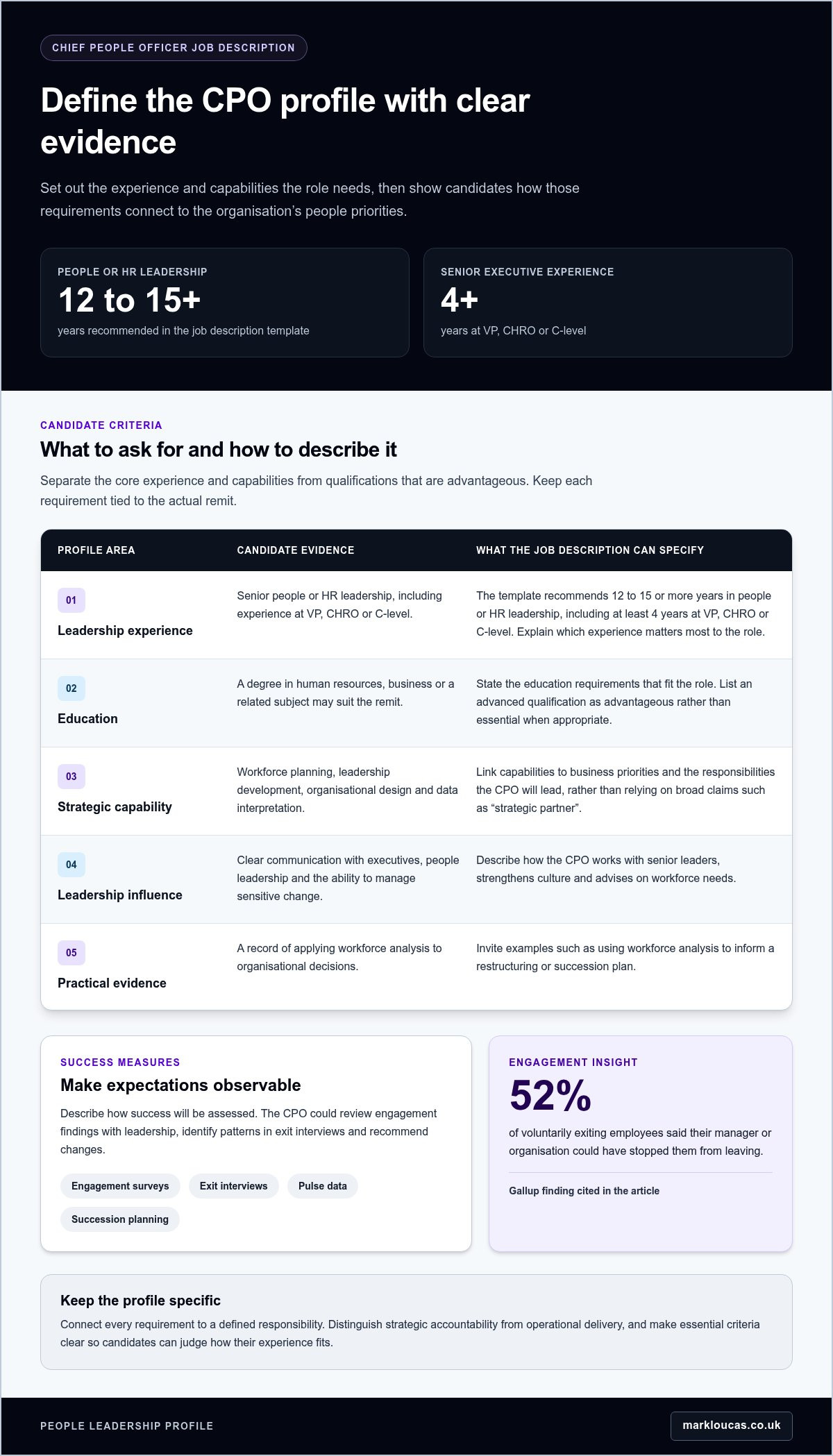
A suitable CPO brings senior people leadership experience, relevant education and a record of shaping organisational capability. A job description template recommends 12 to 15 or more years in people or HR leadership, including at least 4 years at VP, CHRO or C-level. Explain which experience matters most, such as leading workforce planning through organisational change.
State the education requirements in a way that fits the role’s remit. A degree in human resources, business or a related subject may be relevant, while an advanced qualification can be listed as advantageous rather than essential. Separating essential criteria from preferences helps candidates judge whether their experience fits.
Skills for the CPO Role
A CPO needs to connect people decisions with business priorities, communicate clearly with executives and oversee work across the employee lifecycle. Look for evidence of strategic workforce planning, leadership development, organisational design and data interpretation. For example, a candidate might explain how workforce analysis informed a restructuring or succession plan.
These capabilities matter because the CPO must turn broad goals into practical action. Ask candidates how they have influenced senior leaders, strengthened culture and managed sensitive change. When deciding how to write a job description for a CPO, use role-specific examples instead of broad claims such as “strategic partner”.
What skills should employers look for in a CPO? Look for strategic judgement, clear communication, people leadership and the ability to use evidence in decision-making. Experience in workforce planning, succession and organisational change shows how a candidate applies those skills.
What are common mistakes to avoid when writing a CPO job description? Avoid confusing a Chief People Officer with a Chief Product Officer, listing vague duties or making every qualification essential. Connect each requirement to a defined responsibility, such as leading succession planning or advising executives on workforce needs.
Employee experience and engagement also belong in the role’s remit. A CPO can assess engagement and retention through surveys, exit interviews and pulse data, then use the findings to guide action. Gallup found that 52% of voluntarily exiting employees said their manager or organisation could have stopped them from leaving. Collecting feedback without acting on it can weaken trust.
Describe how success will be assessed instead of relying on broad expectations such as “improve culture”. For example, specify that the CPO will review engagement findings with leadership, identify patterns in exit interviews and recommend changes. This clarifies the work for candidates and helps interviewers assess evidence against consistent expectations.
What is a Chief People Officer?
A Chief People Officer leads an organisation’s people strategy, culture and talent agenda. The role typically reports to the Chief Executive Officer and connects workforce capability with business priorities.
CPO Role Scope and Accountabilities
The CPO is the senior executive accountable for turning people priorities into organisational plans. Define the scope so candidates understand where their authority begins and how it supports the CEO’s strategy.
For example, the CPO may advise the executive team on workforce planning, organisational design and leadership succession. Distinguish strategic accountability from operational delivery, such as setting a talent approach versus managing each recruitment process. Name key partners, including finance and business leaders, so candidates understand how decisions are made.
Useful responsibilities might include:
- Align people plans with business goals and workforce needs.
- Advise executives on organisational change and leadership capability.
- Oversee talent planning, culture and employee experience.
- Report people priorities and progress to the CEO and executive team.
Responsibilities by Company Size and Industry
Shape the CPO’s remit around the organisation’s scale, structure and operating environment. In a growing business, the role may combine strategic planning with direct oversight of people operations. A larger organisation may distribute delivery across specialist teams.
Industry also shapes the priorities. A financial technology business, for example, may need the CPO to plan for scarce specialist skills and rapid organisational change. An established employer may focus more on leadership succession, consistent culture and workforce development. Describe the business context, then link each priority to a clear responsibility.
How should CPO responsibilities vary by company size and industry? Set the remit according to organisational complexity, workforce needs and existing team structure. For example, a growing fintech business may need close CPO involvement in workforce planning, while a larger employer may define oversight across established people functions.
What does a Chief Product Officer (CPO) do? A Chief Product Officer defines product strategy and oversees the product lifecycle, from design through launch, aligning customer needs with business growth and technology delivery. This differs from a Chief People Officer role, so spell out the title in full to prevent confusion.
Product responsibilities belong in a Chief Product Officer description, not a Chief People Officer description. For a product executive, define accountability for product vision, requirements and roadmaps, including how feasibility, time, cost and impact shape decisions. The officer may also lead product management, innovation and user experience, and present roadmap and performance updates to executive leadership and the Board.
For employers shaping senior hiring in payments, payments industry recruitment can support the search for relevant talent.
CPO role overview and reporting structure
Start with the organisation’s priorities, then explain the CPO’s contribution and executive relationships. Spell out the title in full because CPO can mean Chief People Officer or Chief Product Officer.
Give candidates a concise picture of the business before describing the role. Identify its sector, operating model and current priorities, such as entering new markets or strengthening leadership capability. Wright State University recommends a job-purpose summary of three or four sentences. Use it to explain why the role exists, whom it reports to and the outcomes it supports.
For a Chief People Officer, state that the role typically reports directly to the Chief Executive Officer and sits on the executive team. Explain how the CPO works with senior leaders to connect people strategy with business plans. If the organisation is entering a growth phase, for example, the summary could identify workforce planning and leadership development as central contributions.
Keep the job title brief and accurate. Wright State University recommends a title of 1-4 words that reflects the role’s content, purpose and scope. Use “Chief People Officer” where the remit covers people strategy, culture and talent. Avoid calling the position simply “CPO” in the advert’s opening, as candidates may interpret it as a product leadership role.
What is the difference between a CPO and a VP of Product? A Chief Product Officer sets product vision and strategy across the organisation, whilst a VP of Product generally leads product teams and delivery within that strategy. Their precise remit depends on the company’s structure, so specify decision-making authority and reporting relationships in the description.
A Chief Technology Officer has a distinct focus. The CTO leads technology strategy and delivery, while a Chief Product Officer defines product direction and aligns it with customer needs and business goals. The executives collaborate: product requirements and roadmaps must reflect technical feasibility, while technology plans should support intended product outcomes.
For a Chief Product Officer role, describe responsibility for the product lifecycle, from design through launch, and for product management, innovation and user experience. Explain how the executive will define roadmaps and requirements, weighing feasibility, time, cost and impact. This gives candidates a clearer view of the role’s strategic scope and day-to-day contribution.
Set out executive reporting expectations, too. A product CPO may present strategy, performance and roadmap updates to executive leadership and the Board. A Chief People Officer description should instead clarify how people priorities reach the CEO and leadership team. These distinctions help candidates understand which officer the organisation needs and how success supports its strategy.
CPO’s strategic people and culture mandate
A Chief People Officer translates business objectives into plans for leadership, talent and employee experience. Show how the executive partners with the CEO and turns priorities into accountable work across the organisation.
Define the partnership in practical terms. The CPO may advise the CEO on workforce capability, organisational change and leadership succession, then work with executives to implement agreed plans. If a business is expanding into a new market, for example, the CPO can assess the skills required, identify gaps and propose recruitment or development priorities. This makes the role a strategic partner, not just the head of HR operations.
Give culture clear ownership, too. Describe how the CPO will shape employee experience, set expectations for leaders and act on engagement findings. Survey and pulse data help only when leaders respond to the issues they reveal. Include responsibility for sharing themes with executives, agreeing actions and reviewing progress, so the remit covers follow-through as well as measurement.
A useful template allocates 25% of responsibilities to people strategy and business partnership, 20% to culture architecture and employee experience, and 15% to talent acquisition and succession planning. It also assigns 10% to total rewards and compliance. Treat these proportions as a starting structure, not a universal formula. Adjust the balance to reflect the organisation’s priorities and make sure listed duties describe the actual role.
For talent responsibilities, specify whether the CPO leads succession planning for senior roles, builds leadership capability or oversees hiring strategy. One template recommends responsibility for succession planning across the top 50 roles. That scope can help candidates understand the level of influence expected, whilst giving the CEO a defined point of accountability.
Keep product strategy separate. A Chief Product Officer defines product vision and roadmap, oversees the product lifecycle from design through launch, and aligns delivery with customer needs and business strategy. These responsibilities do not belong in a Chief People Officer description unless the role genuinely combines both remits. Clear titles and boundaries prevent confusion between people and product leadership.
Set objectives that connect the CPO’s work to observable outcomes. These could include stronger succession coverage, improved employee experience or more consistent leadership development. Avoid promising a particular result without context. Instead, name the responsibility, the executive partners involved and how progress will be reviewed.
Finally, explain how the CPO will work with leaders on salary and total rewards decisions. Clarify whether the role advises on reward strategy, oversees its design or partners with finance on implementation. This distinction gives candidates a realistic view of their authority and helps the CEO align expectations before hiring.
CPO job title, reporting line, location, employment type and compensation
Set out practical employment terms alongside the remit so senior candidates can assess the opportunity accurately. For a UAE position, state the work location and express any salary figures in AED.
Use the full title, “Chief People Officer” or “Chief Product Officer”, rather than relying on the abbreviation CPO. Wright State University recommends a brief job title of 1-4 words that reflects the role’s content, purpose and scope. Naming the executive function clearly helps candidates understand whether the position leads people strategy or product strategy.
Make the reporting line explicit. A CPO job description commonly places the role directly under the Chief Executive Officer and identifies it as a full-time member of the executive team. Explain whether the executive also presents to the Board, and name the leadership relationships that shape decisions. For example, a Chief People Officer may partner with the CEO on workforce priorities, while a Chief Product Officer may present product roadmaps to executive leaders.
State whether the position is full-time or permanent, then describe its location clearly. For a UAE role, name the emirate or office location and explain the expected working arrangement, such as office-based or hybrid, where applicable. If the role involves travel between UAE offices or markets, state that plainly. Specific terms help candidates judge whether the position suits their circumstances.
Compensation should reflect the remit, organisation and seniority of the hire. State the salary in AED and explain additional components, such as a performance-related bonus or benefits, if they are part of the package. For consistency, define how performance-linked pay relates to the role’s objectives. A people executive might be assessed against agreed workforce priorities, while a product executive’s measures may relate to product performance.
For a UAE-based executive, shape the package around the role’s scope, reporting level, organisation size and required expertise. Consider internal equity, including how the proposed salary aligns with comparable senior roles and the organisation’s established pay structure. Make clear what a competitive offer includes rather than leaving candidates to infer the total package from a headline figure.
Before publishing, review each term against the actual position. Confirm that the title, CEO reporting line, location, employment type and compensation description tell a consistent story. If the organisation is developing a new executive function, explain whether the CPO will build a team or lead established colleagues. Discuss your senior fintech hiring needs when defining a permanent or interim leadership search.
Mark Loucas Permanent Fintech Recruitment
Mark Loucas Ltd supports fintech organisations seeking senior people who can shape strategy and lead through growth. For a permanent Chief People Officer appointment, its Permanent Fintech Recruitment and Fintech Executive Search offerings are relevant when the role calls for specialist sector understanding and executive-level assessment.
When the need is temporary or evolving, Fintech Providers Contract & Interim Solutions can support contract and interim hiring. Market Mapping & Intelligence helps employers understand the talent landscape and refine a search before finalising the candidate profile.
If you’re preparing a senior fintech search, contact Mark Loucas Ltd to discuss your hiring needs.
Shape the next stage of your leadership team
A CPO appointment can influence how an organisation grows, adapts and supports its people. Before publishing, bring the CEO and relevant leaders together to agree on the role’s priorities and what success looks like. A shared view gives the search direction and keeps expectations consistent from the advert through to final interviews.
A thoughtful approach to how to write a job description for a CPO starts with the organisation’s future needs, not a generic list of executive duties. Use the description to set a clear brief, then assess candidates against the leadership contribution the business genuinely needs. For fintech organisations, Mark Loucas offers Permanent Fintech Recruitment, Fintech Executive Search and Fintech Providers Contract & Interim Solutions.
Contact Mark Loucas to discuss your role and take the next step towards a well-defined executive search.
Frequently Asked Questions
What are the key responsibilities of a CPO?
A Chief People Officer turns workforce needs into priorities leaders can act on. Alongside culture and talent planning, the role can guide organisational design, leadership development and succession. If a business is preparing a new leadership structure, for example, the CPO can identify capability gaps and coordinate development plans with department heads. Show which decisions the CPO owns and where they advise other executives.
What qualifications and experience should a CPO job description require?
Set requirements that match the organisation’s needs, then separate essential experience from desirable credentials. Candidates should be able to show evidence of leading people initiatives, influencing executives and managing sensitive organisational change. Ask, for example, about a workforce plan they developed, the decisions they shaped and how they assessed its impact. This helps assess practical leadership ability rather than relying on job titles alone.
What should a CPO job description include?
Include the role’s purpose, decision-making scope, reporting relationships, key duties, candidate criteria and employment terms. Briefly describe the organisation’s current people priorities, such as leadership succession or workforce development, so candidates can assess the context. Clarify which responsibilities belong to the CPO and which sit with other executives. Close with application requirements and an inclusive statement welcoming candidates with varied backgrounds and experience.
What KPIs and outcomes should a CPO be accountable for?
Choose measures tied to the organisation’s actual priorities, such as internal appointments to senior roles, time to fill critical vacancies, engagement and retention. A job-description template recommends a 50% or higher internal-fill rate for senior roles and reducing time to fill critical positions by 20%. Treat targets as objectives to adapt, not universal benchmarks. Pair each measure with a review process, so leaders can act on results rather than simply report them.

Article by
Liam Henfrey
Liam Henfrey is a seasoned specialist in the payments and banking sectors with over two decades of experience. As the Founder and CEO of FINOPSIS and Managing Director at Mark Loucas Ltd, he advises organisations on complex financial operations and technology. His career includes senior roles at PwC, Deloitte, and Visa Europe.
Related Fintech Recruitment Guides
If you liked this guide then you may also like the following: