


Building a Sales Team for a Payments Company
A larger sales team isn’t automatically a stronger one. Building a sales team for a payments company should start with the buying journey, not a headcount target: who needs to explain the product, who closes the deal, and whether growth will come through direct sales, partnerships or both. In the UAE, the right structure depends on your customers, payments model and route to market.
It’s easy to see why hiring can feel uncertain. Payments sales often calls for a blend of commercial judgement, technical understanding and experience with complex buying decisions. Hire too broadly or too early, and responsibilities can blur; hire in the wrong order, and important parts of the sales process may lack ownership.
This guide offers a practical framework for defining the boundaries of roles such as sales development, account executive, sales engineering and partner sales. It will help you choose a hiring sequence and decide when permanent or interim talent fits your priorities. You’ll also learn how specialist recruitment and market mapping can inform realistic plans for sourcing and assessing payments talent as your company grows.
Key Takeaways
- When building a sales team for a payments company, start with its revenue model and buying journey, then define the roles needed to support them.
- Set clear ownership for prospecting, closing and technical sales support, adjusting the mix to your customers and product complexity.
- Choose permanent, contract or interim talent according to the capability, continuity and timing your business needs.
- Use a staged hiring plan to connect business priorities with role design, talent research, candidate assessment and onboarding.
- Specialist recruitment and market mapping can help shape realistic role profiles and identify payments talent suited to your growth plans.
To shape a team around your commercial priorities, discuss your payments hiring plans.
Why building a sales team for a payments company starts with its revenue model
A payments sales team is the group of commercial roles responsible for generating and developing customer relationships. Its purpose is not simply to win new accounts. The team must explain the offer clearly, build confidence through the buying process and support the company’s chosen route to revenue.
That route matters. A business selling payment processing to merchants may need to explain transaction flows and integration requirements. An acquirer, processor or orchestration provider may each face different buyer questions, sales cycles and commercial relationships. These distinctions should shape hiring only where they reflect the company’s actual offer. A team built around an assumed industry template can leave important customer needs without an owner.
A payments sales structure should mirror how the company earns revenue, because each route to market calls for its own customer relationships, expertise and commercial focus.
Start with the payments offer and target customer
Begin by stating what the company sells and the customer problem it solves. Then define which customers it serves and how they buy. A direct sales motion to enterprise clients may involve a considered purchase across several teams, while a mid-market route may need a different level of account coverage. If partners are central to growth, partner-led sales needs clear ownership too. Don’t create all three routes unless they exist in the business.
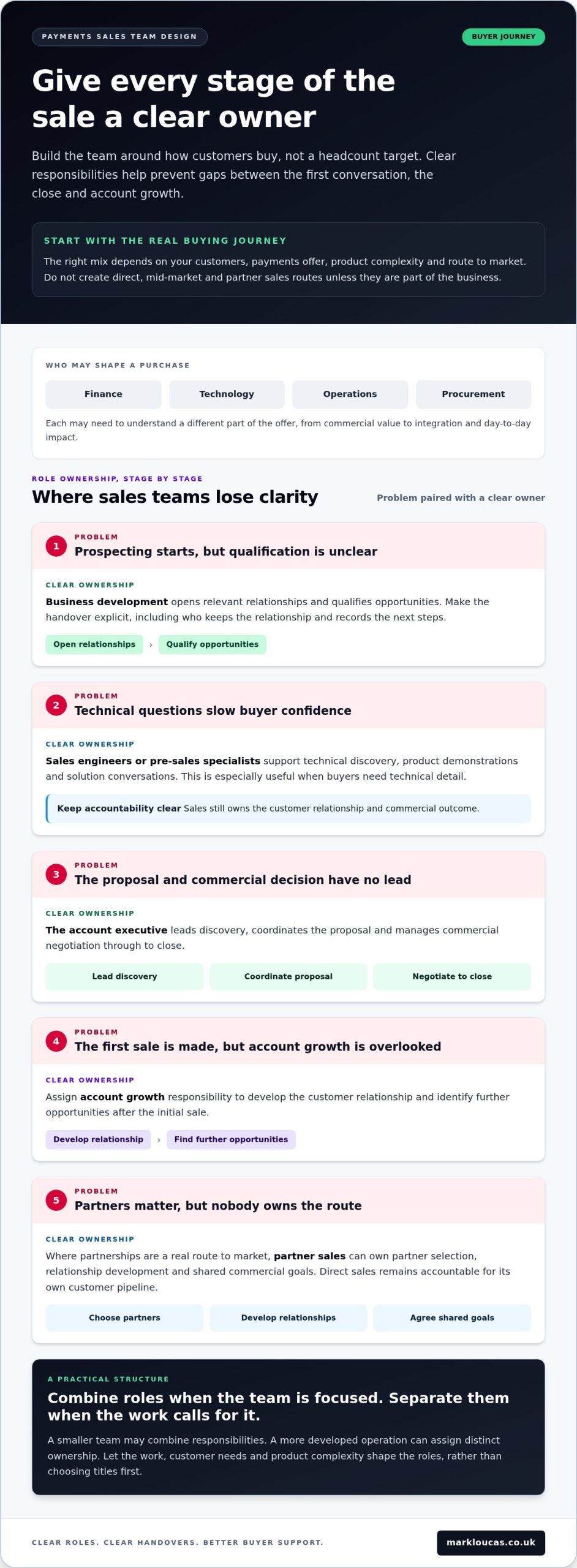
Map the people involved in a typical purchase. A finance leader may assess commercial value, whilst technology and operations teams examine integration and day-to-day impact. Procurement may take part in the buying process. Knowing who influences the decision, what each person needs to understand and where questions arise helps clarify the sales capability required.
Turn commercial priorities into capability requirements
Translate growth plans into practical responsibilities. If the priority is to deepen existing accounts, define how much account coverage is needed. If growth depends on partnerships or entering new markets, identify who will develop those relationships and what experience they need. Sales planning should connect targets, territories and forecasts with the team’s capacity, as outlined in this overview of sales management.
Separate what the business needs now from what it may need later. A new team may first require focused customer acquisition; broader account development or partner coverage can follow when the commercial model calls for it. Keep the structure tied to measurable priorities, such as target customer segments, planned account coverage or a defined partnership goal. This creates a more useful brief for hiring than a list of job titles.
For a clearer view of relevant roles and talent in the sector, explore payments industry recruitment as part of your planning.
To shape the right mix of payments talent, explore a tailored payments hiring discussion.
Which sales roles does a payments company need to cover the buyer journey
There’s no fixed team template. The roles a company needs depend on who buys its service, how long a purchase takes and how much technical detail buyers need before they can make a decision. A focused team may combine several responsibilities, whilst a more developed operation can assign distinct ownership across the buyer journey.
Sales owns the customer relationship and commercial outcome; specialist colleagues strengthen the solution, but don’t replace that ownership.
Match commercial roles to the buying process
A sales leader can set direction, choose priority customer groups, agree performance expectations and review whether activity is translating into progress. In a smaller team, that leadership may sit with a senior commercial hire who also manages key accounts. The role should reflect the work required, not simply the company’s preferred title.
Account executives and business development professionals can own different stages, depending on the sales motion. Business development may focus on opening relationships and qualifying opportunities; an account executive may lead discovery, coordinate the proposal and manage commercial negotiation through to close. Make the handover explicit, including who maintains the relationship and records the next steps.
- Prospecting: Identify suitable organisations and begin relevant conversations.
- Solution design: Understand the buyer’s needs and shape a credible approach with technical colleagues.
- Commercial negotiation: Own the proposal, decision process and agreement.
- Account growth: Develop the relationship and identify further opportunities after the initial sale.
Partnerships roles are valuable where referrals, distribution or strategic relationships form a real route to market. Their remit should cover partner selection, relationship development and shared commercial goals, while direct sales remains accountable for its own customer pipeline.
Define specialist support without blurring accountability
Sales engineers or pre-sales specialists can help with technical discovery, product demonstrations and solution conversations. Their contribution is especially useful when buyers need to understand how a proposed service would fit their systems or operating processes. Set clear boundaries: the sales owner leads the opportunity, while technical colleagues assess requirements and explain the solution.
Implementation and customer success have a different purpose from new business sales. They support delivery, adoption and ongoing value once a customer has committed. Their insight can inform account growth, but responsibility for prospecting and closing new business should remain clear. This distinction helps avoid gaps at handover and prevents customers receiving conflicting messages.
For roles that work closely with technical teams, fintech banking technology recruitment reflects the value of aligning commercial and specialist expertise. The aim is a coherent buyer experience, with one clear sales owner and the right expertise brought in at each stage.
To weigh the options against your commercial priorities, consider your payments talent requirements.
Permanent, contract or interim sales talent for a payments company
The right hiring model depends on the capability gap, how long it is likely to remain and whether the business needs lasting ownership or focused expertise for a defined period. Permanent hiring, executive search, contract and interim support each serve a different purpose. None is automatically the best choice.
Before deciding, describe the work that must be done, the level of accountability required and the expected timeframe. A company building a sales team for a payments company might need ongoing ownership of strategic accounts, a senior leader to shape a new function, or temporary support for a specific commercial priority. A clear brief helps distinguish these needs.
When permanent hiring may support lasting sales ownership
A permanent appointment can suit continuing responsibilities such as developing key accounts, building customer relationships or leading a sales function over time. Before recruitment begins, define the role’s scope, reporting lines and measures of success. This gives candidates a clear view of the work and helps the business assess experience against its actual priorities.
For senior leadership appointments, executive search can provide a focused route to identifying and assessing experienced candidates. It can be particularly relevant when the role requires a considered combination of payments knowledge, commercial judgement and leadership capability.
When contract or interim support may fit a defined need
Contract talent may suit a time-bound project or a specific capability requirement, whilst interim support can help address a temporary leadership or delivery gap. For example, an interim commercial leader could provide direction during a transition, with the remit and handover agreed in advance. These options offer a different form of capacity, not a substitute for defining the longer-term team.
Fintech providers’ contract and interim solutions may be relevant when a business needs specialist capability for a defined period. Market mapping can also help show which skills and profiles exist in the talent landscape, informing the role brief and whether a permanent or temporary route better fits the need.
| Model | Suitable scenario | Planning consideration |
|---|---|---|
| Permanent hiring | Ongoing account coverage or lasting sales ownership | Set the remit and success measures before recruitment |
| Executive search | Senior commercial leadership appointment | Define the leadership mandate and experience required |
| Contract | Specific project or time-bound capability need | Clarify the deliverables and expected period of support |
| Interim | Temporary leadership or delivery gap | Agree decision-making scope and handover arrangements |
Use the model that matches the business need, rather than choosing based on habit. A clear comparison of urgency, continuity and capability can make the next hiring decision more grounded. For support shaping a payments talent plan, discuss the options with a specialist recruiter.
To turn your priorities into a focused hiring plan, plan your next payments sales hire.
How to build a sales team for a payments company in five stages
A clear sequence helps keep recruitment connected to the commercial work the business needs done. In building a sales team for a payments company, each stage should produce a decision or output that makes the next one more precise. This reduces the risk of searching for a broad profile before the role, success measures and candidate assessment are agreed.
Set the brief before beginning the search
Start with the customer segment, the role’s commercial responsibilities and the outcomes expected. Separate essential payments experience from skills a capable candidate could develop after joining. Agree who will make the hiring decision and how candidates will be assessed before approaching them. A concise brief gives the search a clear direction and helps candidates understand the opportunity.
- Set business priorities. Choose the commercial outcome the hire must support, such as expanding a defined customer segment or strengthening account coverage. Record how progress will be judged.
- Design the role. Set out responsibilities, decision-making scope, reporting lines and the experience needed. Distinguish essential payments knowledge from transferable commercial skills.
- Research the talent market. Use market mapping to explore relevant profiles, where this experience sits and how the available talent aligns with the brief. The findings can show whether the role is realistic as written or needs adjustment before the search begins. A specialist payments industry recruitment search can focus on candidates whose experience relates to the sector.
- Assess evidence. Use consistent questions and a shared scorecard to compare candidates against the agreed requirements, rather than relying on general impressions.
- Plan onboarding. Set the initial priorities, key relationships and support the new hire will need. A considered handover from recruitment to the hiring manager helps connect the appointment with the outcomes in the brief.
Assess evidence of relevant commercial judgement
Ask candidates to describe a complex sale they managed, how they uncovered the customer’s needs and how they handled differing stakeholder priorities. Probe for their own decisions and the evidence behind them. For a payments role, invite them to explain a relevant payment concept first to a commercial audience, then to a technically informed one. This tests clarity without turning the interview into a product examination.
For senior appointments, assess how candidates set direction, make trade-offs and build accountability, not only their personal sales record. A consistent process lets the hiring team compare like with like and identify where further discussion is needed.
Refine the role brief and assessment approach with a specialist recruiter by discussing your payments sales hiring plan.
To align your search with your commercial priorities, discuss specialist payments recruitment.
How specialist fintech recruitment can support a stronger payments sales team
Payments experience can be difficult to assess from job titles alone. Two candidates with similar sales backgrounds may have worked with different customer types, sales cycles or payment models. A specialist search brings those distinctions into the hiring discussion, helping connect the role’s responsibilities with relevant experience and a consistent approach to candidate assessment.
This matters when building a sales team for a payments company, where the brief needs to reflect both commercial ownership and the knowledge required to discuss the product credibly. Specialist recruitment can help clarify what the position must deliver, which experience is essential and how candidates’ examples relate to the employer’s actual offer. The aim is a well-defined search, not a generic profile labelled “payments sales”.
Use market insight to sharpen the hiring brief
Market mapping can show how relevant talent is distributed across roles, sectors and levels of experience. That insight helps employers consider whether a brief is too narrow, whether responsibilities belong in one position or more than one, and how the role compares with the available talent landscape. It can also inform realistic conversations about the search scope before recruitment begins.
Talent advisory adds a wider workforce perspective. If a payments business is developing its commercial function, advice can help prioritise the capabilities needed now and those that may become important as the team grows. The recommendations should be specific to the company’s customers, payments offer, route to market and hiring objectives, rather than based on a standard team structure.
Make the next hiring decision clear
There is no single hiring model for every capability gap. Permanent recruitment can support lasting sales ownership and continuing customer relationships. Interim recruitment can suit a temporary leadership requirement or a defined period when specialist capability is needed. The choice should follow the work, the level of continuity required and the timing of the business need.
Before taking the next step, bring three points into focus: the commercial priority the hire will support, the capability the team currently lacks and the hiring model that best fits the requirement. This concise view gives a specialist search or talent advisory discussion a useful starting point, while leaving room to refine the brief around the business.
Mark Loucas Ltd focuses on fintech, payments and digital banking recruitment, including permanent recruitment, executive search, contract and interim solutions, market mapping, intelligence and talent advisory. For a search shaped around your payments business and hiring objectives, discuss your talent requirements.
Discuss your payments sales hiring plans and take a considered next step.
Set your next payments hiring decision in motion
The next step is to turn your growth ambition into a clear decision: which commercial capability will make the greatest difference now, and what will the business need as it develops? A thoughtful approach to building a sales team for a payments company gives that decision a practical foundation, helping you focus on the talent that fits your customers, offer and priorities.
Mark Loucas Ltd brings specialist recruitment experience across fintech, payments and digital banking, with permanent recruitment, executive search, contract and interim solutions, as well as market mapping, intelligence and talent advisory. This support can help you shape a focused search or consider how your commercial talent needs may change over time.
Share the role you’re considering, the capability you need and the priorities behind the hire. A considered next step can help you build a team suited to your business.
Frequently Asked Questions
Can a payments company build its sales team before its product is fully mature?
Yes, if the role is clear about what can be sold now and what is still evolving. Early commercial hires can help test customer interest, gather feedback and identify objections, but they need accurate product information and clear limits on what they can promise. When building a sales team for a payments company at this stage, look for people who can handle ambiguity and share useful customer insight with product colleagues.
How should a payments company assess sales candidates without relying only on past targets?
Assess how candidates reached their results, not just the figures. Ask them to explain a difficult customer conversation, how they qualified an opportunity and what they changed when a deal stalled. A practical exercise could ask a candidate to prepare discovery questions for a fictional merchant or payments partner. This can reveal listening, judgement and clarity, whilst giving candidates a fair chance to show how they work.
What happens if a new payments sales hire needs technical support during customer conversations?
Set a clear route for bringing technical colleagues into customer discussions. The sales hire should remain responsible for the relationship and follow-up, while a product or technical specialist helps answer detailed questions. Before a meeting, agree who will cover each topic and what the customer needs to leave understanding. Afterward, capture unanswered questions and assign an owner, so the conversation progresses without unsupported promises.
Is a payments sales leader always the first commercial hire?
No. The first hire should address the most pressing commercial gap. If the founders can set direction and need more capacity to develop opportunities, a hands-on business development or account executive role may be more useful initially. A sales leader can make sense when the company needs dedicated direction, team management or a more established sales approach. Consider who will manage the new hire before deciding which role comes first.
Can contract or interim talent work alongside a permanent payments sales team?
Yes. A contract specialist might support a defined initiative, whilst permanent colleagues retain ongoing customer relationships. An interim leader could also provide temporary direction while a business makes a longer-term appointment. To make the arrangement workable, define decision rights, reporting lines and how knowledge will be shared with the permanent team. This helps prevent overlapping responsibilities and keeps important customer information within the business.
How can market mapping help when building a sales team for a payments company?
Market mapping can give an employer a clearer view of relevant roles and experience across the talent market. It may show whether the brief combines capabilities rarely found together, or whether adjacent sector experience could also be relevant. These insights can support better decisions about role scope, seniority and search focus. Market mapping is also useful for longer-term planning, particularly when future hiring needs are still taking shape.

Article by
Liam Henfrey
Liam Henfrey is a seasoned specialist in the payments and banking sectors with over two decades of experience. As the Founder and CEO of FINOPSIS and Managing Director at Mark Loucas Ltd, he advises organisations on complex financial operations and technology. His career includes senior roles at PwC, Deloitte, and Visa Europe.
Related Fintech Recruitment Guides
If you liked this guide then you may also like the following: