


Contract AML Specialist Roles and Hiring Options
AML work can be demanding, and a contract AML specialist often feels the pressure when complex customer reviews, transaction alerts and tight deadlines converge. The role requires careful judgement as well as pace: decisions need clear evidence and sound reasoning. Contract assignments can be especially intense when a team needs experienced support for a defined period or a heavy workload.
The work is not purely reactive. AML specialists help financial firms understand their customers, assess risk and investigate activity that needs closer attention. Responsibilities may include KYC checks, customer due diligence and enhanced due diligence, depending on the organisation and the role.
This article explains what AML specialists do, why the work can be demanding, and how contract and permanent roles differ in the UAE fintech market. It also covers what organisations should consider when hiring contract expertise, and how the right approach can address immediate compliance needs while building longer-term capability.
For support with fintech hiring, discuss your recruitment needs.
Key Takeaways
- Understand how KYC, customer due diligence and enhanced due diligence help financial firms assess customer risk.
- Recognise why alert volumes, complex cases and deadlines can make AML work demanding.
- Compare contract and permanent roles by considering the organisation’s immediate needs and longer-term plans.
- Identify how a contractor’s responsibilities can range from case reviews to improving AML processes.
- Explore how recruitment support can help fintech firms find permanent, executive or interim AML talent.
If your UAE fintech team is weighing temporary support against a lasting appointment, discuss the hiring requirement with Mark Loucas Ltd.
Demand for AML professionals
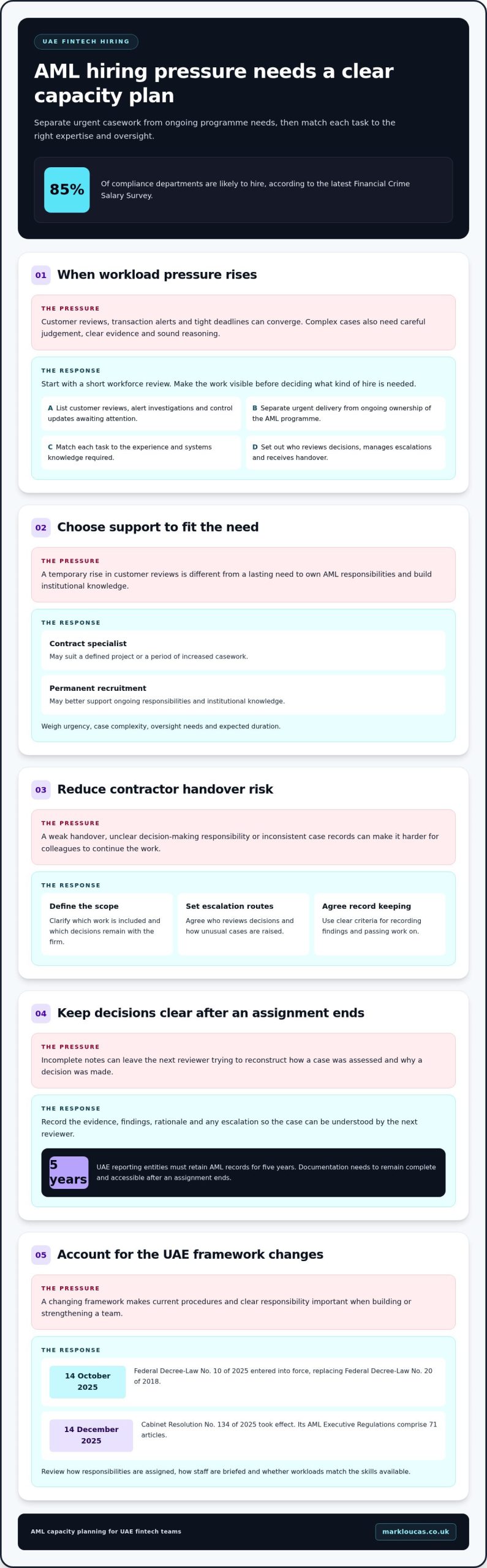
Demand for AML expertise reflects the sustained work involved in identifying financial crime risks, reviewing customer information and handling alerts. According to the latest Financial Crime Salary Survey, 85% of compliance departments are likely to hire. For UAE employers, that demand sits alongside a framework that changed in 2025, making knowledge of current procedures important when building or strengthening a team.
The UAE’s Federal Decree-Law No. 10 of 2025 entered into force on 14 October 2025, replacing Federal Decree-Law No. 20 of 2018. Cabinet Resolution No. 134 of 2025 took effect on 14 December 2025, and its AML Executive Regulations comprise 71 articles. These changes give firms a practical reason to review how responsibilities are assigned, how staff are briefed and whether workloads match the skills available.
Not every organisation needs the same hire. A temporary increase in customer reviews may call for operational capacity, while a business changing its controls may need someone to assess and improve its processes. Consider case volume and complexity, the team’s experience, and whether the need is short-term or ongoing.
What are the risks of hiring a freelance AML specialist in the UAE? Key operational risks include a weak handover, unclear decision-making responsibility and inconsistent case records. A defined scope, documented escalation route and secure access process can help manage them.
Continuity matters because AML work often passes between people and teams. For example, a contractor reviewing customer files needs clear criteria for recording findings and escalating unusual cases. Without agreed steps, colleagues taking over may have to reconstruct decisions from incomplete notes. UAE reporting entities must retain AML records for five years, so documentation needs to remain complete and accessible after an assignment ends.
Hiring teams can assess demand through a short workforce review:
- List the work awaiting attention, such as customer reviews, alert investigations or control updates.
- Separate urgent delivery needs from ongoing ownership of the AML programme.
- Map each task to the experience and systems knowledge required.
- Set out who reviews decisions, manages escalations and receives the contractor’s handover.
This review helps distinguish a temporary capacity gap from a lasting capability need. A contract AML specialist may suit a defined project or period of increased casework; permanent recruitment may better support ongoing responsibilities and institutional knowledge. Assess the work itself, including its urgency, complexity, oversight requirements and expected duration.
Teams assessing KYC capacity can discuss specialist hiring for their fintech roles.
KYC, customer due diligence, and enhanced due diligence
In the UAE, KYC gives a financial firm a structured view of its customers. A reviewer may examine identity documents, business details, ownership information and the expected purpose of an account. Customer due diligence brings this information together to assess whether the customer’s profile is clear, consistent and supported by evidence.
Consider a fintech onboarding a small trading company. The reviewer compares the company’s registered details with its ownership records and information about its business activity. If the stated purpose does not fit the available evidence, the reviewer records the mismatch and follows the firm’s escalation process. A complete file shows what was reviewed and how the conclusion was reached.
Enhanced due diligence, or EDD, involves closer scrutiny when a customer or relationship presents higher risk under the firm’s assessment. This may involve seeking more information about ownership, source of funds or expected account activity. For example, a complex corporate structure may require tracing ownership through several entities rather than relying on the first name shown in a company document.
The work is more than a document checklist. A KYC reviewer compares information across records, identifies gaps and distinguishes minor inconsistencies from concerns that need escalation. In a transaction review, activity that differs from the customer’s stated business profile may prompt further analysis. The written rationale should make the evidence and decision clear to the next reviewer.
A clear review sequence helps maintain consistency across customer files:
- Confirm the customer’s identity and, for a business, its legal details.
- Understand the ownership structure and the stated purpose of the relationship.
- Compare the information with expected activity and note any gaps or contradictions.
- Apply the firm’s risk assessment to determine whether standard checks or EDD are appropriate.
- Record the evidence, outcome and any escalation for later review.
A contract AML specialist’s assignment may focus on one stage, such as clearing a backlog of customer files, or cover the full review process. The hiring team should define which customer types are in scope, which systems the reviewer will use, and who makes final decisions. Clear boundaries help contractors follow the firm’s approach without confusing case review with programme ownership.
Where customer reviews are creating a capacity gap, agree the scope and escalation route before work begins. Teams planning specialist fintech recruitment can discuss their hiring requirements as a next step.
AML contractor responsibilities
In the UAE, an AML contractor supports the reporting entity’s controls rather than replacing its accountable decision-makers. Relevant rules include Federal Decree-Law No. 10 of 2025 and Cabinet Resolution No. 134 of 2025, whose Executive Regulations comprise 71 articles. The contractor’s assigned duties should reflect the organisation’s activities, risks and internal procedures.
What are the UAE AML and CFT requirements relevant to contract specialists? They need to work within the entity’s AML and counter-terrorist financing controls, including its risk assessment, record-keeping and escalation processes. UAE reporting entities must retain AML records for five years, freeze and report targeted financial sanctions matches within 24 hours, and refresh business risk assessments at least annually.
An assignment might involve reviewing alerts, documenting findings, supporting sanctions screening or testing procedures. A contractor should follow the firm’s escalation route when a potential match or suspicious activity needs further assessment. They should clearly record the basis for their work so the organisation can review decisions and maintain an audit trail.
What should an AML specialist contract include in the UAE? It should define the assignment’s scope, deliverables, reporting line, access arrangements, confidentiality expectations and handover process. It should also clarify who approves decisions and how unresolved cases are escalated, keeping operational support distinct from the organisation’s oversight responsibilities.
Precise boundaries matter. A contractor might, for example, review a defined queue of transaction monitoring alerts, while a named employee retains responsibility for escalation decisions. The assignment should specify which systems and procedures the contractor will use, how work will be recorded, and what information must be returned or retained at completion.
How can I verify a contract AML specialist’s experience and credentials? Compare their CV with the assignment’s actual tasks, then ask for specific examples of similar work, systems and case types. Verify claimed qualifications with the issuing body, and assess how they document evidence, explain decisions and escalate concerns.
Relevant experience depends on the role. A person supporting sanctions screening needs familiarity with screening outcomes and escalation procedures; someone improving monitoring scenarios needs technical experience in detection design. Some AML contract roles require experience designing and enhancing detection scenarios in SAS AML versions 7.1 and 7.2. Treat this as a role-specific example, not a universal requirement.
Use a fictional case for a practical assessment. Ask the candidate what information they would review, how they would record a concern and when they would escalate it. This tests judgement without exposing real customer data. Make the final selection against the assignment’s scope, oversight arrangements and handover needs.
AML recruitment across permanent and contract roles
Choose between contract and permanent hiring by starting with the work to be done. A defined backlog, project deadline or temporary capacity gap may suit a fixed-term assignment. Ongoing ownership of controls, regular staff training and institutional knowledge may point to a permanent role. The right fit depends on the responsibilities, not simply the job title.
An advertised AML Specialist role in Dubai is a 6-month contract. It requires at least 6 years of AML or compliance experience within a fintech or licensed financial institution, in the UAE or internationally. That example shows how a contract can be designed around experienced support for a specific period. It does not establish a standard duration or experience threshold for every vacancy.
What qualifications and certifications are required for contract AML specialists? Requirements depend on the role and employer. The advertised Dubai position requires a bachelor’s degree in finance, law or a related field; a master’s degree is listed as a plus, and CAMS certification is mandatory for that role.
For a permanent appointment, assess whether the candidate can sustain the work beyond an immediate delivery need. This may involve maintaining procedures, supporting colleagues and adapting controls as the business changes. For a contract appointment, focus on the agreed deliverables, relevant experience and ability to work within the organisation’s existing processes.
Before advertising, define the role using practical criteria:
- Workload: identify the cases, controls or project tasks requiring attention.
- Duration: decide whether the need is tied to a defined assignment or continuing activity.
- Experience: match the required expertise to the actual duties and systems.
- Oversight: name the person who sets priorities, reviews work and handles escalations.
- Handover: set out how open tasks, records and process knowledge will transfer.
A contract hire can add focused capacity, but a clear end point and handover plan help preserve continuity. A permanent hire may provide longer-term ownership, but still needs a precise remit and suitable support. Compare candidates against the same core duties, then assess whether their experience fits the employment arrangement and the organisation’s priorities.
For fintech employers shaping a contract or permanent search, discuss the hiring requirement and the experience the role needs.
AML roles and seniority levels
AML job titles vary, so compare each role’s decisions, duties and oversight rather than relying on its label. A useful role profile sets out the tasks, systems and authority required.
AML role types
An AML analyst may review customer files, investigate transaction monitoring alerts or document findings. An investigator usually handles cases requiring closer examination, while an AML manager may oversee workflows, procedures and quality checks. A Money Laundering Reporting Officer role has broader oversight responsibilities. Titles can overlap, so assess the actual remit and decision-making authority in each job description.
A Dubai fintech, for example, might need an analyst to clear alerts, while a growing compliance function may need a manager to coordinate reviews. List the expected outputs, such as completed investigations, improved procedures or team oversight. Then distinguish delivery work from control ownership. This helps candidates understand whether the role is operational, managerial or senior leadership.
Seniority levels
Junior roles commonly focus on following procedures, gathering evidence and recording outcomes. Mid-level specialists may handle complex cases, support colleagues and identify recurring process issues. Senior professionals are expected to shape frameworks, assess gaps and present findings to decision-makers. The key measure is the scope of judgement, not the word “senior” in the title.
An advertised AML Specialist role rates strategic thinking at Level 4, achieving results at Level 5, customer focus at Level 2, and leading change at Level 3. These ratings illustrate how a role can set different expectations across capabilities. Hiring teams should connect each rating to observable work, such as explaining a control improvement or resolving a complex case.
A shared case exercise can help distinguish experience levels. Give candidates the same fictional alert and ask them to explain their next steps. A junior candidate might describe evidence collection and escalation. A more senior candidate could also identify a process weakness, recommend a control change and explain how to monitor its effect.
Use these distinctions when setting the role’s scope:
- Analyst: review files, follow procedures and record clear findings.
- Investigator: examine complex alerts and explain the evidence behind conclusions.
- Manager: allocate work, review quality and address recurring workflow issues.
- Senior leader: shape the AML framework and present material findings to decision-makers.
For a contract appointment, define whether the specialist will deliver cases, improve a process or lead a defined change. A permanent role may place greater emphasis on continued ownership and team development. In either case, test candidates against realistic tasks and agree who approves decisions. To discuss the level and remit your fintech team needs, get in touch about your hiring requirements.
Mark Loucas: Permanent Fintech Recruitment
Mark Loucas Ltd helps fintech employers decide whether they need AML expertise permanently, for executive leadership or on a contract basis. Its Permanent Fintech Recruitment and Fintech Executive Search support organisations seeking lasting capability or senior appointments. For a defined project or temporary workload, Fintech Providers Contract & Interim Solutions can address the hiring need.
Market Mapping & Intelligence helps employers understand the talent landscape before shaping a search, clarifying role requirements and the experience needed. This can be useful when a team is weighing immediate casework against long-term ownership of its AML function. The right route depends on the responsibilities, seniority and duration of the requirement.
To discuss your fintech hiring needs, contact Mark Loucas Ltd.
Turn your AML hiring needs into a clear plan
Start by defining what success should look like after the appointment. Set out the work the specialist will own, the decisions they can make and how their contribution will be assessed. A clear brief helps candidates understand the role and gives the hiring team a consistent basis for evaluating relevant experience.
For a contract AML specialist, distinguish immediate delivery from longer-term responsibilities. Consider how the assignment fits the existing team, who will provide oversight and what knowledge must remain when the engagement ends. These details help shape a focused search and a more productive conversation with prospective candidates.
Mark Loucas can discuss recruitment needs across fintech and digital banking, including permanent and interim hiring. If you are ready to refine your brief or discuss your next appointment, contact Mark Loucas about AML hiring. A thoughtful hiring plan is a practical first step towards strengthening your team.
Frequently Asked Questions
Is AML in demand?
Financial firms seek AML expertise when they need to strengthen reviews, investigate alerts or adapt controls to new business activity. A fintech launching a new payment service, for example, may need additional compliance capacity to assess customer and transaction risks. Demand varies by organisation, role seniority and workload. Employers can identify their needs by asking which AML tasks are delayed, expanding or require skills the current team lacks.
What does an AML contractor do?
An AML contractor provides specialist support for an agreed assignment, working within the organisation’s processes and reporting structure. A business might bring in a contractor to review a defined group of cases, test a procedure or support a project team. The scope should state expected outputs and who will review them. Contractors provide focused expertise for a particular need, rather than automatically taking responsibility for the organisation’s whole AML function.
What does a specialist in a contract AML role do?
A contract AML specialist carries out the duties set for a temporary AML role, which may include casework, control testing or project delivery. A fintech preparing a new customer onboarding process, for instance, could engage someone to assess how its AML checks work. The specialist follows the agreed remit and shares findings with the designated manager. Clear priorities help the team assess progress without confusing delivery support with ongoing programme ownership.
What is the average contract AML specialist salary or hourly rate in the UAE?
Pay in the UAE depends on the assignment’s seniority, duration, required expertise and scope of responsibility. Routine operational work differs from a role requiring specialist systems knowledge or leadership of a complex project. Compare compensation with the actual duties, experience and engagement structure, rather than relying on a generic title. State whether the role is hourly or salaried in the hiring brief.
How do UAE companies hire and onboard a contract AML specialist?
UAE companies can start by agreeing the assignment’s outcomes, required experience and reporting line, then assess candidates using realistic work examples. Once selected, provide relevant procedures, approved system access and named contacts for questions or escalations. A sample case exercise can show how a candidate handles evidence and written reasoning. Before live work begins, agree how progress will be reviewed and open tasks handed back.
What is the difference between a contract AML specialist and a permanent AML officer?
A contract specialist is engaged for a defined assignment, while a permanent AML officer supports continuing responsibilities within the organisation. A contractor might help deliver a specific review project, whereas a permanent officer can maintain relationships with internal teams over time. The title alone does not determine authority. Compare role descriptions to see who owns recurring tasks, approves decisions and maintains the organisation’s ongoing AML processes.

Article by
Liam Henfrey
Liam Henfrey is a seasoned specialist in the payments and banking sectors with over two decades of experience. As the Founder and CEO of FINOPSIS and Managing Director at Mark Loucas Ltd, he advises organisations on complex financial operations and technology. His career includes senior roles at PwC, Deloitte, and Visa Europe.
Related Fintech Recruitment Guides
If you liked this guide then you may also like the following: