


Hiring after Fintech Layoffs and the Strategic Acquisition of Elite Talent in 2026
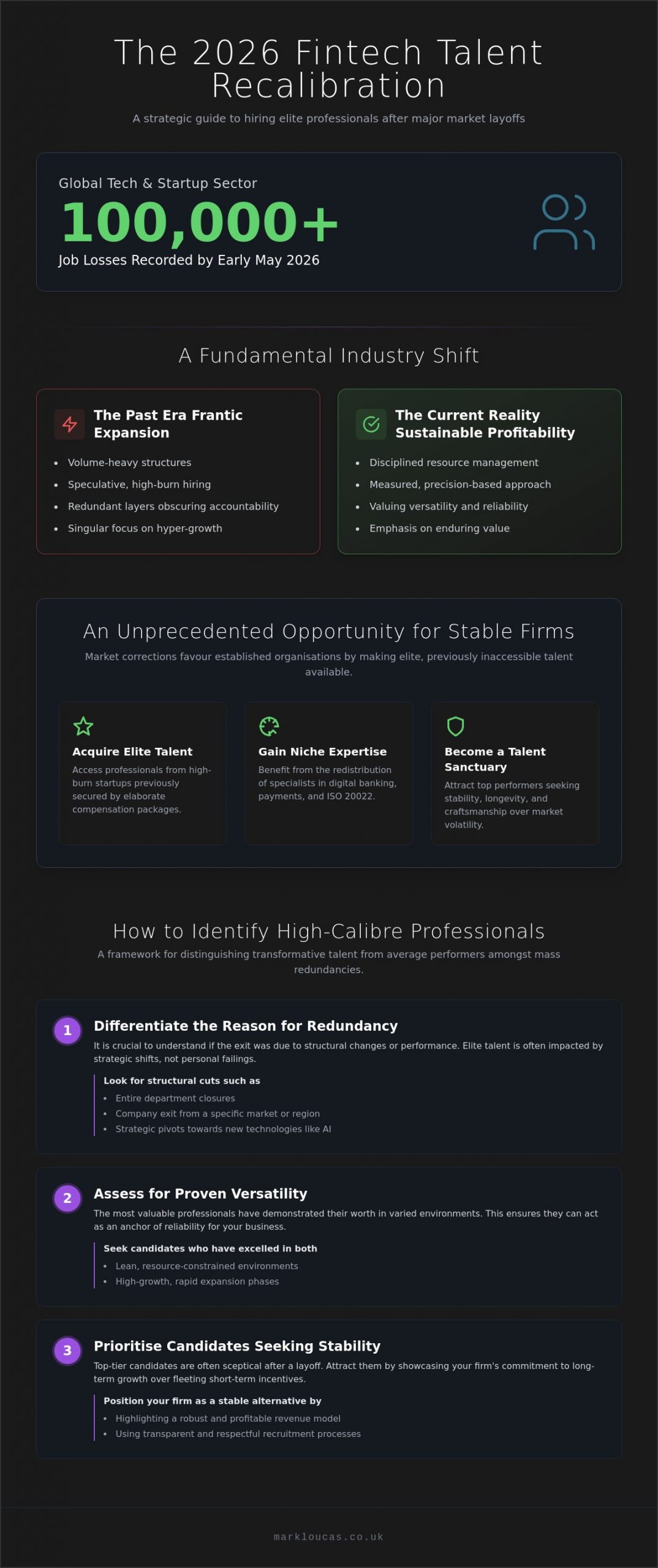
By early May 2026, tech and startup companies had already recorded more than 100,000 job losses worldwide, creating a dense and often overwhelming landscape for those seeking to strengthen their teams. Whilst such a surplus of candidates suggests a wealth of choice, the delicate art of hiring after fintech layoffs requires a level of precision that few organisations truly master. You are likely aware that distinguishing the genuine architects of digital banking from average performers amongst mass redundancies is a significant challenge. There is also the persistent worry that elite talent might only view your firm as a temporary sanctuary until the market peaks once more.
This guide provides a strategic framework to help you navigate these complexities with quiet confidence and expert care. We promise to deliver a clear process for vetting talent from recent redundancies, ensuring you identify niche specialists in payments and digital banking who align with your long-term vision. We shall explore how to move from volume-driven recruitment to a more intimate, tailored approach that prioritises craftsmanship and distinction. You will learn how to position your firm as a stable and prestigious alternative to the volatility of the wider market, securing the rare expertise that defines industry leaders.
Key Takeaways
- Understand the transition towards sustainable profitability and how this shift allows stable firms to capture elite talent during market corrections.
- Learn to differentiate between structural redundancies and performance-based exits to ensure you only acquire the most impactful and resilient professionals.
- Discover how hiring after fintech layoffs can accelerate your product development cycles by integrating seasoned specialists who have already navigated complex industry challenges.
- Establish a strategy to attract sceptical candidates by emphasising long-term stability and transparent recruitment processes over fleeting short-term incentives.
- Gain access to exclusive and non-public talent pools through sophisticated market mapping and intelligence that larger corporate entities often overlook.
If you wish to discuss how these market shifts affect your specific talent requirements, please reach out to our team at the contact us page for a private consultation.
The Fintech Labour Market Landscape in 2026
The current climate represents a profound recalibration of the sector, offering hiring managers a rare chance to rebuild with precision. As we move away from the frantic expansion of previous years, the industry has embraced a more measured philosophy. To understand the foundations of this evolution, one might ask What is Fintech? in the context of 2026. It’s no longer just about disruption. It’s about enduring value. By May 2026, the global market saw over 100,000 job losses, yet this figure masks a deeper truth. The demand for excellence hasn’t diminished; it has simply become more discerning.
Understanding the Shift to Sustainable Profitability
Organisations are now redesigning their internal architectures to eliminate redundant layers that once obscured accountability. This is a deliberate move away from the volume-heavy structures of the past. Speculative hiring has been replaced by a disciplined approach to resource management that mirrors the precision of a high-end concierge service. To further optimise these internal structures, many growing organisations check out Financial Foothold for expert outsourced accounting and payroll administration. Leaders now prize professionals who have demonstrated their worth in both lean environments and high-growth phases. This versatility is essential for firms navigating the complexities of hiring after fintech layoffs. It ensures that every new appointment acts as an anchor of reliability for the business.
Why the Current Market Correction Favours Established Firms
For established entities with robust revenue models, this correction offers an unprecedented opportunity to acquire elite talent. Individuals who were previously secured by elaborate compensation packages are now accessible. These professionals often seek the sanctuary of profitable fintech providers over the volatile uncertainty of high-burn startups. We are seeing a significant redistribution of niche expertise across the digital banking sector. This isn’t a decline. It’s a curated movement of the industry’s finest minds towards organisations that value longevity and craftsmanship.
In prestigious districts like the City of London, the availability of specialised talent has reached a unique peak. The migration to ISO 20022 standards has further intensified the need for payments industry recruitment specialists. As regional hubs evolve, the most successful firms are those that act with unhurried diligence. They recognise that the best talent isn’t found in volume, but through discreet, non-public opportunities. This period of flux is, in reality, a window of exclusivity for those prepared to master the art of hiring after fintech layoffs.
If you require a bespoke approach to identifying the leaders within this new talent landscape, please visit our contact us page to arrange a private discussion.
Identifying High Calibre Professionals Amongst the Redundancies
The current market presents a unique paradox for hiring managers. Whilst the volume of available candidates has increased significantly, the task of identifying genuine excellence has become more nuanced. Recent FinTech sector layoffs, often driven by strategic pivots towards artificial intelligence and leaner operational models, have released a wealth of high-calibre talent into the market. However, the process of hiring after fintech layoffs requires a sophisticated vetting framework to ensure that your organisation acquires individuals who bring transformative value rather than inherited challenges.
As these professionals navigate their next career steps, many top-tier tech experts check out QuickApply to streamline their applications, making it easier for them to identify and engage with organisations that offer genuine stability.
Differentiating Structural Cuts from Performance Issues
It is a common misconception that redundancies only affect average performers. In reality, structural redesigns often sweep up top-tier specialists and senior leaders simply because their entire department or geographical region was closed. To distinguish these elite professionals, hiring managers should employ a rigorous evaluation process. Consider the following markers of high-calibre talent amongst recent exits.
- Departmental Context. Was the candidate part of a wider team closure or a strategic exit from a specific market like cryptoassets or retail banking?
- Quantifiable Impact. Can the individual demonstrate clear architectural or commercial contributions that remained viable until the point of restructuring?
- Strategic Seniority. Senior talent is frequently the first to be affected by organisational flattening. This often provides a rare opportunity to secure leaders who would otherwise be unattainable.
Utilising market mapping and intelligence is essential here. It allows you to identify which teams were considered high-performing before the market correction, ensuring your search is focused on the most prestigious talent pools.
The Hidden Value of Specialists from Scaled Fintech Providers
Professionals who have navigated the journey from high-growth startup to scaled provider possess a rare blend of technical expertise and operational resilience. We are seeing a particular demand for candidates with deep experience in payments industry recruitment, especially those who have managed complex digital banking transitions or global infrastructure migrations. These specialists bring a wealth of “battle-tested” knowledge that can significantly accelerate your own product development cycles.
The importance of data analytics and devops expertise remains paramount. Individuals who have successfully managed large-scale data migrations or maintained high-availability systems during periods of intense growth are invaluable. By focusing on these niche technical skills, you can build a team that is not only highly skilled but also deeply familiar with the rigours of the modern fintech environment. If you find yourself in need of expert guidance to navigate these choices, our specialist advisors can help you refine your selection with the meticulous attention to detail your firm deserves.
If you would like to explore how our executive search services can help you secure these elite professionals, please reach out to us via our contact page for a confidential discussion.
Strategic Advantages of Hiring Post Layoff Talent
Whilst market corrections are often viewed through a lens of adversity, they present a rare opening for discerning firms to enhance their competitive posture. The act of hiring after fintech layoffs is not merely a recruitment exercise; it’s a strategic acquisition of battle-tested expertise. These individuals bring a wealth of knowledge from organisations that have already navigated the complexities of rapid scaling and regulatory pressure. By integrating this talent, you bypass the typical learning curves associated with new hires. This allows your firm to maintain its steady, unhurried pulse of excellence whilst others are still attempting to find their footing.
Accelerating Product Development with Seasoned Experts
Securing a seasoned fintech engineer who has already weathered the storms of infrastructure migration can save your organisation months of expensive training and trial-and-error. These professionals have solved similar problems in high-pressure environments, bringing a level of craftsmanship that is difficult to replicate through standard training schemes. Product managers who have successfully navigated intense regulatory scrutiny offer an immediate impact, ensuring that your project-specific needs are met with precision and distinction. They don’t just fill a role; they elevate the entire team’s output by applying refined methodologies from the industry’s most prestigious districts.
Strengthening Operational Resilience and Compliance
In the 2026 landscape, the role of compliance officers has become more critical than ever. Professionals transitioning from highly regulated firms carry a realistic view of market volatility and a deep understanding of safeguarding rules. They are a significantly safer bet for growing companies that must balance innovation with meticulous attention to detail. To ensure you find the right fit, we recommend using these best interview questions to ask your compliance expert candidate. This approach ensures that your high-stakes hires are correct from the outset, strengthening your operational resilience whilst your competitors are still adjusting to the new regulatory climate.
Candidates who have experienced a market cycle firsthand possess a rare maturity. They have a realistic view of market volatility, which makes them more resilient than those who have only known periods of unchecked growth. Bringing in talent from different fintech cultures also improves your organisation’s diversity of thought, introducing refined methodologies from prestigious global hubs. These individuals understand that high-value transactions require a steady, unhurried pace. By valuing patience and diligence, they help ensure your firm remains a stable and attractive alternative for both clients and future hires. This strategic redistribution of expertise is what allows a boutique advisor to maintain its reputation for curated excellence.
If you wish to discuss how to refine your employer brand to attract the industry’s most discerning talent, please reach out to our team at the contact us page.
Attracting Elite Candidates in a Sceptical Market
The talent landscape of 2026 is defined by a newfound caution amongst the industry’s most gifted professionals. Having witnessed the rapid restructuring of once-celebrated firms, these individuals now approach new opportunities with a discerning eye. Successful hiring after fintech layoffs requires more than a standard recruitment drive; it necessitates a profound restoration of trust. You must position your organisation as a destination of curated excellence, where stability is not just a promise but a core component of the firm’s architecture. This involves crafting a value proposition that speaks directly to a candidate’s desire for meaningful impact and enduring security.
Rebuilding Trust with Transparent Processes
Transparency is the most effective tool for overcoming candidate scepticism. It’s essential to be candid about your firm’s financial health, revenue models, and long-term roadmap. This openness acts as a signal of exclusivity and reliability, reassuring candidates that their interests are being managed with expert care. The interview experience itself must be smooth and respectful, acknowledging the professional calibre of those who have recently faced redundancy. By addressing the ‘laid off’ stigma directly during the initial screening, you can reframe their transition as a strategic move towards a more sustainable environment. This unhurried, sincere approach differentiates you from the impersonal, volume-driven nature of larger corporate entities.
Offering Stability and Long Term Career Growth
Elite professionals are increasingly rejecting the ‘burn culture’ that characterised the early fintech boom. They are seeking organisations that value craftsmanship and offer a more balanced, professional pace. When engaging in fintech executive search, emphasise the opportunities for candidates to shape the future of your firm. Highlight how their niche expertise will be instrumental in achieving long-term objectives rather than short-term gains. By utilising sophisticated fintech talent advisory, you can create bespoke packages that reflect the rarity of their skills. This ensures that your value proposition resonates with their desire for both impact and security.
Navigating these delicate transitions requires the touch of a discreet, highly connected boutique advisor. Niche recruitment experts play a vital role in managing the expectations of senior talent, ensuring that the move to your firm feels like a natural evolution of their career. If you are ready to secure the future of your leadership team through a tailored recruitment strategy, please get in touch with our specialist consultants for an intimate, personalised consultation.
If you wish to discuss a bespoke talent strategy that aligns with your long-term objectives, please visit our contact us page to arrange a private consultation.
Partnering with a Specialist Recruiter to Navigate Market Flux
In a landscape where the technology and finance sectors are witnessing significant restructuring, the noise of the market can often drown out the signal of true talent. This is where the value of a discreet boutique advisor becomes most apparent. Unlike large corporate entities that often prioritise volume, a specialist partner offers an intimate, personalised approach that ensures your firm remains the sole focus of their attention. Successfully hiring after fintech layoffs requires a steady, unhurried pulse; it is about finding the rare expertise that resides in the non-public spaces of the industry.
Leveraging Market Mapping and Talent Intelligence
Sophisticated market mapping and intelligence act as the architectural foundation for elite recruitment. By utilising data-driven insights, we help firms understand the competitive landscape with a level of detail that is often unavailable to the wider market. This involves identifying where the most impactful leaders have moved and which teams have remained resilient during periods of flux. Proactive talent mapping allows your organisation to prepare for future requirements before a vacancy even arises, ensuring you are never in a rush to fill a critical role. For senior appointments, a refined fintech executive search provides the surgical precision needed to secure leaders who can operationalise complexity and drive sustainable growth.
Accessing Private Opportunities and Niche Specialists
The most exceptional candidates are rarely found on public job boards; they are identified through discreet, highly connected networks built over years of meticulous service. Working with a recruiter who understands the granular details of payments and digital banking is essential for identifying these niche specialists. We focus on the craftsmanship of the placement, ensuring that each candidate possesses the specific technical and cultural attributes required by your firm. This level of curated excellence is what distinguishes a successful hire from a merely adequate one.
Ultimately, the process of hiring after fintech layoffs is an exercise in discernment. It requires a partner who values privacy and tailored solutions above all else, acting as a knowledgeable local insider in the world’s most prestigious financial districts. By choosing a specialist who understands the history and context of the fintech sector, you ensure that your interests are managed with expert care. This strategic partnership allows you to navigate market flux with quiet confidence, securing the elite talent that will define your organisation’s future success.
Securing the Future of Your Leadership Team
The shifting tides of 2026 offer a rare window to rebuild your organisation with unparalleled precision. By carefully distinguishing structural redundancies from performance-based exits, your firm can acquire the visionary architects of digital banking who were once secured by golden handcuffs. These seasoned professionals bring more than just technical skill; they offer a realistic maturity and battle-tested resilience that accelerates product cycles and fortifies your operational core.
Since 2011, Mark Loucas Ltd has served as a discreet boutique advisor, providing the dedicated expertise in payments and digital banking required to master the nuances of hiring after fintech layoffs. Our comprehensive market mapping and talent advisory services ensure you access the private, non-public opportunities that define industry leadership. We invite you to secure the elite talent your organisation deserves by contacting our specialist team today for a personalised consultation.
Building a team of distinction requires a steady, unhurried pulse and a partner who values craftsmanship above all else. With a refined strategy and expert care, this period of market flux will become the foundation for your firm’s most successful chapter.
Frequently Asked Questions
Is it a risk to hire someone who was recently laid off from a fintech firm?
It is not inherently risky; rather, it represents a strategic opportunity to acquire elite talent released due to structural pivots. By May 2026, tech and startup companies had recorded more than 100,000 job losses globally, many of which were driven by AI adoption and organisational flattening rather than individual performance. This surplus allows discerning firms to secure high-calibre specialists who were previously unattainable.
How can I tell if a candidate was a top performer amongst mass redundancies?
Distinguish top performers by evaluating their quantifiable impact on core infrastructure and cross-referencing the status of their previous department. If an entire high-performing payments team was disbanded due to a regional exit or a strategic pivot away from a specific product line, the individuals likely retain their elite status. Utilising market mapping helps verify if the candidate was part of a high-achieving group.
What are the most in demand fintech skills in 2026 after the layoffs?
The most sought after skills involve operationalising artificial intelligence, managing ISO 20022 migrations, and navigating the new UK cryptoasset regulations that open for authorisation in September 2026. Niche expertise in payments infrastructure and regulatory technology is paramount, especially as 73% of European fintechs plan to increase their investment in Regtech this year to manage increasing complexity.
Should I adjust my salary offers when hiring from a market with high layoffs?
You should maintain competitive offers based on current market value to ensure long term retention. Whilst the market is in flux, elite talent remains highly mobile and aware of their worth. With the median salary for jobs requiring fintech skills reaching $198,000 in 2026, low-ball offers will likely result in candidates departing as soon as market volatility subsides and competition intensifies.
How do I convince a candidate that my firm is more stable than their last one?
Transparency regarding your firm’s revenue models and long term roadmap is the most effective way to demonstrate stability to sceptical professionals. Contrast your sustainable growth and disciplined resource management with the ‘burn culture’ of their previous employers. Providing evidence of profitable quarters and a clear, unhurried vision for AI integration will reassure high-calibre candidates that their interests are managed with care.
What is the difference between hiring for permanent roles versus interim solutions during a market correction?
Permanent roles build long term organisational architecture, whilst interim solutions provide immediate, project-specific expertise for navigating regulatory deadlines or infrastructure migrations. When hiring after fintech layoffs, firms often utilise interim specialists to bridge gaps during the September 2026 crypto authorisation period. This allows organisations to access niche skills without immediately committing to long term headcount during periods of market flux.
How can market mapping help me find the best talent after a competitor announces layoffs?
Market mapping identifies exactly where high-performing teams have been displaced, allowing your firm to act with surgical precision. This intelligence ensures you aren’t merely reacting to a volume of applications but are strategically targeting the specific specialists who driven previous industry successes. It provides a foundational understanding of the competitive landscape, revealing private opportunities that remain hidden from large, volume-driven corporate entities.
What questions should I ask a candidate about their previous firm’s layoff process?
Enquire about the structural nature of the cuts and how their specific role contributed to the firm’s core objectives before the strategic pivot. Ask whether the redundancy was part of a blanket percentage cut or a total exit from a specific market or product line. This helps clarify if their departure was a result of organisational redesign or performance, ensuring your search for excellence remains focused and successful.

Article by
Liam Henfrey
Liam Henfrey is a seasoned specialist in the payments and banking sectors with over two decades of experience. As the Founder and CEO of FINOPSIS and Managing Director at Mark Loucas Ltd, he advises organisations on complex financial operations and technology. His career includes senior roles at PwC, Deloitte, and Visa Europe.
Related Fintech Recruitment Guides
If you liked this guide then you may also like the following: