


How to Assess Leadership Skills in an Interview
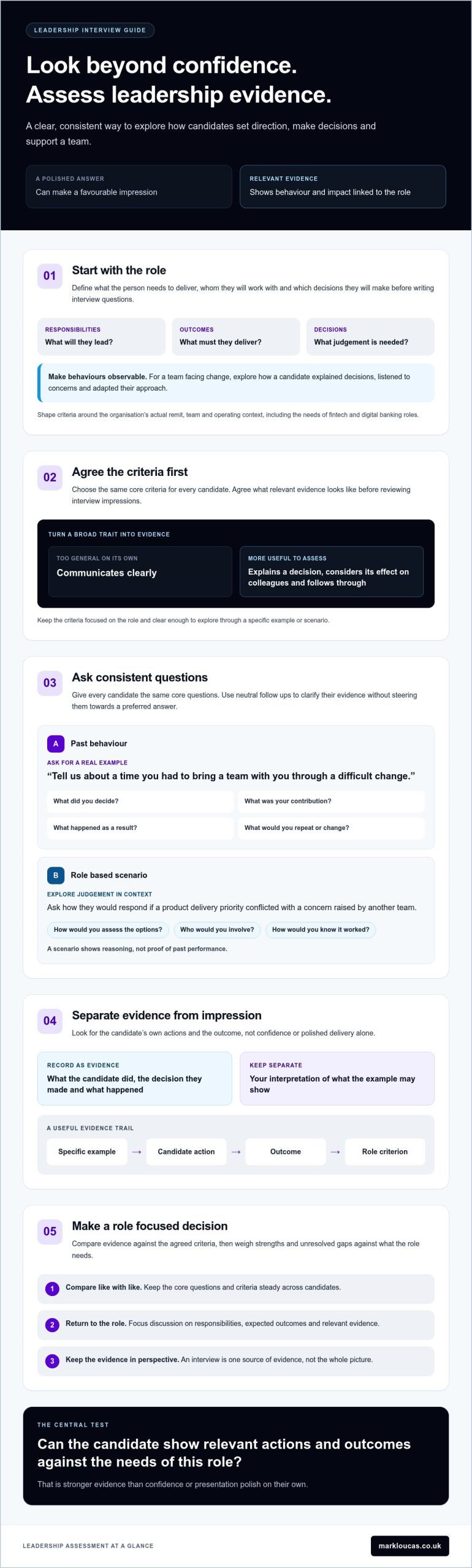
What if the most confident candidate in the room isn’t the strongest leader for the role? Polished answers can make a favourable impression, but they don’t always reveal how someone sets direction, handles difficult decisions or supports a team. Assessing leadership skills in an interview means looking beyond delivery and asking for clear evidence of behaviour and impact.
Interviewers can assess candidates differently, particularly when questions are broad or decisions rely on instinct. A consistent structure helps you compare like with like and keeps the discussion focused on what the role requires. That matters in fintech and digital banking, where leadership needs can vary between organisations, functions and positions.
This guide explains how to identify the leadership behaviours that matter before the interview, use structured questions to draw out specific examples and evaluate responses against clear criteria. You’ll also learn how to distinguish persuasive stories from relevant evidence, so your decision is fairer, more consistent and grounded in the needs of the role.
Key Takeaways
- Define the role’s outcomes and responsibilities before choosing which leadership behaviours to assess.
- Use consistent questions about past behaviour and relevant scenarios to gather evidence you can compare.
- When assessing leadership skills in an interview, look for specific actions and outcomes rather than confidence or polished delivery.
- Record factual examples against agreed criteria, keeping candidate evidence separate from your interpretation.
- Weigh strengths and unresolved gaps against the role, remembering that an interview is only one source of evidence.
If you’re defining a fintech or digital banking leadership role and need sector-specific recruitment support, discuss your requirements with Mark Loucas Ltd.
How to assess leadership skills in an interview by defining the role
Leadership potential isn’t the same as seniority, confidence or a polished presentation. A candidate may have held a senior title without demonstrating the behaviours your role needs. Someone with a less conventional career path may offer relevant evidence of sound judgement and team leadership.
Evidence-led leadership assessment means judging candidates against observable behaviours linked to the role’s responsibilities and expected outcomes. Before writing questions, clarify what the person will need to deliver, whom they will work with and which decisions they will be expected to make. This gives you a practical starting point for assessing leadership skills in an interview.
Translate the role into observable leadership behaviours
Connect each priority behaviour to a real responsibility and outcome. If the role involves guiding a team through change, assess how a candidate has explained decisions, listened to concerns and adapted their approach. If it involves setting priorities across a payments or digital banking function, explore how they have balanced competing needs and communicated trade-offs.
Build a concise framework of competencies around the role, rather than a broad list of desirable traits. Confidence may help someone communicate, but it isn’t evidence of effective decision-making or team development by itself. For fintech roles, shape examples around the organisation’s actual remit, team and operating context. Confirm the proposed behaviours with hiring stakeholders before using them.
Agree assessment criteria before meeting candidates
Choose the same core criteria for everyone applying for the role, then describe what relevant evidence would look like at the level required. “Communicates clearly” is too general on its own. A more useful criterion might assess whether the candidate explains a decision, considers its effect on colleagues and follows through on agreed actions.
Ask hiring stakeholders to agree the criteria before they review interview impressions. This keeps later discussion focused on the role rather than personal preferences or shifting expectations. Keep the list short enough to use consistently, and make sure each criterion can be explored through a specific example or scenario. The result is a clearer basis for the questions and evaluation that follow.
For support with a leadership search in fintech, payments or digital banking, discuss your hiring requirements with Mark Loucas Ltd.
Use structured leadership interview questions to gather evidence
Once the role criteria are agreed, give every candidate the same core questions. This creates a consistent basis for comparison and makes it easier to distinguish relevant evidence from an engaging but general answer. Ask follow-up questions where needed, but keep the main questions and assessment criteria steady.
For a leadership role in a fintech organisation, questions should reflect the work and decisions the role involves. This guide to interview questions for compliance candidates illustrates how prompts can be shaped around a particular function.
Ask behavioural questions that invite specific examples
Ask candidates to describe a real situation, what they personally did and what happened as a result. For instance: “Tell us about a time you had to bring a team with you through a difficult change.” Follow up with neutral prompts such as “What did you decide?” and “What was your contribution?” These questions help separate the candidate’s actions from the wider team’s work. Invite reflection too: “What would you repeat or change next time?”
Use scenarios to test judgement in the role’s context
A hypothetical scenario can reveal how a candidate approaches a challenge they may face in the role. Keep it realistic and relevant to the organisation’s remit. For example, ask how they would respond if a product delivery priority conflicted with a concern raised by another team. Explore how they would assess the options, involve others and reach a decision. Treat the response as evidence of reasoning, not proof of past performance.
Use follow-ups consistently, and avoid leading candidates towards a preferred answer. Prompts such as “What information would you need?” or “How would you know whether your approach had worked?” can clarify their judgement without suggesting what to say. Combining past examples with role-based scenarios gives interviewers more comparable material when assessing leadership skills in an interview.
If the leadership role requires specific fintech or digital banking experience, speak with Mark Loucas Ltd about your recruitment requirements.
If you’re shaping a leadership search in fintech or digital banking, discuss your recruitment requirements with Mark Loucas Ltd.
Assess leadership answers beyond confidence and interview polish
A fluent answer can sound persuasive without showing how the candidate led. Equally, a measured or less polished response may contain strong evidence of sound judgement. Assessing leadership skills in an interview means considering what the candidate actually did and how it relates to the role, rather than treating charisma as a measure of ability.
Specific examples provide stronger evidence than confident assertions because they let you examine a candidate’s decisions, actions and outcomes. Listen for a clear account of the challenge, the candidate’s own contribution and the people affected. Broad statements such as “I’m a collaborative leader” offer little to assess unless the candidate can explain what that looked like in practice.
| Observable evidence | Impression-based signal |
|---|---|
| Explains the decision and personal actions taken | Speaks confidently about being decisive |
| Describes how relevant colleagues or stakeholders were considered | Appears charismatic or well liked |
| Gives a clear outcome and recognises other contributing factors | Claims responsibility for a successful result without detail |
| Reflects on what changed in their later approach | Delivers a polished answer with no specific learning |
Look for decisions, actions and outcomes
Explore how the candidate understood the challenge, which options they considered and why they chose a particular course. Ask who was affected and how their views shaped the decision. Then clarify what followed, without assuming the candidate alone caused the result. This helps reveal ownership and stakeholder awareness where they matter to the role, while keeping claims in proportion to the evidence.
Test reflection without rewarding rehearsed answers
Ask what the candidate learned and whether it changed how they handled a later situation. A thoughtful response needn’t describe a perfect outcome. It should show an ability to recognise what worked, what did not and what they would adjust. If details are missing, use the same neutral follow-ups for each candidate, such as “What was your part in that?” or “What would you do differently?”
Score relevant behaviour, not accent, presentation style or personal similarity to the interview panel. A rehearsed answer may still contain useful evidence, but it needs to stand up to considered follow-up. Keep the focus on the agreed role criteria, and distinguish what the candidate described from what you inferred.
For a senior fintech leadership appointment where sector context matters, discuss your executive search requirements with Mark Loucas Ltd.
Score leadership skills fairly with a repeatable interview framework
A structured scorecard turns agreed role criteria into a clear record of what each candidate said. It helps interviewers compare evidence consistently rather than relying on memory or an overall impression.
Keep the format practical. For each criterion, record:
- Agreed competency, such as decision-making or stakeholder communication, if relevant to the role.
- Evidence notes, capturing the candidate’s example, actions and stated outcome.
- Rating, using the same scale and plain-language anchors for every candidate.
- Evidence gaps, including details to clarify or follow-up questions.
Define the rating anchors before interviews begin. For example, a lower rating might mean the answer provided little relevant evidence, while a higher rating might mean it included a clear example that matched the role criterion. Set the descriptions to suit your chosen scale. Avoid vague labels such as “good” or “poor” without explaining what they mean.
Keep notes factual and separate from interpretation
Record what the candidate described, not a conclusion about their character. “Explained how they consulted two teams before changing priorities” is more useful than “seems collaborative”. If you add an interpretation, label it clearly and connect it to the criterion. This keeps the record grounded and makes it easier to review the reasoning behind each rating.
Discuss differences against the criteria
Ask interviewers to score independently before discussing the candidate. This gives each person space to assess the evidence without being influenced by the first overall opinion shared. During the discussion, ask interviewers to cite their notes and explain how the example meets the agreed criterion.
If ratings differ, return to the evidence and rating anchors rather than personal preference. A difference may reflect different interpretations, or an answer that needs clarification. Record uncertainty honestly; don’t fill missing details with assumptions. This is especially useful in senior hiring, where the role’s remit and sector context can shape which examples are relevant. Mark Loucas Ltd provides fintech executive search alongside recruitment for payments and digital banking roles.
For support with a senior fintech appointment, contact Mark Loucas Ltd to discuss your hiring needs.
For a leadership appointment in fintech, payments or digital banking, discuss your recruitment requirements with Mark Loucas Ltd.
Turn interview evidence into a confident leadership hiring decision
A confident decision comes from weighing the evidence against the role, not choosing the candidate who made the strongest impression. Review each person against the same agreed requirements, noting both the evidence that supports their suitability and any gaps that remain. A strong example in one area shouldn’t automatically outweigh a missing capability that is central to the role.
An interview is one source of evidence, not a complete view of future performance. Treat it as an assessment of the candidate’s examples, reasoning and responses, while recognising where it cannot answer every question. If an important point remains unclear, decide whether a proportionate follow-up or another relevant assessment would provide useful evidence.
Make a decision against the requirements, not a favourite impression
Compare candidates criterion by criterion. Record why the evidence supports or does not support each requirement, using clear language such as, “Described how they resolved competing priorities and explained the effect on the team.” Avoid conclusions based on general impressions, and distinguish evidence from assumptions. If the panel disagrees, return to the examples and clarify which requirement each one addresses.
Be precise about uncertainty. A candidate may have demonstrated strong stakeholder communication but offered limited evidence of developing a team. Note that gap rather than inferring ability from confidence, seniority or experience elsewhere. Further assessment is most useful when it addresses a specific, important uncertainty, rather than adding steps without a clear purpose.
Know when specialist recruitment support may help
Some fintech and payments leadership briefs call for experience shaped by a particular function, market or operating context. In those cases, revisit the brief with the hiring stakeholders and confirm which sector knowledge is essential and which capabilities could transfer from another setting. A specialist perspective can help refine the search criteria and identify where relevant talent may sit.
Where appropriate, payments industry recruitment and market mapping can inform the search strategy. Use that context to sharpen the candidate brief, not as a substitute for assessing each person against the role’s agreed requirements. The decision remains yours, grounded in the evidence gathered and the needs of the organisation.
Discuss your leadership hiring requirements with Mark Loucas Ltd.
Make your next leadership hiring decision with clarity
Strong leadership hiring begins with clarity about what the role requires. Agree the behaviours that matter, ask consistent questions and assess specific examples against shared criteria. This makes it easier to distinguish relevant evidence from confident delivery, identify gaps and reach a decision grounded in the organisation’s needs.
Assessing leadership skills in an interview can bring structure to an important decision, but an interview is only one part of understanding a candidate’s potential. For leadership roles in fintech, payments and digital banking, relevant sector experience may also shape the brief and the search.
Founded in 2011, Mark Loucas Ltd specialises in recruitment across fintech, payments and digital banking, with executive search, market mapping and talent advisory capabilities.
With a well-defined brief and a measured assessment process, you can move forward with greater confidence in your decision.
Frequently Asked Questions
What leadership skills should you assess in an interview?
Assess the behaviours that matter to the role, rather than applying a fixed list to every leadership appointment. Depending on the responsibilities, these might include decision-making, communication, stakeholder awareness, developing colleagues or responding to change. Agree the relevant criteria with hiring stakeholders first. For each one, decide what evidence would demonstrate it at the level required, then use that definition consistently when reviewing candidates’ examples.
How do you assess leadership skills in an interview?
Start by defining the role’s outcomes and responsibilities, then agree observable behaviours to assess. Ask every candidate the same core questions about relevant past situations, and use role-based scenarios to explore their judgement. Follow up neutrally to clarify their personal actions, decisions and the outcome. Record the evidence against shared criteria. Assessing leadership skills in an interview is more consistent when decisions rest on examples rather than confidence or instinct.
What are good interview questions for assessing leadership?
Ask questions that invite a specific example and make the candidate’s own contribution clear. For instance: “Tell us about a time you had to bring a team through a difficult change. What did you decide, and what happened?” You might also ask, “What would you do differently now?” Tailor questions to the role’s actual responsibilities, and use consistent follow-ups to clarify context, actions, stakeholders and outcomes.
How can you tell if a candidate has leadership potential?
Look for relevant evidence of how the candidate learns, makes decisions, responds to feedback and works with others, rather than relying on seniority or a confident style. Ask what they learned from a challenging situation and how it changed their later approach. Consider whether their reasoning and behaviours match the role’s needs. Interview responses can indicate potential, but they don’t establish how someone will perform in every situation.
How do you score leadership interview answers fairly?
Use a scorecard that lists the agreed criteria, evidence notes, a consistent rating scale and space for unanswered questions. Define rating anchors in plain language before interviews. Ask interviewers to score independently, then discuss differences by referring to examples and criteria. Keep notes factual, separating what the candidate said from your interpretation. If evidence is unclear or missing, record that uncertainty instead of treating an assumption as fact.
Can an interview alone show whether someone is a good leader?
No. An interview offers evidence about a candidate’s examples, reasoning and responses, but it is not a complete view of their performance. Use it alongside other relevant information available to the hiring team, and consider further assessment if an important question remains unresolved. Any additional step should address a specific role requirement. Make the decision by weighing the evidence gathered against the agreed criteria, including its limitations.
How do you assess leadership skills for a fintech role?
Base the assessment on the organisation’s actual remit and the responsibilities of the particular fintech role. A leadership brief in payments may differ from one in digital banking, so confirm with stakeholders which behaviours and sector experience are genuinely relevant. Ask for examples connected to comparable work, while assessing decisions and impact against the same criteria used for all candidates. Specialist recruitment or market mapping may help clarify a narrow talent brief.
For support with a leadership search in fintech, payments or digital banking, contact Mark Loucas Ltd to discuss your requirements.

Article by
Liam Henfrey
Liam Henfrey is a seasoned specialist in the payments and banking sectors with over two decades of experience. As the Founder and CEO of FINOPSIS and Managing Director at Mark Loucas Ltd, he advises organisations on complex financial operations and technology. His career includes senior roles at PwC, Deloitte, and Visa Europe.
Related Fintech Recruitment Guides
If you liked this guide then you may also like the following: