


Fintech executive compensation trends and the evolution of leadership remuneration in 2026
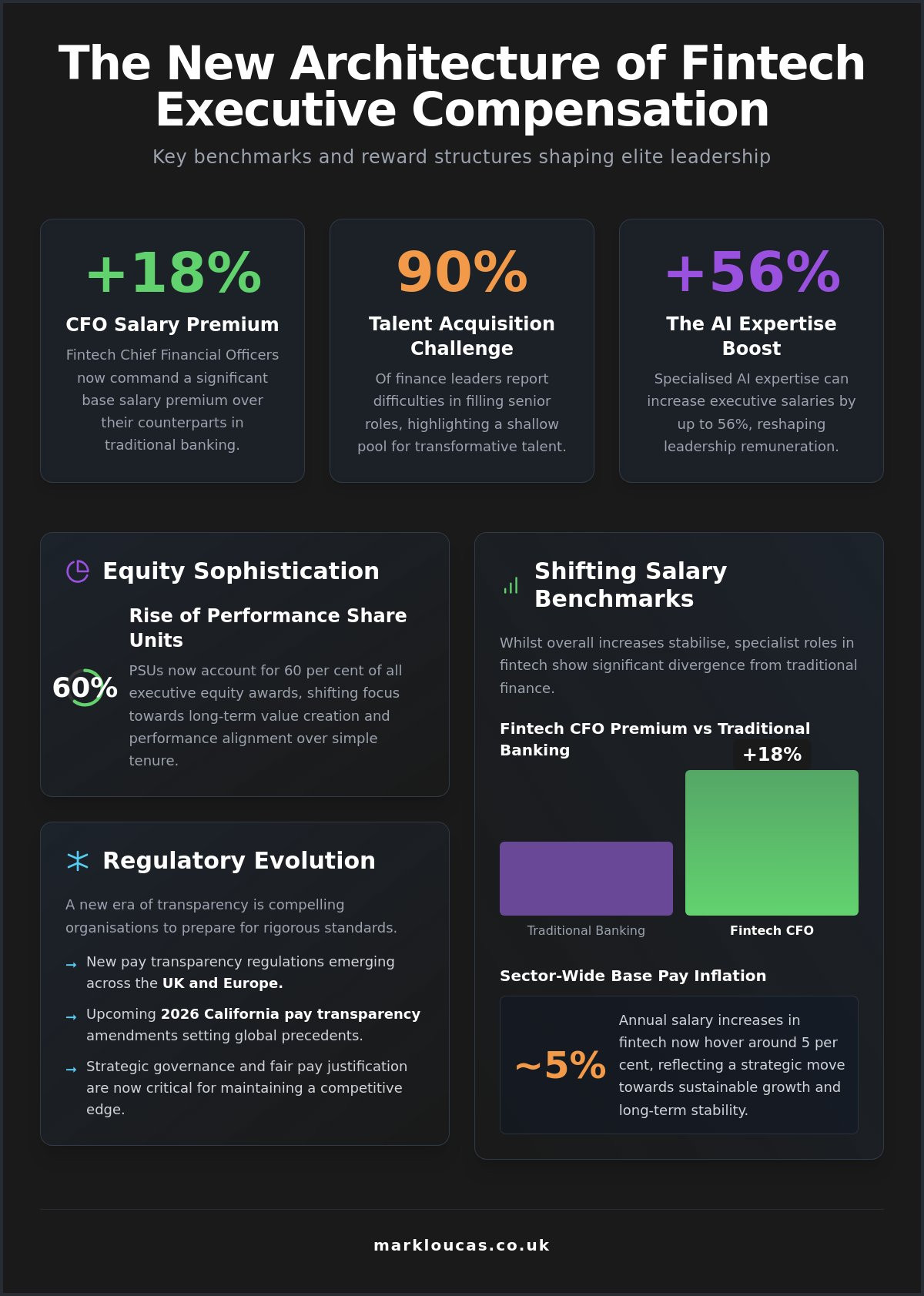
Did you know that the average fintech CFO now commands an 18 per cent base salary premium over their counterparts in traditional banking? Whilst the allure of established institutions remains strong, elite fintech executive compensation trends are shifting toward sophisticated, purpose-driven reward architectures that prioritise long-term alignment. You likely feel the pressure of a tightening market where 90 per cent of finance leaders report difficulties in filling senior roles. It’s a delicate balance to strike. You must compete against the deep pockets of legacy banks whilst maintaining the agility that defines your organisation.
In this guide, you’ll discover how elite fintech organisations are structuring executive packages to attract and retain world-class leadership in a competitive global market. We examine the rise of performance share units, which now account for 60 per cent of executive equity awards, and the impact of new pay transparency regulations across the UK and Europe. From navigating the 2026 California pay transparency amendments to understanding how AI expertise can boost salaries by up to 56 per cent, we provide the insights needed to secure the industry’s most sought after talent. This is about more than just numbers. It’s about strategic governance.
Key Takeaways
- Understand the evolving landscape of salary benchmarks where specialist roles like the CFO now command significant premiums over traditional banking counterparts.
- Master the latest fintech executive compensation trends by moving beyond standard equity models toward performance linked incentives that ensure long term alignment.
- Prepare your organisation for the rigorous new pay transparency standards emerging across the UK and Europe to maintain a competitive edge.
- Learn how to structure bespoke remuneration packages that reflect the specific needs of elite leaders whilst navigating market volatility.
- Gain insights into the premium values placed on AI expertise and how these specific skills are reshaping leadership costs in the digital banking sector.
For those seeking bespoke guidance on securing elite leadership within the global market, please reach out to our team through our contact page.
The 2026 landscape of fintech executive compensation
The global fintech leadership market in 2026 is defined by a paradox of growth and scarcity. Whilst the sector continues to mature, the talent pool for truly transformative leaders remains exceptionally shallow. Recent data indicates that 90 per cent of finance leaders find it difficult to fill senior roles, a statistic that underscores the competitive nature of current fintech executive compensation trends. Elite firms have moved away from the loud, aggressive bidding wars of previous years. Instead, they embrace a strategy of quiet confidence, where remuneration is treated as a discreet, highly personalised agreement rather than a public auction. This unhurried approach ensures that both the organisation and the candidate find a perfect alignment of values and vision.
Generic salary surveys often fail to capture the nuance required for these high level appointments. They provide a grand vision of the market but overlook the granular details of craftsmanship and specific expertise that a boutique advisor identifies. For instance, a Chief Financial Officer in a fintech firm now earns an 18 per cent premium over traditional banking roles, a distinction that broad surveys often miss. True excellence in talent acquisition requires a curated approach that acknowledges the rarity of the individual and the specific geography of premium urban centres. It’s about finding the right fit for a role that demands meticulous attention to detail.
Market dynamics in digital banking
Leaders within the digital banking sector are increasingly redefining traditional C-suite boundaries. The demand for those who can bridge the gap between legacy finance and agile technology has never been higher. This shift has placed a premium on digital banking recruitment, as neobanks and emerging startups compete for a limited number of visionaries. These organisations are no longer just looking for managers; they seek architects of the future who can navigate complex regulatory environments whilst driving rapid innovation. It’s a landscape where the distinction between a startup and a neobank is often defined by the calibre of its leadership team.
Inflation impacts on base pay
Base salary remains the fundamental anchor of reliability in any package. In 2026, we’ve seen annual salary increases in the fintech sector hover around 5 per cent, according to Ravio. Whilst this is a slight decrease from the previous year, it reflects a move towards sustainable growth and stability. Understanding the broader executive compensation structures is vital when contrasting the UK market with global hubs like New York or Singapore. In London, the focus has shifted towards maintaining purchasing power through meticulous adjustments, ensuring that the core of the remuneration package remains robust against inflationary pressures. A steady, reassuring pulse in base pay provides the confidence needed for executives to focus on long term strategic goals.
For those seeking a tailored approach to executive search that reflects the unique requirements of their organisation, we invite you to connect with our consultants for a private discussion.
Shifting salary benchmarks and total reward structures
The architecture of remuneration in 2026 has evolved beyond simple salary brackets, moving instead toward a model of curated excellence. In premium financial centres like London and New York, the distinction between traditional investment banking and elite fintech firms is becoming increasingly nuanced. Whilst legacy institutions often rely on higher base salaries to anchor their talent, fintech organisations are leveraging sophisticated total reward structures to attract visionaries. This requires a meticulous attention to detail that generic surveys cannot provide, particularly when benchmarking roles that demand a rare blend of technical prowess and commercial acumen. It is a matter of precision.
For the discerning leader, understanding which roles command the most significant investment is essential. These five positions currently represent the pinnacle of the market in terms of total compensation growth:
- Chief Technology Officer – With base salaries ranging from $300,000 to $400,000, this role remains the primary driver of technical innovation.
- Vice President of Engineering – Commanding between $280,000 and $370,000, these leaders are the architects of scalable infrastructure.
- Chief Revenue Officer – Packages often include a base of $260,000 to $340,000, balanced by significant variable components.
- Chief People Officer – Reaching up to $320,000, this role is now recognised as vital for managing elite talent pools.
Total direct compensation in a high growth environment is no longer just about the monthly pay cheque. It is a strategic alignment of base salary, annual bonuses, and long term incentives. In 2026, long term incentives often comprise 60 per cent of the total direct compensation for C-suite executives, reflecting a commitment to sustainable value creation. These fintech executive compensation trends suggest that leaders remain focused on the grand vision of the firm rather than short term fluctuations. This unhurried approach to wealth building provides the stability required for truly transformative leadership.
Competitive analysis against traditional finance
Fintech firms occasionally offer lower base salaries than top tier investment banks, yet the total upside remains the primary draw for elite candidates. Discerning professionals often accept a slightly reduced immediate cash component in exchange for substantial equity participation, which acts as a signal of confidence in the firm’s trajectory. Our fintech banking technology recruiters observe that this equity sophistication is what separates market leaders from their peers. It creates a partnership between the executive and the organisation that traditional banking models struggle to replicate, ensuring that interests are aligned with expert care.
Priority roles commanding premiums
We are seeing a notable surge in demand for CTOs and Chief Revenue Officers who can navigate the complexities of global expansion with quiet confidence. Equally, the role of a compliance expert has become a cornerstone of the executive suite, especially within heavily regulated sectors where risk management is paramount. Niche expertise in payments infrastructure is also driving compensation higher, as firms seek those who can manage the granular details of cross border transactions. This demand ensures that those with specialised knowledge are rewarded with packages that reflect their rarity and strategic importance. If you are looking to secure such talent, a private consultation can help define the optimal package structure.
To ensure your leadership team is aligned with your long-term vision through expertly crafted reward structures, please speak with our advisors via the contact page.
Equity sophistication and performance-linked variable pay
In 2026, the complexity of reward structures has reached a level of architectural detail that mirrors the maturity of the sector itself. Series C and D firms are moving beyond the rudimentary stock option grants of their early years. They now opt for sophisticated Long Term Incentive Plans (LTIs) that reflect a grand vision of sustainable growth. These plans are designed with an unhurried pace, using extended vesting schedules to act as a discreet yet powerful retention mechanism. By aligning the executive’s personal wealth with the long-term health of the firm, organisations ensure that every decision is made with expert care. This evolution in fintech executive compensation trends highlights a shift towards reward architectures that are both elite and approachable, avoiding the high-pressure volatility of earlier market cycles.
Variable pay is increasingly used as a precision tool to drive specific business outcomes. It’s no longer just about meeting revenue targets. It’s about how those targets are achieved. Negotiating these complex arrangements requires a deep understanding of the market, making the role of fintech executive search indispensable in securing global leadership. These deals require a boutique touch to ensure that the interests of the individual and the organisation are perfectly harmonised.
Long term incentive plans
In the current landscape, approximately 60 per cent of executive equity awards are structured as Performance Share Units (PSUs). Unlike traditional stock options, which can feel impersonal and volume-driven, PSUs and Restricted Stock Units (RSUs) offer a refined sense of ownership. Milestone-based vesting has become the standard for high-growth firms, where specific operational achievements act as triggers for equity release. This approach allows firms to organise their equity pools with meticulous attention to detail, ensuring that rewards are directly linked to the craftsmanship of the executive’s work. It’s a steady, reassuring pulse that rewards patience and diligence.
ESG metrics in bonus structures
Institutional investors now favour remuneration models that go beyond pure financial returns, seeking a commitment to long-term sustainability. Bonuses are increasingly tied to measurable outcomes, such as reducing the gender pay gap, which currently stands at 20.0 per cent in the fintech sector. Other metrics include carbon footprint reduction targets and diversity benchmarks within the leadership team. By embedding these values into the compensation framework, firms project the persona of a responsible, knowledgeable insider who values more than just the bottom line. This focus on curated excellence ensures that the brand’s reputation remains untarnished in a discerning global market.
If your organisation requires expert guidance on aligning your remuneration strategies with the latest regulatory mandates, please reach out to our team via our contact page.
Regulatory evolution and the demand for pay transparency
The EU Pay Transparency Directive, which has reached its full global influence in 2026, has fundamentally altered the landscape of leadership remuneration. Whilst the UK maintains its own distinct legal framework, elite London based firms are proactively adopting these transparency standards to ensure they remain attractive to a global pool of talent. These fintech executive compensation trends reflect a broader shift towards institutional maturity and accountability. It’s a move of quiet confidence. Firms that embrace transparency early signal to the market that their reward structures are built on a foundation of fairness and curated excellence. Navigating these requirements whilst preserving the privacy of high level agreements requires a sophisticated touch. Engaging with specialised financial recruitment is vital for firms that wish to meet these new standards without losing the discretion that defines elite executive search.
The influence of transparency directives
The 2026 mandates require organisations to provide clear pay scales and good faith estimates of remuneration ranges during the hiring process. This shift has significantly changed candidate behaviour during the negotiation phase. Leaders now enter discussions with a wealth of data, expecting a level of directness that was previously uncommon in the C-suite. To avoid legal and reputational risks, firms must organise their internal data with meticulous attention to detail. This involves auditing existing packages to ensure they align with the grand vision of internal equity. It’s a steady, reassuring process that builds trust with prospective hires from the very first interaction.
Addressing senior gender pay gaps
The fintech sector continues to face scrutiny regarding the gender pay gap, which currently sits at 20.0 per cent. This figure is notably higher than the segment average of 17.3 per cent, prompting a renewed focus on strategic initiatives to close the gap at the executive level. Transparency is being used as a powerful signal of exclusivity and fairness. By disclosing pay data and setting clear benchmarks for advancement, firms can attract a more diverse range of elite candidates who value a culture of meritocracy. These efforts are not just about compliance. They are about building a brand that is recognised for its commitment to craftsmanship and distinction in every aspect of its operations.
If you are seeking to refine your approach to transparency whilst maintaining the discretion your leadership team expects, we invite you to consult with our specialised advisors.
To explore how a bespoke remuneration strategy can elevate your leadership search, please contact our consultants through the dedicated enquiry page.
Strategic talent acquisition through tailored remuneration
In an era where elite talent is increasingly discerning, the success of a leadership appointment often hinges on the craftsmanship of the offer itself. A personalised approach to executive search transcends the limitations of standardised models. It’s about understanding the unique aspirations of a candidate and weaving them into the grand vision of the organisation. This is where bespoke reward architectures become a powerful differentiator. Whilst large corporate entities might rely on rigid structures, a boutique advisor helps you structure deals that feel intimate and exclusive. Current fintech executive compensation trends demonstrate that the most successful firms are those that treat every hire as a high value transaction requiring expert care. It is a process of curation rather than volume.
This approach to curation is equally essential when managing strategic corporate transitions; learn more about how Pinnacle Global Advisory’s expert solutions can support your firm’s growth and M&A objectives.
The transition from a candidate being an outsider to becoming a cornerstone of your leadership team is a delicate journey. It requires a steady, reassuring pulse of communication and a commitment to transparency that builds lasting trust. By crafting a remuneration package that acts as an anchor of reliability, you provide the candidate with the confidence to fully commit to your firm’s long term objectives. This unhurried approach to negotiation ensures that every detail is polished to perfection, reflecting the high standards of your brand. Mark Loucas Ltd operates as a knowledgeable local insider in these moments, ensuring that the alignment between executive and firm is both precise and sustainable.
Personalised benefits for elite candidates
Beyond the base salary and performance linked equity discussed earlier, non-cash benefits play a crucial role in securing world class talent. Bespoke wellness plans and comprehensive private healthcare are no longer just perks. They are signals of a brand that values individual attention and the long term well being of its leaders. Flexible working arrangements for senior leaders also reflect a sophisticated understanding of modern high end living, allowing for a balanced life without sacrificing professional impact. These details paint a picture of a brand that is never in a rush, valuing the person behind the title with a sincerity that elevates the offer from a mere contract to a partnership.
Specialist executive search partnerships
Partnering with a boutique firm allows for a level of market mapping and intelligence that volume driven recruiters simply cannot match. It provides a discreet, highly connected gateway to private opportunities that are often not visible in the public domain. Mark Loucas Ltd acts as this knowledgeable advisor, ensuring that your interests are managed with meticulous attention to detail from the initial search to the final negotiation. This level of expertise is the cornerstone of high stakes recruitment, where the stakes are too high for anything less than perfection. Success in 2026 requires more than just data. It requires a tailored solution delivered with quiet confidence. Expert guidance is the ultimate luxury in a competitive market.
For organisations seeking a discreet partner to navigate the complexities of senior leadership search, please visit our contact page for a private consultation.
Securing the future of fintech leadership
The evolution of the sector requires a move towards reward architectures that prioritise long term alignment and strategic governance. We’ve examined how elite organisations are responding to fintech executive compensation trends by integrating performance linked equity and proactive transparency into their leadership packages. These strategies are no longer optional for firms that wish to attract the most sought after visionaries in a global market. Mark Loucas Ltd acts as a discreet and highly connected boutique advisor, bringing over 15 years of specialised expertise in global fintech recruitment to every engagement. Our data driven market intelligence ensures that high stakes senior appointments are managed with the meticulous attention to detail they demand. By focusing on curated excellence and individualised attention, your firm can build a leadership team capable of navigating the grand vision of the future. We invite you to partner with our elite fintech executive search team to secure your next leader. The path to sustained growth begins with a commitment to excellence in every hire.
Frequently Asked Questions
How much has fintech executive base salary increased in 2026
The average increase in executive base salaries for established firms reached approximately 4.7 per cent in 2026. This growth suggests a move towards sustainable reward architectures rather than the reactive bidding cycles of previous years. By focusing on steady adjustments, organisations maintain a sense of reliability whilst ensuring they remain competitive within the global leadership market.
Can fintech firms compete with traditional banks on executive compensation
Fintech organisations often outperform traditional banks by offering significant premiums for specialised roles. For instance, a Chief Financial Officer in the fintech sector now earns about 18 per cent more in base salary than their counterparts in legacy banking. Whilst banks may offer higher immediate cash, fintech firms leverage sophisticated equity upside to attract elite visionaries who value long term wealth creation.
What happens if a firm does not comply with new pay transparency regulations
Non-compliance with pay transparency mandates can lead to significant legal penalties and profound reputational damage. In certain jurisdictions, the statute of limitations for pay violations has been extended to three years, making meticulous data management essential. Beyond legal risks, failing to provide clear pay scales can alienate elite candidates who expect a level of professional directness during the hiring process.
Is equity still the most important part of a fintech executive package
Equity remains the dominant component of remuneration, often accounting for 60 per cent of total direct compensation for C-suite executives. These fintech executive compensation trends highlight a move toward Performance Share Units which align personal rewards with the firm’s grand vision. This structure ensures that leaders remain focused on sustainable growth rather than short term fluctuations in market value.
How much of an executive bonus is typically linked to ESG targets
Executive bonuses are increasingly tied to measurable social and environmental outcomes, with a growing emphasis on closing the 20.0 per cent gender pay gap. Institutional investors now favour models that link a portion of variable pay to ESG targets, such as diversity benchmarks and carbon reduction goals. This approach ensures that leadership behaviour reflects the broader values of a discerning and socially conscious clientele.
How can a boutique recruitment firm help in benchmarking executive pay
A boutique recruitment firm provides the discreet market mapping and intelligence required to benchmark niche roles with precision. Unlike larger entities that rely on generic surveys, a specialist advisor identifies private, non-public opportunities and provides a granular view of the local market. This personalised approach ensures that your offer is both competitive and reflective of the candidate’s unique craftsmanship.
Is the gender pay gap closing in the UK fintech sector
The gender pay gap in the fintech sector currently stands at 20.0 per cent, which is notably higher than the segment average of 17.3 per cent. Whilst transparency regulations are driving more rigorous reporting, significant work remains to close this gap at the executive level. Strategic initiatives that tie remuneration to diversity targets are becoming a hallmark of firms that value curated excellence.
Can interim directors expect the same compensation structures as permanent executives
Interim directors typically operate under different remuneration structures that prioritise immediate impact over long term equity. Whilst permanent executives focus on multi-year vesting schedules, interim leaders are often rewarded through competitive day rates that reflect their specialised expertise. This allows firms to secure elite talent for specific projects without the complexities of long term incentive plans.

Article by
Liam Henfrey
Liam Henfrey is a seasoned specialist in the payments and banking sectors with over two decades of experience. As the Founder and CEO of FINOPSIS and Managing Director at Mark Loucas Ltd, he advises organisations on complex financial operations and technology. His career includes senior roles at PwC, Deloitte, and Visa Europe.
Related Fintech Recruitment Guides
If you liked this guide then you may also like the following: