


Building a Go-to-Market Team for a Fintech Startup in 2026
A go-to-market strategy is little more than a static document until it’s animated by a high-calibre team. In a global market projected to reach 460 billion dollars this year, the margin for error in building a go-to-market team for a fintech startup has never been thinner. You likely recognise that the cost of a senior mis-hire often exceeds the initial salary, especially when navigating the complex web of state-level money transmitter licences and increased regulatory scrutiny. It’s a delicate balance to strike. You require the agility of a disruptor alongside the meticulous discipline of a seasoned compliance officer.
This article provides a refined blueprint for assembling your leadership engine, ensuring your path to market dominance is both accelerated and secure. We shall explore the essential GTM team structures and recruitment roadmaps that reduce the risk of senior appointments. From identifying the ideal Chief Revenue Officer to securing specialists who understand the nuances of the latest executive orders, you’ll discover how to curate a workforce that transforms ambitious visions into sustainable commercial reality.
Key Takeaways
- Understand the essential architecture of a cross-functional unit designed to deliver your financial products to the market with absolute precision.
- Identify the three core pillars of Sales, Marketing, and Customer Success that are fundamental when building a go-to-market team for a fintech startup.
- Learn why your GTM talent must possess a rare combination of startup agility and sophisticated regulatory knowledge to thrive in the 2026 financial landscape.
- Access a structured recruitment roadmap that secures high calibre executive leadership whilst significantly reducing the risk of costly senior mis-hires.
- Discover the distinct advantages of engaging a discreet boutique advisor to uncover exclusive talent that remains hidden from volume-driven recruitment agencies.
If you are looking to secure the leadership necessary for your next phase of growth, please contact us for a consultation to discuss our executive search and advisory services.
The Foundation of a Scalable Go-to-Market Team
A go-to-market strategy provides the theoretical map, but the GTM team is the cross-functional group that actually navigates the terrain to deliver a product to the end customer. In the current 2026 climate, where the global fintech market is projected to reach values between 324 billion and 460 billion dollars, the human element represents the most significant risk factor for any burgeoning enterprise. Whilst code can be debugged and financial models can be recalibrated, a fundamental mis-hire at the leadership level can derail a launch for many months. For many founders, the journey begins with founder-led sales, an intimate period where the vision is sold through sheer passion. However, scaling requires a transition into a structured GTM organisation. This shift is where the process of building a go-to-market team for a fintech startup becomes a critical exercise in precision and architectural planning.
Understanding the Human Element of GTM Success
A strategy document is a static asset, yet the market is a living, breathing entity that requires constant interpretation. High-performing teams act as the dynamic bridge between technical development and widespread market adoption. They translate complex features into value propositions that resonate with a discerning audience. In a high-pressure environment, cultural alignment amongst your first few hires is non-negotiable. These individuals set the standard for every subsequent appointment, acting as the custodians of your brand’s reputation. They must possess the quiet confidence to manage high-value transactions whilst maintaining the agility required for rapid scaling. Finding talent that understands both the tech and the unique regulatory demands of 2026, such as the 49-state money transmitter licensing requirements, is the key to avoiding costly delays.
While fintech requires a unique set of skills, this principle of audience-focused growth applies to all sectors; for those in healthcare or the non-profit space, you should check out Throughmotion Ltd. for expert guidance on engagement and nurturing.
Avoiding the Generalist Trap in Early Stages
Early-stage ventures often fall into the trap of hiring generalists to save on initial costs. Whilst a “jack-of-all-trades” approach may seem efficient, it frequently hinders growth in a sector as nuanced as fintech. Specialised knowledge in areas like fintech banking technology is essential for navigating modern regulatory hurdles and complex bank partnerships. Bringing in niche expertise early allows for more robust long-term workforce planning. Utilising a bespoke fintech talent advisory service ensures that your recruitment roadmap aligns with your strategic growth targets. This prevents the common pitfall of hiring for the present whilst ignoring the structural requirements of the future. By focusing on high-calibre specialists, you ensure that every hire contributes to a foundation of excellence that can support sustainable, long-term market dominance.
If you wish to discuss the bespoke requirements for your next senior hire, please reach out to our team for a private consultation.
Essential Roles for Your Initial GTM Structure
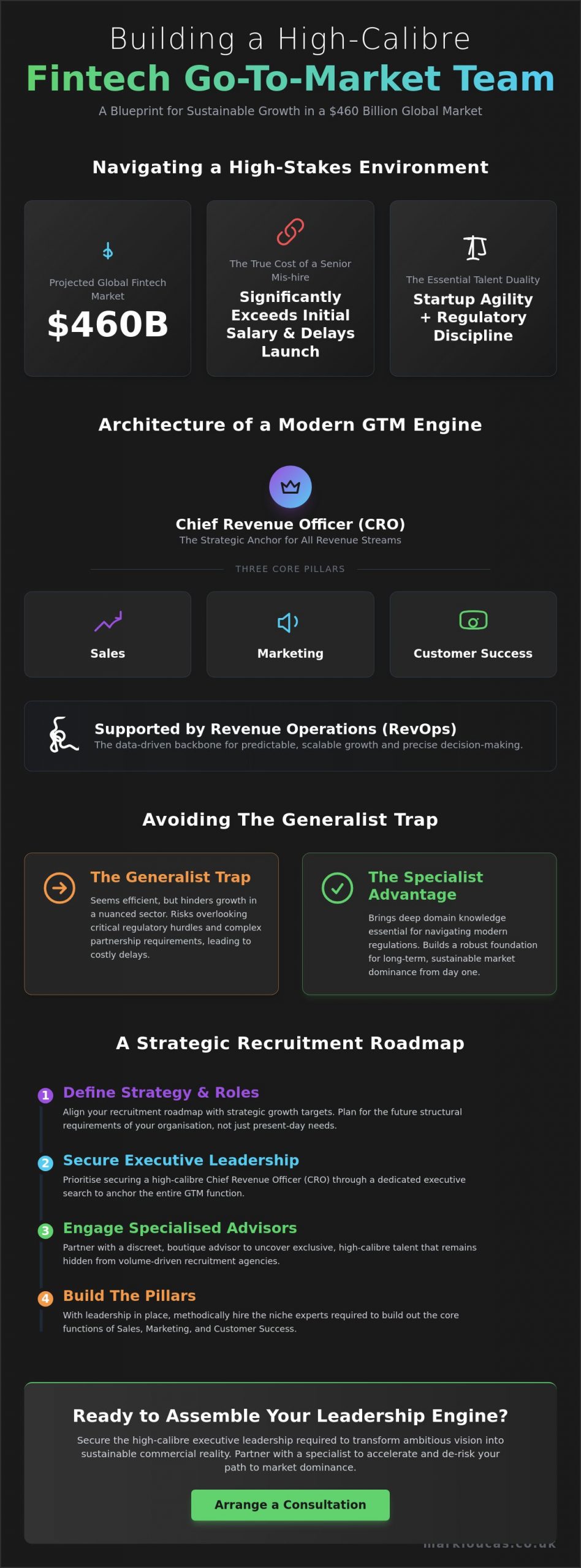
A modern GTM engine rests upon three fundamental pillars: Sales, Marketing, and Customer Success. In the context of 2026, these are no longer siloed departments but interconnected functions that must move in synchrony to capture market share. At the summit of this structure is the Chief Revenue Officer (CRO), the strategic lead for all income streams. This individual ensures that every customer touchpoint is optimised for commercial growth and long-term stability. When building a go-to-market team for a fintech startup, securing this leadership through a dedicated fintech executive search is often the first step toward institutional excellence. Supporting the CRO is the growing necessity of Revenue Operations. In a market where data is as valuable as capital, RevOps provides the analytical backbone required for precise, data-driven decision-making, ensuring that your growth is both predictable and scalable.
The Chief Revenue Officer as the Strategic Anchor
The CRO serves as the bridge between all revenue-generating departments, harmonising discordant goals into a unified strategic go-to-market approach. Whilst a generalist leader might understand standard sales cycles, a CRO with deep fintech experience understands the friction of regulatory compliance and the nuances of building institutional trust. In the 2026 market, the CRO is the architect of sustainable revenue who balances rapid customer acquisition with the meticulous health of the unit economics. For those seeking to refine their leadership structure, our bespoke talent advisory offers the clarity required to move forward with confidence.
Marketing and Sales Alignment through Specialist Hires
Product Marketing Managers are the vital translators of your organisation. They take technical, often dense, product features and refine them into elegant value propositions that solve specific pain points for your clientele. In the field, Account Executives and Sales Development Reps must collaborate with a degree of sophistication that mirrors the complexity of the fintech environment. It’s no longer about simple volume; it’s about the quality and depth of the engagement. Finally, Customer Success Managers act as the guardians of retention. In subscription-based digital banking models, where churn is the primary enemy of growth, these specialists ensure that the initial promise of the product is delivered throughout the entire customer lifecycle.
If you require assistance in sourcing professionals who possess this rare blend of regulatory acumen and commercial drive, our consultants are available to discuss your needs at our contact page.
Navigating the Unique Talent Demands of Fintech
The distinction between a standard SaaS enterprise and a financial technology firm is often found in the complexity of the “yes”. In traditional software, a purchase decision usually rests on utility and cost. In the financial sector, every transaction is filtered through a dense layer of risk and regulation. Building a go-to-market team for a fintech startup requires a radical departure from the generalist hiring patterns seen in broader tech circles. There’s a common objection amongst some founders that any competent salesperson can sell a well-designed product regardless of the industry. In the 2026 landscape, this is a costly misconception. The global fintech market’s growth, projected to exceed 400 billion dollars, is driven by trust as much as it’s by innovation. Without deep industry context, a GTM lead cannot build that trust. This reality is why payments industry recruitment has become a highly specialised field, focusing on candidates who can navigate the friction of institutional finance.
Regulatory Knowledge and Compliance Expertise
GTM leaders must understand that compliance is a core component of the sales cycle, not a secondary concern for the legal department. They must possess the ability to explain how their product aligns with evolving priorities from bodies like the FCA or the latest executive orders regarding anti-money laundering. This knowledge allows them to anticipate objections before they arise, effectively shortening the path to a signed contract. We’ve previously highlighted the strategic role of a compliance officer as a vital support function. Your GTM leadership must act as the commercial mirror to that role, translating security and regulatory adherence into a competitive advantage that reassures the most discerning institutional clients.
The Impact of Payments Infrastructure Experience
Technical literacy in payments infrastructure is a non-negotiable asset for GTM hires in 2026. As the industry undergoes the massive shift of ISO 20022 migration, your team must understand how these standards impact message richness and interoperability. A leader who can discuss the nuances of Real-Time Gross Settlement (RTGS) or the future of digital currencies commands immediate authority. Pure sales ability is certainly helpful for opening doors, whilst deep technical infrastructure knowledge is what actually closes them. This expertise affects everything from market positioning to the credibility of your brand in premium urban centres. It ensures that your GTM team isn’t just selling a dream, but a robust, compliant, and technically superior financial solution.
To see how these technical standards are applied in practice, you can visit Gemba to explore their banking infrastructure solutions for non-banks.
To begin the process of identifying your next high-calibre executive, we invite you to connect with our consultants for a private discussion regarding your leadership requirements.
Strategic Steps to Assemble Your Executive Leadership
Assembling a leadership team is an exercise in architectural precision that requires a steady, reassuring pulse. Before a single interview occurs, one must engage in comprehensive market mapping and intelligence to understand the competitive landscape and the exact location of the most capable talent. This preparatory work is the foundation for successfully building a go-to-market team for a fintech startup, ensuring that your search is targeted and efficient. Partnering with specialised fintech banking technology recruiters allows for a level of insight that generalist agencies cannot provide, offering access to a network of professionals who possess both technical depth and commercial acumen. This roadmap moves logically from the grand vision of your venture to the granular details of a candidate’s professional history, ensuring a perfect alignment with your strategic goals.
Defining the Ideal Candidate Profile
Creating a scorecard that balances startup agility with deep industry expertise is essential for long-term success. Whilst a candidate may have a glittering career at a Tier 1 bank, they might lack the specific grit required to navigate the unchartered waters of an early-stage venture. Conversely, a startup veteran may lack the technical discipline needed for complex payments infrastructure or the patience required for lengthy regulatory cycles. A single mis-hire in a high-stakes payments environment is not merely a financial loss; it’s a structural failure that can delay market entry by years. You must weigh the value of a proven track record against the potential for future growth, seeking those rare individuals who can operate effectively at both levels.
Implementing a Rigorous Executive Search Process
A professional search moves through several unhurried stages, beginning with a discreet longlist of potential candidates. In the exclusive world of fintech leadership, the most exceptional individuals are rarely found on public job boards. This focus on non-public opportunities is a hallmark of elite recruitment, ensuring you have access to talent that is otherwise invisible to the market. During the interview phase, you must assess a candidate’s ability to build a functional team from scratch, rather than simply managing an existing one. This involves examining their previous recruitment roadmaps and their success in retaining high-calibre talent in high-pressure environments. To secure the leadership your venture deserves, you may enquire about our executive search services to discuss a tailored approach for your organisation.
For those seeking to secure the elite leadership required for market dominance, we invite you to discuss your requirements with our team of specialist advisors.
Partnering with Specialists to Secure High Calibre Talent
The final stage of building a go-to-market team for a fintech startup is perhaps the most delicate, as it involves moving beyond the internal network of the founders to secure individuals who possess the specific, high-calibre experience required for the 2026 landscape. Large, volume-driven corporate firms often struggle with the nuanced requirements of the payments sector. Their approach is frequently impersonal, focusing on quantity rather than the architectural fit of a candidate. In contrast, a boutique consultancy like Mark Loucas Ltd offers a tailored approach that prioritises privacy and excellence. By leveraging fintech talent advisory services, you gain access to a level of market intelligence that ensures every hire is a strategic asset. This unhurried, logical flow of talent acquisition ensures that your brand is never in a rush, reflecting the patience and diligence required in high-value transactions.
Why Niche Recruitment Outperforms General Agencies
The personalised approach of a specialist recruiter is built upon years of deep industry connections and a sophisticated understanding of the financial ecosystem. Whilst general agencies may rely on broad databases, a niche partner utilises Market Mapping & Intelligence to identify talent that is perfectly aligned with your specific geography and culture. This meticulous attention to detail leads to higher quality placements and significantly better long-term retention. For fintech providers, having a partner who understands the granular details of your history and context is a distinct competitive advantage. It ensures that your GTM team is not just a collection of individuals, but a cohesive unit designed for growth.
Accessing Non-Public Talent Pools
The most effective GTM leaders are rarely active on public job boards; they are typically successfully leading other ventures and require a discreet approach. Accessing these passive talent pools requires the intervention of a knowledgeable local insider who can facilitate exclusive introductions to senior talent through a network that remains hidden from the wider market. This curated excellence ensures that the candidates presented to you are not merely available, but are the most qualified individuals for the role. Professional recruitment through a partner that understands payments industry recruitment accelerates your GTM timelines by removing the friction of the search process. Ultimately, professional recruitment does more than fill seats; it acts as a catalyst for market dominance by ensuring your team is functional and compliant from day one.
If you are ready to secure the high-calibre leadership your venture deserves, please contact our expert consultants to begin building your GTM leadership team.
Securing Your Path to Market Dominance
The transition from a visionary concept to a commercially dominant force requires more than just a strategy; it demands the right people. Success in building a go-to-market team for a fintech startup hinges on harmonising specialised technical knowledge with a deep understanding of the evolving regulatory landscape. By prioritising roles such as the Chief Revenue Officer and investing in Revenue Operations early, you create an engine capable of sustainable, predictable growth.
Since 2011, Mark Loucas Ltd has provided the discreet, expert care required to navigate these high-stakes appointments. Our expertise in executive search for payments and digital banking, supported by data-driven market mapping and talent advisory, ensures that your interests are managed with meticulous attention to detail. We invite you to contact our expert consultants to begin building your GTM leadership team and secure the elite talent that remains hidden from the wider market. Your vision deserves a team of this calibre. With the right foundation in place, your path to dominance in the global fintech sector is not just an ambition, but a certainty.
Frequently Asked Questions
When should a startup hire its first GTM leader?
A startup should appoint its first GTM leader once the founders have validated the product and secured initial pilot customers. This strategic hire marks the transition from founder-led sales to a repeatable, scalable commercial engine. It ensures that the unhurried pace of high-value transactions is maintained whilst the organisation expands its reach.
What is the difference between a GTM team and a marketing team?
Whilst a marketing team focuses on brand awareness and lead generation, a GTM team is a broader cross-functional group. It encompasses sales, marketing, and customer success to manage the entire journey of delivering a product to the customer. This structure ensures that every department is aligned with the grand vision of market adoption.
Why is niche expertise critical for fintech GTM hires?
Niche expertise is essential because fintech products are sold into a landscape of high risk and strict regulation. Building a go-to-market team for a fintech startup requires individuals who can speak the language of compliance and infrastructure with absolute authority. This specialised knowledge is the foundation of trust for institutional clients.
Should startups prioritise sales or marketing hires first?
Most startups benefit from hiring a senior GTM lead who can harmonise both functions simultaneously. For enterprise-focused fintechs, early sales hires often take precedence to manage complex institutional relationships. Conversely, product-led firms might prioritise marketing to drive self-serve adoption and establish early brand authority in premium urban centres.
How does executive search improve GTM success rates?
Executive search provides access to elite, passive talent pools that are invisible to standard recruitment methods. By using meticulous market mapping and intelligence, search firms identify leaders with a proven track record in navigating specific regulatory environments. This refined process significantly reduces the risk of a senior mis-hire during critical growth phases.
What are the most common hiring mistakes for new GTM teams?
The most frequent error is the generalist trap, where founders hire all-rounders who lack the technical depth required for finance. Another common mistake is failing to assess a candidate’s ability to build a functional team from scratch. Precise, specialised hiring is required to avoid the high cost of executive mis-hires.
Can a startup use interim directors for GTM execution?
Interim solutions are an excellent choice for startups requiring immediate, high-level expertise for specific milestones. These leaders provide the agility needed for territory expansion or product launches whilst the firm conducts a thorough search for a permanent appointment. This approach maintains a steady, reassuring pulse during periods of rapid transition.
How long does it typically take to build a full GTM team?
Building a go-to-market team for a fintech startup is a gradual process that typically spans twelve to eighteen months. Securing a high-calibre GTM lead often takes three to six months, with subsequent roles filled as the commercial roadmap evolves. This unhurried approach ensures that each appointment is a perfect architectural fit for the organisation.

Article by
Liam Henfrey
Liam Henfrey is a seasoned specialist in the payments and banking sectors with over two decades of experience. As the Founder and CEO of FINOPSIS and Managing Director at Mark Loucas Ltd, he advises organisations on complex financial operations and technology. His career includes senior roles at PwC, Deloitte, and Visa Europe.
Related Fintech Recruitment Guides
If you liked this guide then you may also like the following: