


Talent Strategy for Digital Banks That Builds Lasting Capability
What if the capability your digital bank needs is not best built by filling another vacancy? A talent strategy for digital banks starts with the operating model and business priorities, then identifies which skills to develop, recruit permanently or bring in for a defined project.
That distinction matters in the UAE, where competition for specialist banking, payments and technology talent can make critical roles difficult to fill. It is also familiar to leaders balancing long-term capability with immediate delivery needs. Recruitment can help close a gap, but it works best as part of a wider plan to build and retain the skills the bank depends on.
This guide explains how to turn strategic priorities into clear workforce and capability needs, and how to choose between internal development, permanent recruitment and interim support. It also explores how market mapping and talent advice can inform decisions, so you can prioritise hiring and adapt your approach as the bank’s plans evolve.
Key Takeaways
- Build a talent strategy for digital banks around the capabilities needed to deliver business priorities, not just a list of vacancies.
- Map the skills already available across product, technology, operations and risk, then identify gaps that need focused action.
- Choose internal development, permanent recruitment or interim support according to the capability required and how long it must be in place.
- Turn priority gaps into accountable workstreams, with clear ownership across business, technology, people and talent acquisition leaders.
- Use specialist recruitment, market insight and managed services to support delivery within the wider workforce plan.
For a considered discussion of how workforce choices can support your bank’s direction, start a conversation about your talent priorities.
Why a talent strategy for digital banks must go beyond hiring
A hiring plan records the roles an organisation wants to fill. A talent strategy for digital banks goes further: it connects business direction to the capabilities needed to deliver it, then sets out how those capabilities will be built, retained or brought in. Recruitment is one part of the answer, not the strategy itself.
This distinction matters because a digital bank’s services depend on connected work across product, technology, operations and risk. Customer-facing journeys need to be designed and improved, while the systems behind them must operate reliably and securely. The workforce also needs to support sound decisions about data, payments, cybersecurity and core banking. A gap in one area can affect delivery in another.
What makes digital-bank talent needs distinctive
Digital banking brings together skills that have often sat in separate teams. A product professional shaping a payments journey, for example, needs to understand customer needs and commercial priorities while working closely with technology colleagues who understand the platform and controls. Cybersecurity, data and core banking roles also call for a blend of technical depth and banking context. The precise mix depends on the service and the bank’s operating model.
Role titles alone can give an incomplete picture. Two people with the same title may bring different strengths, and one capability may be spread across several roles. Digital banking recruitment can support a targeted search, but workforce planning should first clarify the capability the organisation needs and how it will contribute to delivery.
A forecast cited by The Financial Brand predicted that two in five hybrid-skill retail banking vacancies would remain unfilled by 2025. That figure is historical context, not a current measure of the UAE market. Its lasting relevance is the challenge it points to: banks need to identify scarce combinations of skills early, rather than assume a vacancy can be filled quickly once a project is under way.
Talent management also extends beyond recruitment to development and retention, as outlined in this overview of talent management. A longer-term workforce strategy considers which capabilities must remain within the bank, where existing employees can grow, and where external expertise can help meet a specific need.
For example, a bank preparing to modernise a core banking platform may need lasting internal ownership of the system, alongside specialist implementation expertise for a defined phase. Treating both needs as identical vacancies could obscure the different skills, timeframes and delivery choices involved.
To discuss how workforce choices can align with your organisation’s priorities, explore a conversation about talent priorities.
Start with the business outcome, not the job title
Begin by asking what the organisation needs its workforce to make possible. Is the priority to improve a customer journey, strengthen payment operations, develop a new service or support a technology change? A clear outcome gives leaders a basis for defining the capabilities required, assessing what already exists and deciding where to focus.
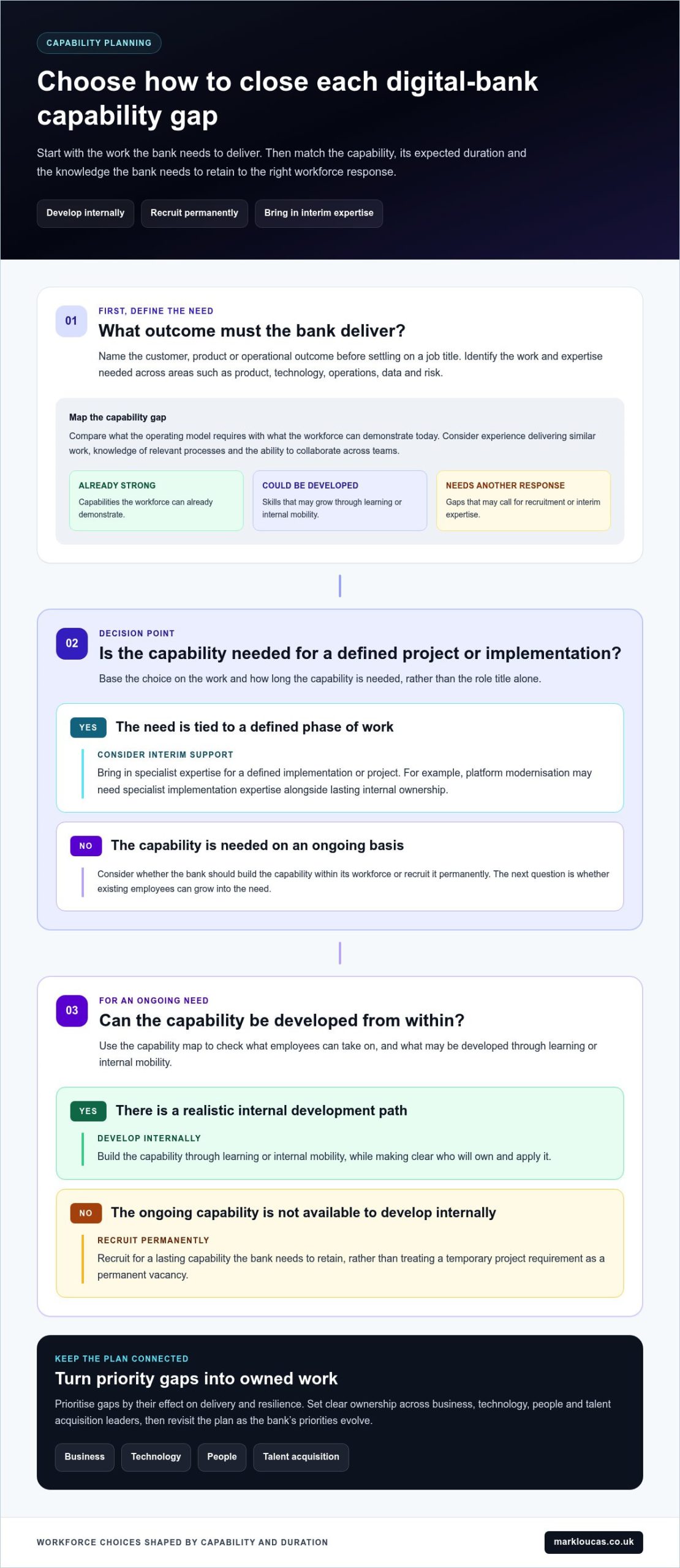
Then distinguish enduring capability from temporary delivery demand. A skill needed continuously to operate and improve a core service may call for internal development or permanent hiring. Expertise required for a defined implementation or project may be better addressed through interim support. Base the decision on the work, the knowledge the bank must retain and the expected duration of the need, rather than the job title alone.
For a considered discussion about aligning workforce choices with your organisation’s priorities, talk through your workforce priorities.
How to map digital-bank priorities into a capability plan
A capability plan translates strategy into choices leaders can act on. It shows what the bank wants to achieve, which capabilities that requires, where the gaps sit and who owns the response. This gives business, technology and people teams a shared basis for deciding what to develop, recruit or source in another way.
Translate strategic outcomes into capabilities
Start with planned customer, product and operational outcomes, then identify the work and expertise needed to deliver them. Group related needs across banking, payments, data, software and risk. A specialist skill, such as a particular data-engineering capability, differs from an organisational capability, such as using data consistently to guide product decisions. Both may matter, but they call for different plans.
Make the link between outcome and capability explicit. If a bank wants to improve a digital payments journey, the plan might include product design, payments operations, software delivery, data analysis and risk oversight. This is a capability cluster, not a single job description. It also helps leaders see where an existing team can contribute alongside specialists.
Prioritise capability gaps and development
Compare the capabilities required by the chosen operating model with those the workforce can demonstrate today. Look at practical evidence, such as experience delivering similar work, knowledge of relevant processes and the ability to collaborate across teams. Record what is already strong, what could be developed through learning or internal mobility, and where external recruitment or interim expertise may be needed.
Prioritise gaps by their effect on delivery and resilience. A capability that supports a critical service or several planned outcomes may warrant earlier action than a narrower need with limited impact. Specialist role families across digital banking recruitment can inform the mapping, but the target capability should guide the search.
Test the plan against plausible changes. If a product launch moves, technology delivery takes a different route or the operating model changes, would the priority skills still matter? Scenario planning helps distinguish capabilities that remain valuable across different futures from those tied to one initiative. It also makes the plan easier to update without rebuilding it from scratch.
For a compact example, suppose a bank plans to improve its digital payments service. Map the outcome to payments expertise, product design, software delivery, data insight and risk oversight. Assess current teams against each need, identify learning or internal moves that can close some gaps, then note where specialist external support is needed. Assign an owner and review point to each action.
The result is a living plan, not a static headcount request. A clear view of priority capabilities also makes workforce conversations more focused. If you’re shaping this process, discuss your workforce priorities with our team.
If you’re weighing development, permanent recruitment and interim support, start a conversation about sourcing options.
How to compare internal development, permanent hiring and interim talent
The right sourcing choice depends on the capability needed, how long it must be available and how much knowledge the bank needs to retain. These routes can complement one another, but they solve different problems. A considered talent strategy for digital banks matches each need to the option best suited to its purpose.
| Approach | Best suited to | Key consideration |
|---|---|---|
| Internal development | Building skills amongst current employees | Allow time for learning and supported practice |
| Permanent recruitment | Ongoing specialist or leadership needs | Builds continuity and organisational knowledge |
| Interim support | Defined projects or short-term resource gaps | Plan how expertise and handover will be managed |
When internal development is the better fit
Develop existing employees when they have relevant foundations and can build the capability required for future work. Learning is most useful when it connects to real responsibilities, with opportunities to apply new skills rather than relying on training alone. Internal mobility can also give employees a route into changing roles as the organisation’s needs evolve.
Plan for continuity as responsibilities shift. Identify who will take on a new task, how existing duties will be covered and where important knowledge sits. Development can strengthen the workforce over time, but it may not address an immediate specialist need or a capability the organisation does not yet have.
When permanent or interim recruitment can help
Permanent recruitment suits capabilities the bank needs to maintain and deepen. Bringing in specialist or leadership talent can add enduring expertise, support succession and build institutional knowledge. It is particularly relevant where the role will continue beyond a single initiative and needs close integration with the organisation.
Interim support can address a defined project or short-term resource gap, bringing focused experience for a particular stage of delivery. Set a clear purpose, expected contribution and handover approach so useful knowledge does not leave with the assignment. Mark Loucas provides contract and interim solutions for organisations considering project-based expertise.
A blended approach may be the best fit. A bank could develop current employees for long-term ownership, recruit permanently for a continuing leadership requirement and use interim expertise during a specific delivery phase. The roles are distinct: development grows internal capability, permanent hiring sustains it, and interim support addresses a time-bound need.
Before choosing, compare the required start point, continuity needs, knowledge retention and the work’s expected duration. This makes sourcing a deliberate response to the capability gap, rather than a default decision to hire. For a tailored discussion, explore the sourcing options for your organisation.
To shape the next steps around your organisation’s priorities, discuss putting your talent plan into practice.
How to turn a digital-bank talent strategy into an operating plan
A strategy becomes useful when each priority has an owner, a delivery route and a way to review progress. The operating plan should connect capability gaps to work leaders can resource and coordinate, rather than leaving actions as broad intentions. Keep it practical: clarify what needs to change, who is accountable and how the work supports the bank’s stated outcomes.
Create ownership and delivery workstreams
For each priority capability, name a decision-maker who can resolve trade-offs and a delivery owner responsible for moving the work forward. Ownership may sit with a business leader, technology lead or people leader, depending on the capability. Involve talent acquisition where external hiring is part of the response, so recruitment activity follows agreed priorities rather than becoming a separate list of vacancies.
Use a simple sequence to turn each gap into an accountable workstream:
- Define the result. State the business or operational outcome the capability must support.
- Choose the response. Decide whether to develop existing employees, recruit permanently, use interim support or combine approaches.
- Coordinate delivery. Align hiring, learning and project resourcing with business planning, including the manager and team who will integrate the capability.
- Plan continuity. Set out how onboarding, knowledge transfer and ongoing ownership will work, particularly where a project-based resource is involved.
This sequence helps expose dependencies early. A specialist joining a technology workstream, for example, needs a clear remit, access to relevant colleagues and an agreed route for transferring knowledge into the team. Without these arrangements, filling the role may not resolve the underlying delivery gap.
Review progress as business needs change
Choose measures that reflect the outcome the bank is pursuing. These might include coverage of priority roles, progress in developing agreed capabilities, or feedback from teams responsible for delivery. Set a baseline where useful, but avoid external targets that have no clear link to the organisation’s own plans. A measure should help leaders decide what to continue, adjust or prioritise next.
Review the plan in line with the organisation’s planning cycle, and revisit it when a meaningful change affects the work, such as a shift in product direction, technology delivery or operating needs. The purpose is not to reopen every decision at each review. It is to check whether the capability response still fits the outcome and whether ownership remains clear.
Where recruitment operations span several projects or teams, managed recruitment services can help coordinate budgeting, forecasting and administration. Leaders retain ownership of workforce priorities and outcomes.
A well-run operating plan makes the talent strategy for digital banks visible in day-to-day decisions, from hiring priorities to knowledge continuity. To discuss how to put your plan into practice, speak with our team about your talent priorities.
To explore how external support could fit your workforce plan, start a tailored talent strategy conversation.
How specialist recruitment and managed services support delivery
External recruitment is most effective when it serves a clear capability need within the wider workforce plan. It can help a digital bank reach specialist candidates or organise project resourcing, but it does not replace decisions about which skills to develop, retain or own over time. The approach should reflect the role, level of confidentiality and expected length of the requirement.
For organisations in the UAE, specialist fintech recruitment can also bring market insight to workforce planning. Mark Loucas combines international reach through its offices in Dubai, London, Singapore and Cyprus, alongside dedicated service teams in the UK and Slovakia. Its access to passive candidates includes the top 5% of London fintech talent, supporting searches where relevant expertise may not be actively looking for a new role.
Match recruitment support to the hiring requirement
Different recruitment arrangements suit different hiring circumstances. Contingent recruitment is a no win, no fee option. Exclusive recruitment means working with one external recruitment partner on the search. Retained search is exclusive and confidential, making it suited to senior appointments or roles where discretion is important. Choose the approach to fit the position, search process and organisation’s needs.
Permanent recruitment can support enduring specialist requirements, while executive search focuses on senior appointments. Interim support can help with project-based work or a short-term resource requirement. Market mapping and talent advisory help leaders understand relevant candidate markets and make informed decisions about role scope and hiring priorities. These services support a talent strategy for digital banks, but do not replace setting that strategy.
Use managed services for complex delivery needs
Where hiring involves several roles, projects or teams, managed services can support the operational work around recruitment. This includes project-based recruitment, outsourced managed services and on-site recruitment management. The aim is to coordinate activity around agreed workforce requirements, while the bank retains direction over its business priorities and capability needs.
Managed recruitment services cover budgeting, forecasting, invoicing, payroll and time-card management, as well as compliant EOR/AOR payroll solutions. They support multi-currency operations in EUR, GBP, USD, PLN, SGD, INR and others, and multi-jurisdiction compliance through third-party partners. CRM and workflow integrations include Ariba, Workday and BGC. An automated timesheet app for contingent workers supports online approval, invoice upload, KYC and custom workflows. Onboarding processes can be customised to align with client systems.
For example, a bank may use permanent recruitment for a continuing leadership need and interim support for a defined delivery project, with managed services coordinating related recruitment administration. The model should follow the work, not the other way round.
If your organisation is shaping a digital-bank workforce plan, discuss the recruitment and managed service options that could support delivery.
Discuss your digital-bank talent strategy with Mark Loucas and consider how your workforce priorities can support the bank’s next stage of growth.
Build capability that can evolve with your bank
The next step is to treat workforce capability as an asset that needs attention as the bank grows. Customer expectations, products and operating models can shift, so a strong talent strategy for digital banks should leave room to adapt. Keep asking whether the skills the organisation is building will support its direction, and whether teams can apply and share those skills as priorities change.
This perspective makes talent planning an ongoing leadership responsibility, rather than an exercise that ends when a role is filled. Mark Loucas is a specialist fintech and digital banking recruitment consultancy operating since 2007, supporting organisations as they consider their workforce needs.
Start with the capability that matters most to your next stage of growth. A considered plan can help your organisation build the expertise it needs to move forward with confidence.
Frequently Asked Questions
Is a talent strategy for a digital bank the same as a recruitment plan?
No. A recruitment plan schedules searches for specific roles, whilst a talent strategy for digital banks links workforce choices to business outcomes. For example, a plan to improve account opening might involve product, data and operations skills, not simply adding a product manager. Leaders can use that broader view to decide which responsibilities belong in teams, what expertise needs developing and where recruitment can help.
Can a digital bank develop specialist skills internally instead of hiring?
Yes, if employees have relevant foundations and can gain the required expertise with suitable learning and practical experience. A bank introducing a new data tool, for instance, might give analysts structured training and opportunities to apply it to live work. Leaders should consider whether the learning route meets the need in time and how managers will support employees as responsibilities change.
How often should a digital bank review its talent strategy?
Review it when a change in business direction, product plans or operating requirements could alter the skills the bank needs. Existing planning meetings can provide a useful point to test whether key assumptions still hold. For example, a revised product roadmap may change which teams need support first. Keep the review focused on evidence, such as delivery progress and new capability gaps.
Can a talent strategy cover permanent and interim roles?
Yes. A workforce plan can include permanent roles for responsibilities that continue over time and interim professionals for a defined project or temporary gap. For example, an interim specialist may support a delivery phase, whilst a permanent team member takes responsibility for ongoing operations. Set out the remit, decision rights and handover expectations so each role contributes clearly to the work.
What should leaders consider when using an external recruitment partner?
Give the partner a clear brief covering the business need, expected contribution, essential experience and reporting relationships. For senior or sensitive appointments, agree how confidentiality will be handled and which stakeholders should be involved in the search. Leaders can also consider whether market mapping would help clarify the candidate landscape before hiring begins. This keeps the external search aligned with the bank’s priorities.
How can a digital bank measure whether its talent strategy is working?
Use a small set of measures linked to the outcomes the bank has chosen. Alongside progress filling priority roles, leaders could track whether employees are gaining agreed skills and whether teams can apply those capabilities to planned work. Review feedback from managers and colleagues who rely on the new expertise. Taken together, these signals offer a fuller view than recruitment activity alone.

Article by
Liam Henfrey
Liam Henfrey is a seasoned specialist in the payments and banking sectors with over two decades of experience. As the Founder and CEO of FINOPSIS and Managing Director at Mark Loucas Ltd, he advises organisations on complex financial operations and technology. His career includes senior roles at PwC, Deloitte, and Visa Europe.
Related Fintech Recruitment Guides
If you liked this guide then you may also like the following: