


Chief Product Officer salary in London in 2026
A single headline figure can be the least useful part of a senior salary benchmark. The chief product officer salary london market looks different depending on whether a source measures base pay, total compensation or a broad mix of roles, and whether its sample reflects fintech, banking or technology more generally.
If published figures seem inconsistent, that’s understandable. Morgan McKinley’s London benchmarks, published on 12 October 2026, offer an experience-based view, while Intelligent People’s UK data covers a wider market and a different period. Neither is a complete answer for every senior product hire, and specialist consultancies like Mark Loucas Ltd often provide a more tailored perspective on executive remuneration.
This article puts the available benchmarks in context, explains the limits of comparing sources and explores how sector, company stage and role scope can shape compensation. You’ll also find a practical way to build a credible range that reflects the position’s responsibilities and the expectations of the candidates you want to reach. The aim is an evidence-led basis for hiring, not a misleading single figure.
Key Takeaways
- Use the chief product officer salary london benchmark as a starting point, then assess whether its source and sample fit the role.
- Define the CPO’s decision-making authority, product remit and organisational context before comparing salary figures.
- Separate London-specific data from UK-wide statistics, and record each source’s period and limitations to avoid false precision.
- Build a credible range by comparing relevant evidence, documenting assumptions and reviewing the full compensation package.
- Use specialist fintech market mapping to understand the relevant talent pool and sharpen role requirements before setting expectations.
For evidence-led support with a senior fintech hire, speak with the Mark Loucas team.
Chief Product Officer salary in London 2026, the figures
Before comparing salary figures, define the question they are meant to answer. Are you looking for a London estimate for annual base salary, a UK-wide median or a full package that may include bonus and equity? These measures describe different things. For an employer shaping a senior offer, or a candidate assessing one, the chief product officer salary london benchmark is useful only when its source, location and measure are clear.
What the available London salary benchmark says
Morgan McKinley’s London salary page, published on 12 October 2026, gives an estimated average annual base salary range of £190,000 to £230,000 for a Chief Product Officer. This is a source-specific estimate, not a guaranteed market rate or a promise of what every London employer will pay. The page also segments figures by experience and sector filters, so readers can explore differences within its data rather than treating the headline range as universal.
For UAE readers, the approximate equivalent is around د.إ931,000 to د.إ1,127,000. These AED amounts are conversions for reference, not figures published by Morgan McKinley, and they can change with exchange rates. The source’s estimate remains specific to London and its stated methodology.
Define the role before applying any range. A Chief Product Officer (CPO) role definition provides useful background, but a job title alone does not show the breadth of a particular remit. Morgan McKinley’s experience and sector filters add context, but they do not replace an assessment of the individual position.
Why one headline figure cannot settle the question
IT Jobs Watch reports a UK-wide CPO median of £120,000 for the six months to 18 October 2026. That is approximately د.إ588,000 for UAE readers, using the same caveat that the AED amount is an indicative conversion rather than the source’s published figure. The statistic is UK-wide, not London-specific. The reported figure for the period provides only a limited view of the wider market.
These figures should not be read as competing answers to the same question. Morgan McKinley provides a London estimated average range, while IT Jobs Watch reports a UK-wide median over a stated period. Geography, sample and method can all affect the result, and a single figure cannot show the full spread of offers or differences between roles.
Salary benchmarks depend on source, period and population. Record those details alongside each figure, then compare like with like. This makes the benchmark more credible and gives employers and candidates a clearer basis for discussing the role.
For a senior fintech appointment, discuss the role with Mark Loucas.
How CPO role scope shapes London fintech salary expectations
A Chief Product Officer title can describe roles with very different levels of influence. One leader may set product direction across an entire organisation, while another oversees a defined product line within a wider structure. Before applying a salary benchmark, compare what the person will own, which decisions they can make and how their work connects to the organisation’s strategy.
Distinguish the title from the actual product leadership remit
Start with decision-making authority. Will the CPO set priorities across the full product portfolio, or advise on choices made elsewhere? Consider whether the role controls the product roadmap, shapes investment decisions and has a direct voice in executive planning. Reporting relationships matter too. A role reporting to the chief executive may have a different organisational reach from one reporting through another function.
Then map the breadth of ownership. A fintech CPO might oversee products spanning payments, digital banking and customer onboarding, with teams working across technology, design, data and operations. Another role may focus on one product or feature area. Both can carry a senior title, but the portfolio’s scale, the number of teams involved and the consequences of product decisions may differ considerably.
Sector labels also need care. Payments and digital banking have distinct product contexts, customers and operating demands, but a fintech remit does not, by itself, prove that a role commands a particular premium. McKinsey’s discussion of fintech industry trends and growth offers wider context on changes in the sector. For an individual appointment, focus on what the CPO must deliver and how much authority the role carries.
Read experience bands alongside role complexity
Morgan McKinley’s London page presents experience segments of 0 to 3 years, 3 to 5 years and 5 or more years. Treat these as categories used by that source, not universal career thresholds or a substitute for assessing leadership scope. Years in product leadership can help describe a candidate’s background, but they do not show whether that person has led an organisation-wide portfolio, built a product function or held comparable decision-making responsibility.
For a fair comparison, consider the candidate’s experience alongside the role’s actual demands. A person with fewer years in a CPO-labelled post may have led broad, complex product work, while a longer career may include narrower ownership. Tenure alone does not settle the match.
For senior appointments, a structured conversation about fintech executive search can help employers clarify the remit and identify the leadership experience that matters.
For evidence-led support with a senior fintech hire, speak with the Mark Loucas team.
Comparing London CPO salary sources without false precision
Salary sources can disagree without either being wrong. They may describe different geographies, use different observation periods or draw on different evidence. A comparison is useful only when those differences stay visible. The AED figures below are approximate conversions of amounts reported by the sources. They are indicative, not figures published by those organisations, and may vary with exchange rates.
What each source measures and leaves uncertain
Morgan McKinley’s salary calculator gives a London estimate for 2026, published on 12 October 2026. Its reported annual base salary range converts to approximately د.إ931,000 to د.إ1,127,000. The source describes its evidence as informed by placements and expert knowledge, but does not provide a detailed sample size. Treat the range as a London-specific estimate, not a complete record of every CPO offer.
IT Jobs Watch uses vacancy data and salary quotations. Its UK-wide median for the six months to 18 October 2026 converts to approximately د.إ588,000. The reported summary gives one salary for that period, which limits what can be concluded from the median. The available Glassdoor information provides no usable salary figure or methodology, so it cannot be assessed alongside the other two sources.
| Source | Geography | Period | Figure in AED | Limitation |
|---|---|---|---|---|
| Morgan McKinley salary calculator | London | 2026 estimate, published 12 October 2026 | د.إ931,000 to د.إ1,127,000 annual base salary | Detailed sample size is not provided in the summary. |
| IT Jobs Watch | UK-wide | Six months to 18 October 2026 | د.إ588,000 median | The reported summary gives one salary for the period. |
| Glassdoor | Not assessable from the available information | Not available | No usable figure | No salary figure or method is available. |
How to interpret conflicting salary signals
A vacancy-derived median and a recruitment firm estimate are not the same measure. One reflects salary information associated with job vacancies over a defined period; the other is an estimated London range from a salary calculator. Their figures can differ because the geography, observation window, sample and method differ. The UK-wide IT Jobs Watch median is not a direct rebuttal of Morgan McKinley’s London range.
For a chief product officer salary london assessment, keep the source and its limitations alongside the figure. Do not calculate a blended average from these two measures or use the UK-wide statistic to infer a London rate. Neither source alone settles what a particular role should pay.
A published benchmark describes reported market evidence; an offer recommendation applies that evidence to a specific role and candidate. Use the benchmark to frame further assessment, then consider the position’s remit and full package separately. This avoids false precision and gives hiring teams and candidates a credible basis for discussion.
For a role-specific discussion informed by fintech recruitment expertise, speak with Mark Loucas.
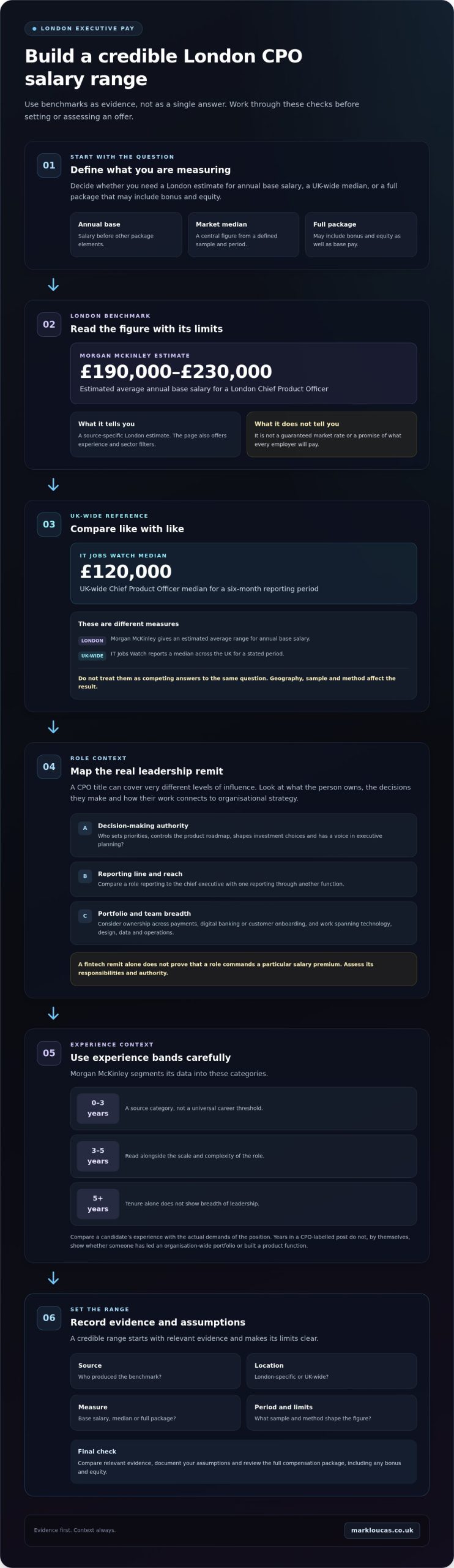
A practical framework for setting or assessing a London CPO package
A useful compensation decision is built in stages, not by selecting the most persuasive figure from a salary page. Employers and candidates can follow the same sequence: define the role, choose relevant evidence, record the reasoning and consider the full package. This keeps the conversation grounded in the position itself.
A sequence for employers building a defensible benchmark
- Define the role first. Set out the product portfolio, strategic remit, decision-making authority, reporting line and organisational context. Clarify whether the CPO leads product across the business or owns a narrower area. The title alone is not enough to establish which roles are comparable.
- Select relevant evidence. Use London-specific data where available and keep it distinct from UK-wide information. A London estimate and a UK vacancy-based statistic may each offer useful context, but they describe different populations and should not be combined into a new figure.
- Record the basis for the comparison. Note each source’s publication date, geography, period, stated method and limitations. If a source does not provide sample details, record that gap rather than filling it with an assumption. This makes the benchmark easier to explain to stakeholders and revisit later.
- Apply judgement to the evidence. Compare the defined remit with roles of similar seniority and organisational reach. Treat source figures as reference points, not ready-made recommendations. A defensible range should follow from the role and the evidence selected, rather than an unsupported blended average.
A clear benchmarking process also creates a record of the decision. Keep the role profile, selected sources and assumptions together, so stakeholders can see how the proposed range was reached and review it if the remit changes.
A sequence for candidates evaluating an offer
- Test the remit against the title. Consider the strategy the CPO will shape, the decisions they can make and the breadth of products and teams they will lead. Compare those responsibilities with the role description and discussions during the hiring process.
- Understand the employer’s reasoning. Ask how the organisation developed its benchmark, which evidence it considered and how it accounted for the role’s scope and location. A clear explanation can help both sides discuss differences in expectations constructively.
- Review the whole package. Consider base salary alongside any bonus, equity, long-term incentives or other terms included in the offer. Separate confirmed elements from possibilities, and assess each against your priorities rather than assuming a particular component is standard.
A benchmark for chief product officer salary london is most useful when both sides can see how the role and evidence support the decision. For employers refining a senior product leadership brief, discuss a role-specific fintech search.
For a considered discussion about a senior fintech appointment, speak with Mark Loucas.
When specialist fintech recruitment can sharpen a CPO search
Salary research provides useful context, but it cannot define the right candidate or establish the full demands of a particular appointment. Specialist fintech recruitment connects the benchmark with the talent market by clarifying the product remit and mapping relevant leadership experience against the organisation’s priorities.
What specialist search adds to salary context
Fintech knowledge helps distinguish a broad product leadership role from one shaped by a specific business model or customer need. A payments organisation may need a CPO to lead products tied to transaction flows, while a digital banking business may place greater emphasis on the breadth of its banking product portfolio. Another financial technology company may have a different mix of product lines and leadership requirements. These examples help shape the search brief, but do not establish a fixed pay premium.
Market mapping gives employers a practical view of relevant talent and experience. It can help identify which leadership backgrounds align with the role, where product expertise sits and how narrowly or broadly to define candidate criteria. Mark Loucas has access to passive candidates among the top 5% of London fintech talent. This helps inform the search and role requirements.
Organisations defining a London-focused talent pool can use specialist London fintech recruitment to connect sector knowledge with the role’s requirements. Executive search is also relevant to senior product leadership appointments, where the remit and evidence of leadership need to be considered together.
How to move from benchmark research to a search brief
Begin with the organisation’s product priorities. Set out what the CPO is expected to shape, the decisions they will own, the teams they will lead and how the role fits into the senior structure. Then distinguish essential experience from preferences. This gives the search a clear focus and avoids relying on a title or an untested assumption about the market.
Next, bring the salary research into the brief with its limits intact. Identify which figures are London-specific, which describe the wider UK, and the period and method behind each source. Keep that evidence separate from the organisation’s assessment of the role. If the data is incomplete, state the uncertainty rather than presenting false precision.
Finally, use market mapping to test whether the candidate criteria reflect the talent pool and leadership remit. Mark Loucas provides fintech executive search and role-specific market intelligence to support this process.
If you’re shaping a senior fintech product search, discuss the role and its requirements with Mark Loucas.
Discuss a specialist fintech product leadership search.
Make the next appointment count
The next step is to turn the compensation discussion into a clear hiring brief. Set out the outcomes the CPO will own, the authority they will need and the experience that matters most to your organisation. This gives candidates a precise picture of the opportunity and keeps expectations grounded in the actual remit.
For organisations seeking a considered perspective on senior fintech leadership, Mark Loucas provides specialist recruitment and executive search, operating since 2007. Market mapping and talent advisory can add context to the search, helping employers refine role requirements and understand the relevant candidate landscape.
A credible chief product officer salary london benchmark is a starting point for a better-informed appointment, not the decision itself. Align the evidence with the role, then move forward with confidence.
To discuss a senior fintech product leadership search, contact Mark Loucas.
Frequently Asked Questions
What is the chief product officer salary in London in 2026?
Morgan McKinley’s 2026 London estimate is £190,000 to £230,000 a year in base salary, or approximately د.إ931,000 to د.إ1,127,000. The source describes this as an estimated average range, not a guaranteed offer. For chief product officer salary london research, check the calculator’s location, role and experience filters before using the figure. The AED amounts are approximate conversions, not amounts published by Morgan McKinley, and exchange rates can change.
Is a London CPO salary benchmark the same as the UK median?
No. A London estimate and a UK-wide median describe different geographical markets. For example, IT Jobs Watch reported a UK-wide median of £120,000, or approximately د.إ588,000, for the six months to 18 October 2026, based on its vacancy data. Use that figure as broader context, not as a substitute for London evidence. For a particular vacancy, note whether the role is London-based or open to candidates elsewhere.
Why do chief product officer salary figures vary between websites?
Websites may use different data sources, time periods and definitions of pay. One may estimate a salary from recruitment insight, while another analyses figures attached to job adverts. Check whether a figure refers to base salary or total compensation, and whether it covers London, the UK or another population. Note publication dates and filters too, so you can judge whether the comparison matches the role you have in mind.
Does a fintech CPO earn more than a CPO in another sector?
Not automatically. Fintech experience may be important where a role involves payments, digital banking or complex financial technology products, but that alone does not prove a higher salary. Compare responsibilities, company context and candidate experience rather than applying a blanket sector uplift. For example, a fintech CPO with a narrow product remit may not be comparable with a leader responsible for product direction across a larger organisation.
Does a published CPO salary figure include bonuses or other benefits?
Not necessarily. Morgan McKinley’s London estimate is described as annual base salary, so do not assume it includes bonus, equity or other benefits. Before comparing figures, identify exactly what each source measures. When reviewing an offer, separate guaranteed salary from variable or conditional elements, and consider only benefits specified by the employer. This makes it easier to compare packages without treating unlike components as equivalent.
How should a candidate negotiate a chief product officer salary?
Prepare by linking your request to the role’s remit and the value of your relevant experience. Identify the decisions you will own, the products and teams within your scope, and examples of comparable leadership work from your career. Ask how the employer set its range and discuss the full package, distinguishing confirmed terms from variable ones. Keep the conversation evidence-led and focused on fit rather than relying on a single online figure.
What should employers consider before setting a CPO salary range?
Write the role brief before choosing a range. Define the product portfolio, reporting line, decision authority, organisational stage and expected outcomes, then select salary evidence that fits the role’s location and responsibilities. Record each source’s date and limitations so stakeholders can understand the basis for the decision. Finally, review the proposed base salary alongside the actual bonus, equity or other terms being offered, without assuming these are standard.

Article by
Liam Henfrey
Liam Henfrey is a seasoned specialist in the payments and banking sectors with over two decades of experience. As the Founder and CEO of FINOPSIS and Managing Director at Mark Loucas Ltd, he advises organisations on complex financial operations and technology. His career includes senior roles at PwC, Deloitte, and Visa Europe.
Related Fintech Recruitment Guides
If you liked this guide then you may also like the following: