


Singapore Fintech Salary Guide 2026: Employers & Candidates
For UAE-based fintech professionals and employers considering regional opportunities, what can a Singapore benchmark tell you about pay? It depends on the role, its scope and the reward package. Figures from another market need careful context. This singapore fintech salary guide 2026, brought to you by Mark Loucas Ltd, explains how to use Singapore data as a point of comparison, not as a UAE salary expectation.
If you are planning a hire or weighing a career move from the UAE, you need benchmarks that are useful without implying more certainty than the data supports. Compare roles by responsibilities and seniority, separate base pay from variable reward, and note how Mark Loucas Ltd defines each figure. The result is a stronger basis for hiring and career discussions, not a one-size-fits-all answer.
In the sections ahead, we will look at compensation across fintech roles and seniority levels, explain what published benchmarks can and cannot tell you, and share practical ways to compare offers or shape hiring discussions. A considered view of the market starts with context.
Key Takeaways
- Use Singapore fintech salary benchmarks as comparative evidence, not as a direct guide to UAE pay or an individual offer.
- Compare roles by scope, seniority and accountability, as job titles alone may not show how the work differs.
- Separate base pay, variable compensation and benefits to assess packages on a consistent basis.
- Before setting a salary range or discussing an offer, define the role clearly and select evidence that matches it.
- Use market mapping to understand candidate availability and inform role design and hiring priorities.
For considered insight on fintech roles across markets, speak with the Mark Loucas team.
What shapes a Singapore fintech salary in 2026
A salary guide is a reference for comparing compensation across defined roles, locations and experience levels. It is not a promise of an individual offer. For UAE employers and candidates, Singapore figures offer an international point of comparison, but they are not UAE salary benchmarks. Location, role scope and the source’s method all affect how useful a comparison is.
Fintech covers a broad set of activities, from payments and digital banking to data, software and financial infrastructure. This overview of What is Financial Technology (Fintech)? helps explain why the sector includes roles with distinct commercial and technical demands. For example, a product role building a payment feature may differ from one responsible for a digital banking platform, even if the job titles look similar.
Geography and remit also shape what a benchmark represents. A Singapore-based role may focus on that market, while a regional position can cover priorities across several locations. A globally scoped role may involve wider coordination or decision-making. UAE employers using Singapore evidence should identify these differences before applying it to a local hiring brief. Specialist payments industry recruitment depends on understanding the work behind the title, not just the label.
Why fintech job titles do not tell the whole story
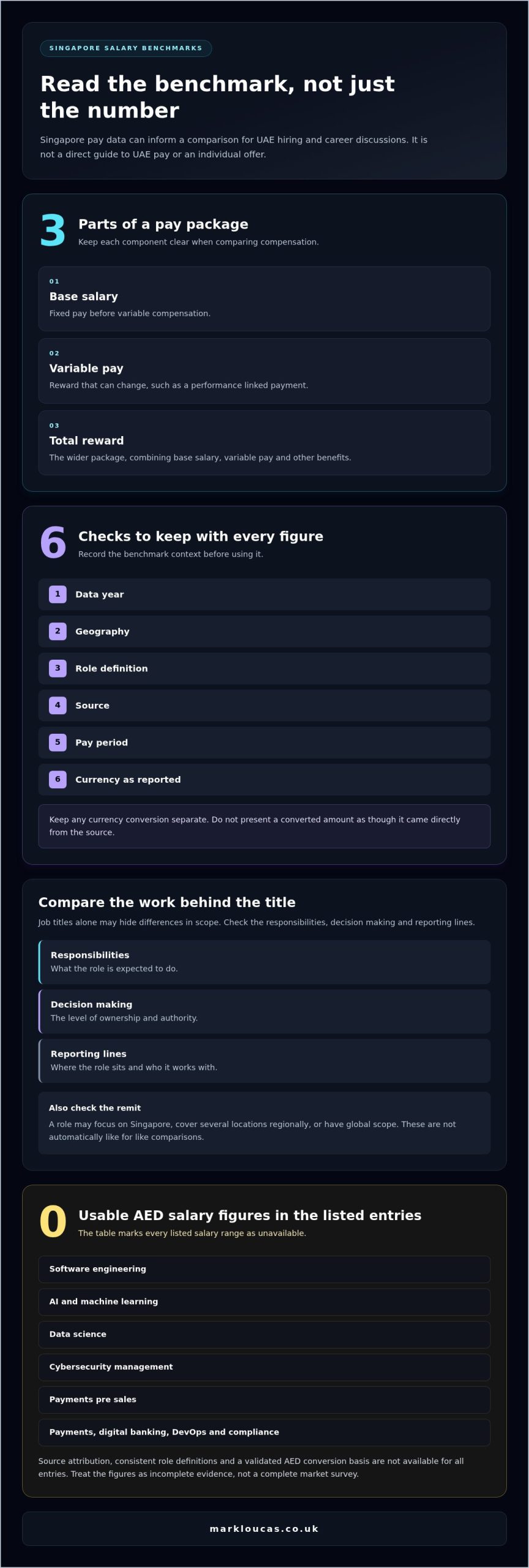
Compare responsibilities, decision-making scope and reporting lines before comparing salaries. Two professionals called product managers may differ in whether they shape strategy, manage delivery or focus on a specific feature. A technical role in payments may centre on transaction systems, while a digital banking role may focus on customer-facing services or platform development. These examples show why role descriptions matter, not that the roles have identical requirements.
Accountability adds further context. Establish who sets priorities, owns outcomes and works across teams. For a UAE hiring decision, use those details to judge whether an overseas reference describes a comparable level of responsibility.
How to read a salary benchmark responsibly
Keep the context attached to every figure. Record the data year, geography, role definition, source and pay period. Note the currency as reported, and keep any conversion separate. This helps UAE readers distinguish the original Singapore data from a later comparison, without presenting a converted value as though it came directly from the source.
Separate observed ranges from estimates, and state the limits of each source. A broad role category may not reflect a specialist remit. An average describes a group, not a guaranteed offer or an individual’s expected outcome.
Base salary is fixed pay before variable compensation. Variable pay is reward that can change, such as a performance-linked payment. Total reward is the wider package, combining base salary, variable pay and other benefits. Keep these components distinct when using an international benchmark to inform a UAE hiring or career discussion.
For role-specific hiring or market insight, discuss your Singapore fintech requirements with Mark Loucas.
Singapore fintech salary benchmarks by role and seniority
A useful benchmark needs more than a job title and a number. It should identify the role, experience band, geography, pay period, currency, source and date. The available October 2026 research provides Singapore salary figures for some technical and commercial roles, but does not name the underlying sources or provide comparable data for every fintech discipline. To avoid presenting unsupported figures, the table marks those gaps clearly.
This table reflects Singapore salary data described as verified in October 2026, but source attribution and consistent role definitions are not available for every entry, so it should not be treated as a complete market survey. As this article is localised for the UAE, the amounts below are shown in AED. No validated conversion basis has been provided, so figures that cannot be responsibly reported in AED are marked unavailable.
| Role family | Experience or level | Salary range in AED | Data date and limitation |
|---|---|---|---|
| Software engineering | Not specified | Unavailable | October 2026 data; source and AED conversion basis unavailable |
| AI and machine learning | Not specified | Unavailable | October 2026 data; source and AED conversion basis unavailable |
| Data science | Entry, mid and senior levels not consistently defined | Unavailable | October 2026 data; source and AED conversion basis unavailable |
| Cybersecurity management | Managerial | Unavailable | October 2026 data; source and AED conversion basis unavailable |
| Payments pre-sales | Experience bands supplied, role scope not defined | Unavailable | October 2026 data; source and AED conversion basis unavailable |
| Payments, digital banking, DevOps and compliance | Not specified | Unavailable | No comparable role-level benchmark supplied |
Which fintech role families belong in the comparison
Compare like with like. Payments, digital banking, data analytics, DevOps and compliance each cover distinct work. Evidence for one discipline should not stand in for another. Payments roles, for example, may span product, technology and commercial activity, while digital banking roles can focus on different platform or customer needs. Payments industry recruitment depends on understanding those distinctions before assessing candidate fit or pay.
The Monetary Authority of Singapore (MAS) Fintech Initiatives offer useful context on Singapore’s fintech environment. They are not salary benchmarks, so use them to understand the sector, not to infer pay.
How seniority changes the benchmark
Use responsibilities, not years served or title alone, to distinguish specialist, managerial and executive scope. A specialist may lead complex work without managing a team. A manager may own delivery across a team, while an executive may carry wider strategic accountability. Team size, decision-making authority and regional remit all affect comparability. Senior leadership searches therefore need role-specific evidence, not a generic seniority label.
Before using the singapore fintech salary guide 2026 to set a range, confirm the source’s date and method, define consistent experience bands, and document the role’s actual remit. Where those details are missing, treat the benchmark as unavailable rather than implying false precision.
For tailored insight on permanent, contract or interim fintech hiring, speak with the Mark Loucas team.
How to compare Singapore fintech pay packages fairly
A headline salary rarely tells the whole story. To compare two fintech opportunities fairly, separate fixed pay, variable reward and benefits, then check that the figures cover the same period and use the same currency. This gives candidates a clearer view of an offer and helps employers set out a compensation range more precisely.
Singapore’s fintech sector includes a broad mix of businesses and specialist roles. The Singapore EDB Fintech Industry Overview provides useful context on the sector, but industry context is not evidence of a particular employer’s pay or benefits. Tie each part of the comparison to information that is actually available.
Base salary and variable reward
Record base salary as its own figure. Put any bonus, commission or incentive in a separate field, and include it only where the source explains how it works. Variable pay can depend on the role and employer. Don’t treat it as guaranteed income or assume the same structure applies across fintech companies.
List benefits individually rather than folding them into salary. If a source does not state a benefit’s value or eligibility, mark that information as unavailable instead of assigning an estimated cash value. A transparent comparison may show less certainty, but it is more useful than an inflated total.
Permanent, contract and executive comparisons
Permanent roles are commonly presented as an annual salary, while contract and interim assignments may be reported using a day rate or another period. Keep the original basis visible. Don’t compare a rate for time worked directly with an annual salary unless you have a clear, consistent method and have recorded its assumptions.
Executive packages need the same discipline, with closer attention to scope, accountability and any stated incentives. A senior title alone cannot establish equivalence between two roles. Compare the remit and reward components that the evidence actually describes.
For a practical comparison, keep a simple record for each opportunity or benchmark:
- Base pay, with the original currency and pay period
- Variable reward, including any stated eligibility or conditions
- Benefits, recorded separately and valued only where evidence supports it
- Employment basis, such as permanent, contract or interim
- Source date and any gaps that affect comparison
The singapore fintech salary guide 2026 is most useful when its figures are read on a consistent basis. If a benchmark is published in Singapore dollars, retain that currency in the source record. If you need to compare it in AED, show the conversion separately with its date and method, rather than presenting the converted amount as the original figure.
For considered support with fintech hiring and salary benchmarking, discuss your requirements with Mark Loucas.
How employers and candidates can use Singapore salary data
Salary evidence is most useful when it informs a decision about a clearly defined role, rather than being treated as an answer on its own. Employers can use it to shape a credible range; candidates can use it to prepare for a focused discussion about scope and reward. In both cases, compare relevant evidence and account for details that a benchmark cannot capture.
A practical benchmarking process for employers
Before setting a range, write down what the hire is expected to deliver. Record the main responsibilities, reporting line, decision-making authority and specialist expertise required. Clarify whether the role is Singapore-based, regional or wider in scope. This creates a useful role profile and helps prevent a familiar title from being matched against evidence for a different job.
Then compare current Singapore data that closely matches the role. Check its date, source, experience definitions, geography and pay basis. If evidence is limited or uses a broad role category, state that limitation rather than presenting the range as definitive. Specialist market knowledge can help employers judge whether apparent differences reflect genuine scope or inconsistent job titles.
Finally, review the proposed range against the organisation’s priorities and the responsibilities documented for the position. If the remit expands to include wider leadership or additional specialist work, revisit the role level and supporting evidence before finalising the range. Keep the reasoning on record so the hiring team can explain how the benchmark informed its decision.
Preparing for a fintech salary discussion
Candidates can prepare by looking beyond the job title. Review the role’s remit, seniority, reporting line and expected outcomes, then consider the full reward package rather than focusing only on the headline figure. A published range offers context, but it cannot decide what an individual role or candidate should be worth.
Bring specific evidence of relevant results. This might include a product or technical delivery, a complex project, leadership responsibilities or specialist expertise that matches the role. Explain your contribution and its relevance clearly. This gives the discussion substance without assuming that years of experience alone determine pay.
A useful conversation can also clarify areas that affect comparability, such as the balance between individual contribution and team leadership, the reach of the remit, and how any variable reward is described. Keep questions anchored to the role and the information available. The singapore fintech salary guide 2026 can support that discussion, but it should not replace individual negotiation.
Check Singapore-specific employment or immigration questions against current official guidance. A salary benchmark is not a statement of statutory requirements or eligibility. Keeping those questions separate helps employers and candidates use market evidence carefully, without relying on it to answer matters it was not designed to address.
For support applying Singapore fintech salary insight to a hiring brief, discuss your requirements with Mark Loucas.
Turning Singapore fintech salary insight into a hiring strategy
A salary benchmark becomes more useful when it informs a wider hiring decision. Employers can use evidence to shape a role, set priorities and consider whether a permanent, executive or interim hire best fits the need. The figures are one part of the picture. The remit, level of accountability and available talent also matter.
When market mapping adds useful context
Published salary ranges show only part of the market. Market mapping can add context by examining how roles are structured, what expertise employers seek and where requirements overlap. This can help clarify whether a job description combines several distinct skill sets or whether its seniority reflects the responsibilities expected.
Use that insight to refine the brief before agreeing a compensation range. For example, an employer seeking both deep technical expertise and broad team leadership may need to decide which requirement is essential and which can be developed. The right emphasis depends on the organisation’s priorities, the role’s level and the talent available. Mapping informs the decision; it does not guarantee access to particular candidates or a specific salary outcome.
Choosing the right recruitment support
The recruitment approach should fit the hiring need. Permanent recruitment can support an ongoing position, executive search can address a senior leadership brief, and contract or interim solutions can suit a defined need for flexible expertise. These routes call for different role definitions and assessment priorities. Make clear what success looks like and how long the need is expected to last.
Specialist fintech recruitment brings sector context to discussions about responsibilities, candidate experience and role fit. For an employer, that context can help distinguish essential expertise from preferences and keep the brief aligned with the intended level. For candidates, it can bring greater clarity to the remit and the experience a role calls for.
A considered hiring strategy can follow a clear sequence:
- Set out the business need and the outcomes the hire should support.
- Define responsibilities, seniority, reporting lines and essential expertise.
- Use current, comparable salary evidence, noting its source and limitations.
- Review whether the role design and hiring route match the organisation’s priorities.
- Revisit the brief if the evidence points to competing requirements or a different level of scope.
The singapore fintech salary guide 2026 can support workforce planning when used alongside a well-defined brief and relevant market insight. Mark Loucas provides permanent recruitment, executive search, contract and interim solutions, as well as market mapping and talent advisory for fintech, payments and digital banking. Each approach can be aligned with the role and the employer’s objectives.
If you are shaping a Singapore fintech hiring brief, share the role and discuss a considered recruitment approach.
Discuss your Singapore fintech hiring or talent requirements.
Make your next fintech hiring decision with confidence
The value of the singapore fintech salary guide 2026 lies in how carefully you apply its evidence to your next decision. For employers, that may mean refining a role before opening a search or aligning workforce plans with the expertise the business needs. For candidates, it can help frame a considered conversation about the contribution they are ready to make.
Mark Loucas supports fintech, payments and digital banking hiring through permanent recruitment, executive search, contract and interim solutions. Market mapping and talent advisory can also help employers connect role design with wider workforce planning. The right approach starts with a clear brief and a grounded view of the talent market.
With clear priorities and specialist insight, you can move forward with greater confidence.
Frequently Asked Questions
What is the average fintech salary in Singapore in 2026?
A reliable average in AED cannot be quoted from the information available here. The supplied 2026 research reports an average in Singapore dollars, but gives no conversion date or method for expressing it in AED. The singapore fintech salary guide 2026 is therefore more useful for understanding how pay differs across roles than for treating one sector-wide average as a personal expectation.
Which fintech roles are typically included in a Singapore salary guide?
Guides may cover software engineering, AI and machine learning, data science, cybersecurity, payments and pre-sales, alongside digital banking roles. Some also include compliance, product or operations, but coverage depends on the guide’s data and definitions. Check whether a title describes a specialist, manager or leader, and whether the role is in fintech rather than the wider financial services sector.
How much can a fintech professional earn in Singapore compared with other financial services roles?
There is no dependable single comparison without matching role scope, seniority and pay basis. A broad financial services benchmark may include banking roles unlike a specialist fintech position, while a fintech guide may focus on technology or payments. Compare equivalent responsibilities and experience, then review the source dates. Any difference may reflect the roles selected, not a general pay premium for one sector.
Does a Singapore fintech salary figure include bonuses and benefits?
Not necessarily. A published figure may refer only to base salary, or it may include variable pay, depending on the source. For an individual offer, check the written terms for bonus eligibility, how any incentive is assessed, and which benefits apply. Treat equity as a separate component, too. If the benchmark does not specify what is included, don’t assume it represents the full package.
How should employers set a salary range for a fintech role in Singapore?
Start by deciding what the role must deliver and which skills are essential on day one. Use evidence for comparable Singapore roles, then test the proposed range against the level of expertise and accountability required. Before advertising, agree how much flexibility the hiring team has and which elements of the package it can discuss. This helps keep candidate conversations consistent and grounded.
Are contract and interim fintech salaries directly comparable with permanent salaries?
No, not without accounting for the different engagement terms and reporting periods. A contract or interim rate may reflect a defined assignment, while a permanent salary relates to ongoing employment. Compare the work, duration, expected availability and stated compensation basis. Avoid converting one figure into another unless the assumptions are clear, consistent and suitable for the decision being made.
How often should a Singapore fintech salary guide be updated?
There is no single update interval that suits every guide. Review the evidence when a source publishes a new edition, when the role’s scope changes, or when hiring outcomes suggest the benchmark no longer reflects the candidates being considered. Keep older figures labelled with their data period rather than silently carrying them forward. For specialist roles, review source relevance as carefully as recency.

Article by
Liam Henfrey
Liam Henfrey is a seasoned specialist in the payments and banking sectors with over two decades of experience. As the Founder and CEO of FINOPSIS and Managing Director at Mark Loucas Ltd, he advises organisations on complex financial operations and technology. His career includes senior roles at PwC, Deloitte, and Visa Europe.
Related Fintech Recruitment Guides
If you liked this guide then you may also like the following: