


Why Contingent Recruitment Fails for Senior Roles in Fintech
What if the quickest route to a senior fintech shortlist leaves strong candidates unseen? For a strategically important appointment in the UAE, understanding why contingent recruitment fails for senior roles starts with the search structure. A non-exclusive brief can reward speed and candidate submissions, while limiting the time spent reaching passive talent across fintech and payments.
A broad shortlist may look reassuring, but familiar profiles and repeated candidates can hide gaps in market coverage. That doesn’t make contingent recruitment wrong for every role. It can suit a clearly defined brief and an accessible candidate pool. Senior appointments, however, often call for discretion, sector insight and a more deliberate approach to assessing fit.
This article explains where contingent recruitment can fall short, how it compares with executive search, and how to choose a model for your brief. It also covers how market mapping and specialist knowledge of fintech, digital banking and payments can help you assess senior talent in the UAE against the role’s complexity, confidentiality needs and candidate availability.
Key Takeaways
- Assess why contingent recruitment fails for senior roles by looking at the limits of a non-exclusive, success-fee search, without assuming the model is unsuitable for every brief.
- Compare recruitment models by commitment, search scope, discretion and the complexity of the appointment.
- Use role outcomes and essential experience to judge how accessible suitable candidates are and how much search capacity the brief requires.
- Consider whether confidentiality and specialist fintech, payments or digital banking knowledge should shape the search.
- Use market mapping and talent intelligence to build a broader view of relevant senior candidates.
For a confidential or strategically important appointment, discuss how a specialist search could support your brief. Contact Mark Loucas to explore the right approach.
Why contingent recruitment can struggle with senior fintech roles
Contingent recruitment is a success-fee model. An agency is generally paid when a candidate it introduces is hired, rather than for carrying out the search itself. This can suit roles with a clear brief and an accessible candidate pool. The model is not inherently ineffective. Its suitability depends on the appointment and the work needed to reach the right people.
Why contingent recruitment fails for senior roles is often less about the model’s label than the demands of the brief. A senior fintech appointment may shape strategy, leadership and delivery, and involve several stakeholders. The search may therefore require more than matching a CV to a list of requirements.
Recruitment covers a range of processes and models, as outlined in Recruitment processes and models. For employers, the practical distinction is how the search is commissioned, resourced and measured.
What the contingent model rewards
In a typical contingent arrangement, an agency earns a fee if its candidate is hired. Where several agencies work on the same vacancy, each may be pursuing the same outcome without exclusive responsibility for the search. That can encourage early submissions, particularly when agencies believe others are approaching the same people.
This is a structural pressure, not a judgement on individual recruiters. Some recruiters take a careful, consultative approach within a contingent model, clarifying the brief and assessing candidates thoroughly. A recruitment model shapes incentives; it does not determine the quality or integrity of the recruiter. The key question is whether the agreed process gives enough time and ownership to reach the candidates the role needs.
Why senior hiring changes the brief
At executive level, relevant experience is rarely defined by job title alone. A fintech hiring team may need a leader who has built a payments operation, guided digital banking change or managed a function through a particular stage of growth. Assessing that fit means understanding the scale of past responsibilities, the decisions made and the environment in which the candidate performed.
Some suitable senior people may not be actively seeking a move. They may consider an opportunity only if its remit, timing and confidentiality make sense. Reaching them can call for a selective conversation rather than broad circulation of the vacancy. Context matters in payments and digital banking: a leader from one part of the sector may not have the experience required in another. Payments industry recruitment depends on understanding those distinctions.
These demands do not make contingent recruitment unsuitable by default. They do make it worth checking whether the model provides enough focus, market reach and careful assessment for the appointment.
For a confidential or strategically important appointment, discuss how a specialist search could support your brief. Contact Mark Loucas to explore the right approach.
Where contingent recruitment can miss the mark in a senior search
These are risks to assess, not inevitable results of every contingent assignment. The model may work well when the brief is clear and relevant candidates are easy to identify. In a senior fintech search, however, how the market is approached can matter as much as the number of profiles received.
Shortlists without enough market context
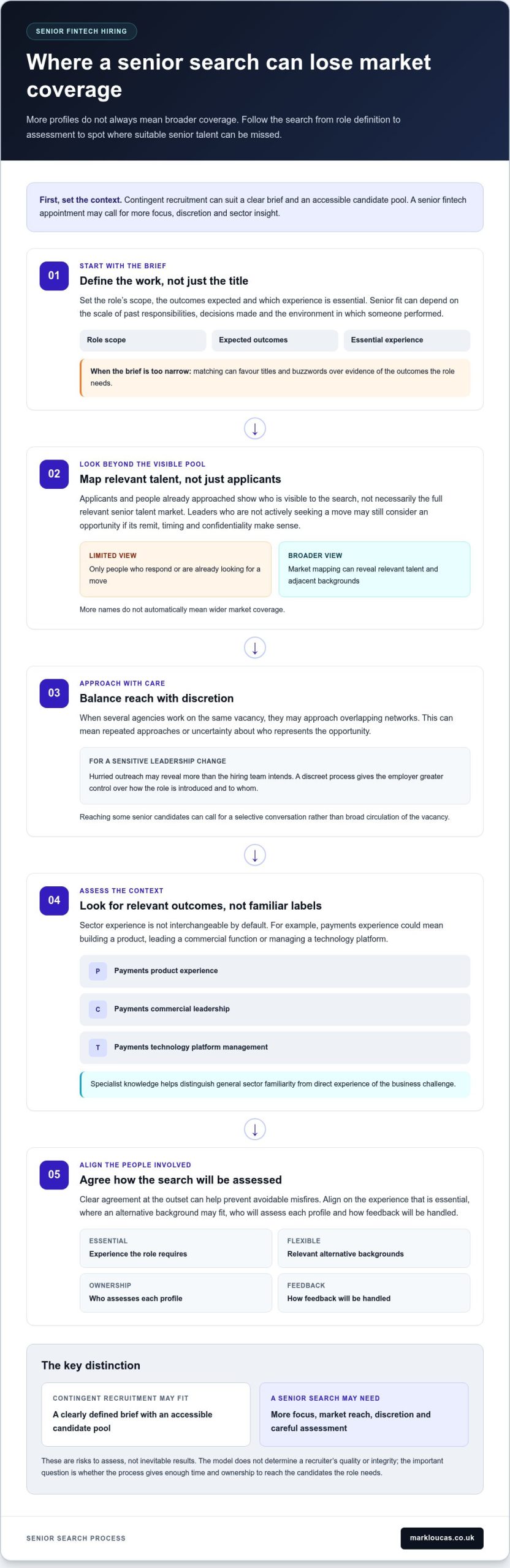
A list of available applicants shows who has responded or been approached, not necessarily the full relevant senior talent market. If the search focuses only on people actively seeking a move, it may miss leaders who could be a strong fit but are not currently applying. More names do not automatically mean broader coverage.
A narrow brief can also weaken matching, even when candidate flow is high. If requirements are reduced to titles and buzzwords, the search may favour candidates who use the right terms over those who have delivered the required outcomes. For example, payments experience could mean building a product, leading a commercial function or managing a technology platform. Those backgrounds are not interchangeable without understanding the context.
Senior shortlist quality depends on role clarity as well as market reach. Before outreach begins, define the role’s scope, the outcomes expected and which experience is essential. Market mapping can then show where relevant talent sits, including adjacent backgrounds that may not be obvious from a conventional title search.
Speed, discretion and stakeholder alignment
Several agencies may approach overlapping candidate networks, particularly if the brief is widely shared. This does not happen in every search, but it can lead to repeated approaches or uncertainty about who is representing the opportunity. For a sensitive leadership change, hurried outreach may also reveal more than the hiring team intends. A discreet process gives the employer greater control over how the role is introduced and to whom.
Alignment at the outset helps prevent avoidable misfires. Agree the essential experience, where candidates can bring an alternative background, who will assess each profile and how feedback will be handled. In fintech, payments and digital banking, these details help distinguish general sector familiarity from direct experience of the business challenge. They also give recruiters a consistent basis for assessing candidates.
Internal delays can still interrupt progress. A search may pause while stakeholders resolve the role’s priorities, review profiles or agree interview decisions. No recruitment model can settle competing views or make internal feedback timely. Naming a decision-maker, agreeing an assessment process and planning review points can help keep the brief coherent.
These are practical ways to assess why contingent recruitment fails for senior roles in some searches. Rather than treating it as a verdict on every agency, examine market coverage, privacy and decision-making before choosing a model. If your UAE fintech brief needs a more considered market view, discuss the search with Mark Loucas.
For a senior fintech appointment, discuss how a search model could support your brief. Contact Mark Loucas to explore the options.
Contingent recruitment versus executive search for senior appointments
Neither model is automatically the right choice. The difference lies in how the search is commissioned and carried out, and whether that process fits the appointment. Contingent recruitment may work when requirements are clear and qualified candidates are readily accessible. Executive search may be a better fit when the brief calls for targeted research, discretion or sustained engagement with senior people who are not actively applying.
| Consideration | Contingent recruitment | Executive search |
|---|---|---|
| Commitment | Often non-exclusive, with a fee linked to a successful hire. | Usually based on an agreed mandate and dedicated search work. |
| Search scope | Can focus on applicants and candidates an agency can reach through its networks. | Can include structured market research and direct outreach to selected candidates. |
| Discretion | May involve several agencies approaching candidates, depending on how the brief is shared. | Can support a more controlled, confidential approach to outreach. |
| Role complexity | Can suit a well-defined role with accessible candidates and clear selection criteria. | May suit specialist or strategically important appointments that need deeper assessment. |
When a contingent approach may be appropriate
Consider contingency when the remit is specific, essential experience is easy to explain and the likely candidate pool is visible. It may also suit a hiring team with the capacity to coordinate agency activity, review profiles and give prompt feedback. Agree who manages the brief, which criteria agencies will use and how candidate submissions will be assessed.
When executive search may be a better fit
For a confidential or specialist appointment, the strongest candidates may not be among active applicants. An agreed mandate can give the search a defined focus and support sustained research and measured, discreet engagement. This can be useful when the organisation needs to compare candidates from different fintech, payments or digital banking backgrounds, rather than relying on job titles or sector keywords alone. Explore the fintech executive search approach for more on this model.
Executive search is not a guarantee of success, nor is it necessary for every senior vacancy. The practical question behind why contingent recruitment fails for senior roles is whether the chosen model allows enough reach, care and alignment for this brief. If the role is complex or sensitive, compare the time and internal capacity each route requires, alongside the need for privacy and market insight.
For a considered discussion about your senior fintech brief in the UAE, contact Mark Loucas.
For a senior fintech appointment, a clear brief can help you choose a search model that fits the role. Discuss your hiring brief with Mark Loucas.
How to decide which recruitment model fits your senior role
Choose the recruitment model after defining the appointment, not before. This five-step assessment helps you weigh the role’s needs against the candidate market and your team’s capacity to run the process. It also gives a specialist recruiter a sound basis for shaping the search.
- Define the outcomes. Describe the leadership challenge and what the successful person will need to deliver. For a payments leader, that might mean building a function, strengthening a platform or guiding a business through a particular stage of growth. Link each outcome to evidence you can assess.
- Separate essentials from preferences. Identify the experience and capabilities the role genuinely requires, then distinguish them from desirable extras. A long list of preferred titles, employers or technologies can narrow the field without improving the match. Consider whether experience in an adjacent fintech, banking or payments environment could meet the underlying need.
- Assess candidate accessibility. Ask whether suitable candidates are likely to be actively applying or whether the search needs to reach people who are not looking to move. A clear brief with an accessible pool may suit contingency. A specialist or less visible pool may call for a targeted search and market mapping.
- Weigh complexity and confidentiality. Consider how much judgement is needed to assess leadership scope, sector context and stakeholder fit. Then decide how discreet the approach must be. A sensitive appointment or a role with a distinctive remit may benefit from a carefully controlled search. For specialist payments leadership, payments industry recruitment can bring relevant sector context to the brief.
- Check internal capacity. Name the decision-makers, agree who will assess candidates and set expectations for feedback and candidate communication. Decide how often the hiring team will review progress. If stakeholders cannot align on criteria or provide timely feedback, resolve that process issue before choosing a model. Recruitment support can organise the search, but it cannot make internal decisions on your behalf.
Diagnose the role before selecting the model
Write the brief around the work to be done, not an idealised profile. Ask what the new leader must understand about your customers, operating environment and stage of development. This can reveal where adjacent experience is relevant while protecting the requirements that are essential to success.
Set the conditions for a credible search
Agree how candidate information will be handled, who can discuss the opportunity and how potential candidates should be approached. For a digital banking appointment, make sure the assessment reflects the sector’s specific context rather than relying on a generic technology leadership profile.
The question of why contingent recruitment fails for senior roles is best answered against these practical conditions. If the role needs focused market insight, specialist assessment or discreet outreach, discuss a search approach for your senior fintech role.
For a senior fintech appointment, discuss your hiring needs with Mark Loucas.
How specialist fintech recruitment supports senior hiring
Choosing a search model is only part of a senior appointment. The brief must also reflect the market in which the leader will work. A specialist recruiter can connect role outcomes with the realities of fintech, payments and digital banking, so candidate experience is assessed in context rather than by job title alone.
Sector knowledge can help determine whether a broad contingent search is likely to reach the right people or whether the role calls for a more focused mandate. It can also help identify essential experience, relevant adjacent backgrounds and the questions the hiring team should explore during interviews.
Market insight beyond an initial shortlist
A shortlist shows the candidates under consideration. Market mapping adds perspective on the wider talent pool, including the types of organisations and functions where relevant leadership experience may sit. Employers can use this insight to assess whether the brief reaches the right part of the market or whether its requirements are unintentionally too narrow.
Talent intelligence can inform decisions before and during a search. A business hiring a payments leader, for example, may use market insight to clarify whether it needs experience in product, technology, commercial leadership or a combination of these areas. The aim is to shape a more informed brief and search plan, not to promise access to every suitable person or a particular placement outcome.
A tailored approach to fintech leadership hiring
Mark Loucas is an independent specialist recruitment consultancy focused on fintech, payments and digital banking. Its work includes permanent recruitment and executive search, supported by market mapping, intelligence and talent advisory. The approach can be aligned with the senior role’s needs, whether the brief calls for a permanent appointment or a more considered executive search process.
Sector knowledge can sharpen both the questions asked and the evidence assessed. A candidate’s digital banking experience, for instance, needs to be considered in relation to the remit, operating environment and outcomes of the role. The specialised financial recruitment approach brings this sector focus into the search, helping hiring teams assess relevant experience more precisely.
When the process does not match the brief, understanding why contingent recruitment fails for senior roles can help employers weigh role clarity, candidate reach, confidentiality and internal capacity together, rather than treating the recruitment model as an isolated choice.
If you are planning a senior fintech appointment in the UAE, discuss your role with Mark Loucas.
As you plan your next senior appointment, discuss your hiring needs with Mark Loucas.
Set your next senior search up with clarity
The choice of recruitment model is a practical decision about how to reach, assess and engage the people your role needs. Before opening a search, agree what success looks like, which experience is essential and how the process will protect candidate confidence. A well-shaped brief makes it easier to judge whether a contingent route has the required reach and focus, or whether a more sustained search is appropriate.
Understanding why contingent recruitment fails for senior roles can help you avoid treating candidate volume as a measure of progress. A more useful measure is whether the search connects your organisation with leaders whose experience fits its ambitions. That calls for informed judgement, clear communication and a recruitment partner who understands the sector.
Mark Loucas is an independent consultancy founded in 2011, supporting senior hiring across fintech, digital banking and payments. Discuss your senior fintech hiring needs with Mark Loucas and take a considered next step towards finding the right leader for your organisation.
Frequently Asked Questions
Why can contingent recruitment fail for senior roles?
Contingent recruitment can fall short when a success-fee process does not give enough focus to a role with a complex remit or a limited talent pool. That is one reason why contingent recruitment fails for senior roles: the search may produce profiles before the hiring team has a clear view of the market or the evidence needed to judge leadership fit. Repeated or loosely matched profiles are signs to review the brief and search process.
Is contingent recruitment always unsuitable for executive appointments?
No. It can suit an executive vacancy when the outcomes, essential experience and selection process are clear, and suitable candidates are actively accessible. For example, an organisation replacing a leader in a well-established function may have a precise profile and an available pool. The model is harder to assess if the role is still changing or stakeholders disagree about what success requires. Those conditions can matter more than seniority alone.
Can contingent recruiters approach passive senior candidates?
Yes. A contingent recruiter can approach someone who is not actively seeking a move, provided the recruiter can identify and engage them appropriately. The candidate’s interest may depend on a credible explanation of the role, its remit and why their experience is relevant. For a senior person, a generic message is unlikely to offer enough context. Employers should also consider how the opportunity will be presented and what information can be shared at each stage.
How does executive search differ from contingent recruitment?
Executive search is commonly commissioned as a defined assignment, with research and candidate engagement organised around the brief. Contingent recruitment is generally paid on a successful hire, so agencies may work without exclusive ownership. Ask how progress will be reviewed, what research will inform outreach and how candidates will be assessed. These details help show whether the process matches the appointment, beyond the model’s label.
What happens if several agencies receive the same senior role?
Several agencies may contact the same person, though this is not inevitable. A candidate could receive overlapping approaches or hear different descriptions of the opportunity, which may weaken confidence in the process. To reduce that risk, agree how agencies will record and share candidate introductions, how duplicate submissions will be handled and who will communicate with each person. Consistent messaging helps protect the employer’s reputation and the candidate experience.
When should a fintech company consider market mapping?
Consider market mapping before launching a search if the role is newly created, the required background is difficult to define or the obvious candidate pool seems limited. It can help a company examine relevant organisations, functions and adjacent experience before settling on a shortlist. For example, a fintech business may use it to test whether leadership experience from a related payments or banking environment could meet its needs.
What should we agree with a recruitment partner before starting a senior search?
Agree the role outcomes, essential criteria, decision-makers and interview responsibilities before outreach begins. Set expectations for how often the team will review progress, how quickly it will share feedback and who will update candidates. Also clarify which details are confidential and how the opportunity should be introduced. In the UAE, make sure the agreed process reflects your organisation’s location, stakeholders and hiring priorities rather than relying on a generic brief.

Article by
Liam Henfrey
Liam Henfrey is a seasoned specialist in the payments and banking sectors with over two decades of experience. As the Founder and CEO of FINOPSIS and Managing Director at Mark Loucas Ltd, he advises organisations on complex financial operations and technology. His career includes senior roles at PwC, Deloitte, and Visa Europe.
Related Fintech Recruitment Guides
If you liked this guide then you may also like the following: