


Fintech Talent Market 2026: Roles and Skills in Demand
In 2026, the strongest fintech hiring priorities in the UAE are AI, cybersecurity, data, payments, compliance and risk. Demand is especially acute for MLROs and Compliance Officers with SCA/CMA, DFSA or VARA expertise, alongside professionals who can bridge business, technology and regulation. A fintech talent market overview for 2026 points to one clear priority: securing specialised people who can support growth while strengthening product quality and operational resilience.
For firms, this means competing on more than role title and salary; a clear remit, credible progression and a focused hiring process matter too. For professionals, the opportunity lies in pairing deep domain expertise with practical AI fluency and the ability to work across disciplines. This article examines the roles gaining traction, how AI is reshaping workforce needs, where specialist talent is hardest to secure and what candidates increasingly expect from employers in the UAE.
Key Takeaways
- Prioritise roles that protect product quality and operational resilience, particularly across compliance, risk, cybersecurity and payments.
- Build AI capability through targeted hiring and internal learning, with a focus on practical applications such as risk modelling and fraud prevention.
- Make specialist hiring more competitive by defining the role clearly and keeping interview stages focused.
- Use career progression and learning opportunities to respond to candidate expectations, alongside a clear and competitive salary offer.
- For senior or specialist appointments, consider whether permanent recruitment, executive search, interim support or market intelligence best fits the hiring need.
For a considered hiring plan in the UAE, discuss your fintech recruitment needs.
Fintech hiring outlook for the second half of 2026
During the second half of 2026, fintech hiring is centred on growth, product quality, compliance and operational resilience. Employers are seeking specialists in AI, cybersecurity, data, payments, compliance and risk. For senior appointments, the strongest candidates often combine technical judgement with commercial awareness and regulatory understanding.
Hedge funds and proprietary trading firms value quantitative professionals who can build, test and own complete trading pipelines. Banks and fintechs also need people who connect payment products, data and risk controls. Hiring managers should define the business outcome first, then identify the technical and regulatory capabilities needed to deliver it.
For regulated fintech roles, VARA, DFSA and SCA/CMA requirements shape the expertise employers seek. Key Persons at regulated firms are generally required to work on-site in the jurisdiction of their licence. Visa and employment arrangements, as well as any role-specific approval requirements, also need consideration when recruiting in the UAE.
UAE fintech employers are prioritising AI, cybersecurity, data, payments, compliance and risk skills. Practical experience matters, especially when candidates can apply technology in regulated financial services. For example, a professional who understands both data systems and AML controls can support product development while keeping operational risk in view.
Hiring hubs include the UAE, with regional competition also involving Singapore, Hong Kong and European fintech markets. Across these markets, firms report shortages of people who combine domain expertise with practical AI fluency. UAE employers should assess candidates across locations while accounting for the licensed role’s jurisdiction and on-site requirements.
The UAE and wider Middle East outlook is shaped by demand for compliance, payments, technology and operational resilience. VARA’s virtual asset framework is creating demand for crypto compliance specialists, while tighter global AML/CFT enforcement is increasing demand for MLROs and AML analysts. Hiring decisions increasingly favour people who can support growth while controlling risk.
Regulatory developments also shape workforce planning: global data privacy and financial conduct rules are expected to take effect in 2026. Employers should map each rule to the roles responsible for implementation, oversight and reporting. This turns regulatory change into defined hiring priorities rather than a broad search for general compliance experience.
Timing can determine whether a firm secures a scarce specialist. Experienced candidates may reject a process with six weeks between interviews, while some quantitative firms use eight or nine interview rounds. Set decision stages in advance, assign clear interview responsibilities and communicate promptly after each meeting. A focused process gives senior candidates a clearer picture of the role and organisation.
For UAE employers shaping an AI-related team, discuss your fintech talent requirements.
AI-related roles and workforce changes
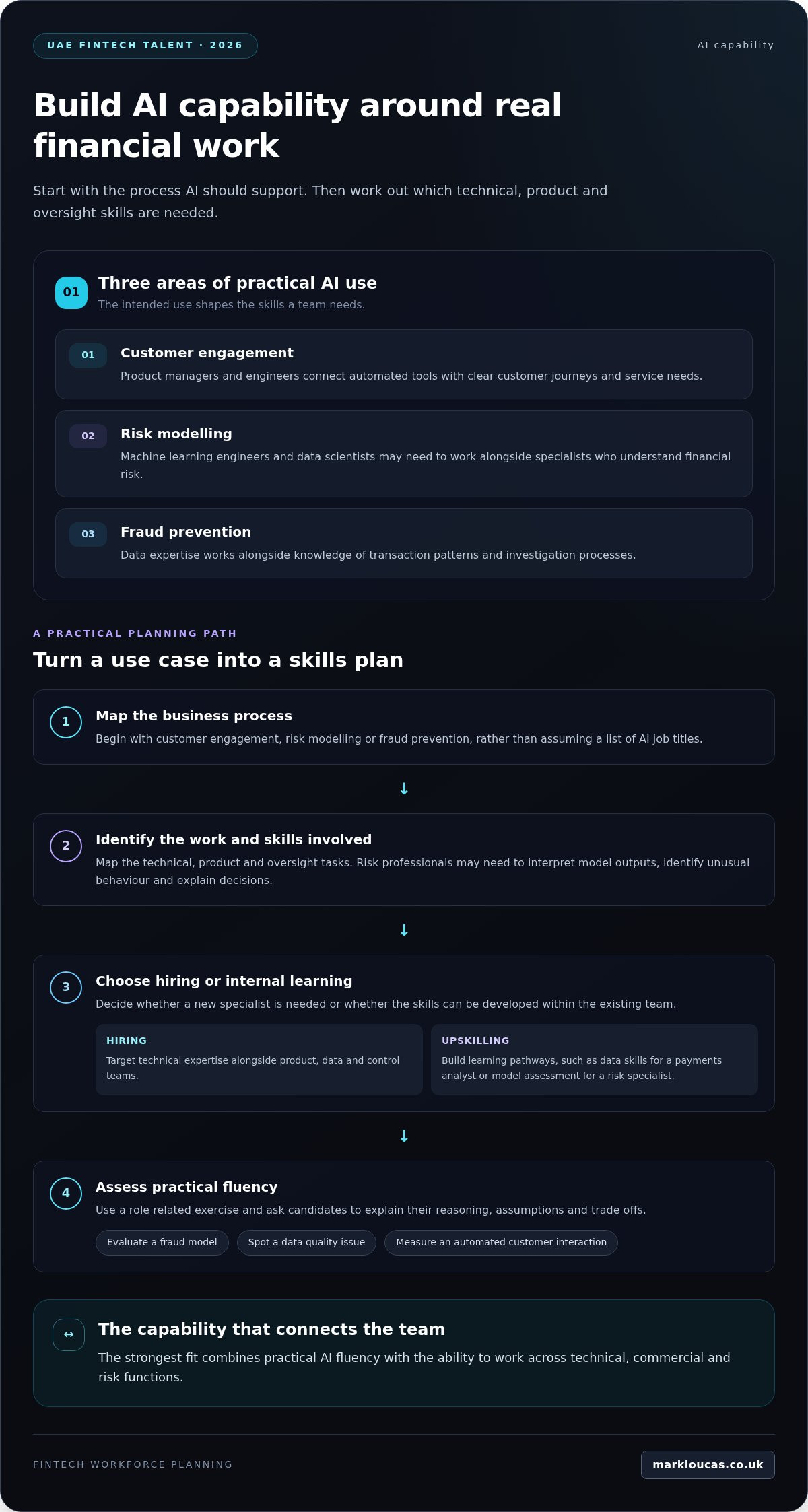
In 2026, artificial intelligence is expected to support customer engagement, risk modelling and fraud prevention across financial services. For UAE fintech firms, the hiring question is how to place technical expertise alongside product, data and control teams. A useful fintech talent market overview 2026 considers not only new AI titles, but also how responsibilities change across existing roles.
Role requirements depend on the intended use. A team developing risk models may need machine-learning engineers, data scientists and specialists who understand financial risk. Fraud prevention may require data expertise alongside knowledge of transaction patterns and investigation processes. For customer engagement, product managers and engineers must connect automated tools with clear customer journeys and service needs.
These developments also reshape established roles. Risk professionals may need to interpret model outputs, identify unusual behaviour and explain decisions to colleagues. Product teams must translate customer needs into workable applications, while engineers and data specialists collaborate with people responsible for controls. The fintech talent market overview 2026 therefore favours candidates who can communicate across technical, commercial and risk functions.
Employers can assess AI capability through practical, role-specific evidence rather than broad claims. Ask candidates how they would evaluate a fraud model, identify a data-quality issue or measure an automated customer interaction. Keep the exercise close to the role’s actual responsibilities, and invite candidates to explain their reasoning, assumptions and trade-offs.
Hiring alone will not close every emerging capability gap. Fintech employers should invest in upskilling and internal learning pathways, helping current employees grow into new responsibilities. A payments analyst could strengthen data skills, while a risk specialist learns to assess model outputs. Defined learning objectives connect training with the work teams need to complete.
Workforce planning should start with a business process, not an assumed list of AI job titles. Map where AI may support customer engagement, risk modelling or fraud prevention, then identify the technical, product and oversight tasks involved. This helps managers decide whether they need a new specialist or can develop the required skills within an existing team.
For candidates, practical fluency means showing how technology supports a financial service, rather than simply naming tools. Examples from data analysis, product delivery, risk assessment or fraud operations can demonstrate that connection. Employers can clarify a role by describing its users, decisions and measures of success. That detail helps candidates assess whether their experience fits the work.
For a focused view of specialist hiring needs, discuss your fintech talent requirements.
Competition for specialised fintech talent
UAE fintech firms compete for specialists with banks, technology companies and one another. The overlap is clearest in engineering, data, product and cybersecurity, where skills transfer across sectors. Fintech employers must also explain the role’s financial-services context, including its customer impact, risk responsibilities and contribution to product delivery.
Local licensing activity adds pressure. CMA licensing expansion has created hundreds of new licensed entities, each requiring approved Key Persons. Dozens of crypto firms in the UAE have obtained VARA licences and are building local teams. These organisations draw on a limited pool of experienced professionals, particularly those combining relevant sector knowledge with leadership or regulatory experience.
Shortages extend beyond compliance. Fintech companies have faced gaps in engineering, product, compliance and commercial leadership. Across Europe, Hong Kong and Singapore, employers also report difficulty finding people who combine deep domain expertise with practical AI fluency. For UAE firms, the implication is clear: requiring several scarce capabilities in one job description may narrow the candidate pool further.
How does fintech talent demand compare with banking and big tech? Fintech competes with both for transferable technical and commercial skills, while also requiring financial-services knowledge. Banks may offer established structures, and big tech can attract candidates through technical scale. Fintech must explain its product, decision-making scope and customer impact.
Salary remains part of the competition, but it is not the only lever. Fintech salary inflation is expected to moderate in the second half of 2026, while salaries remain above pre-2022 levels. Employers can make an offer more compelling by setting out the role’s remit, progression and learning opportunities, rather than relying on compensation alone.
What strategies are fintech companies using to attract and retain talent in 2026? They are refining role requirements, improving career pathways and investing in learning, while presenting candidates with a clear account of the work. A practical example is a development plan that lets a payments professional build data capability alongside defined product responsibilities.
Hiring teams can respond with a disciplined sequence. First, separate essential skills from those candidates can develop after appointment. Next, assess candidates against realistic work, such as a product decision involving customer needs and operational risk. Then show how the role can grow as the business evolves.
For employers, market mapping can reveal where relevant experience sits across fintech, banks and technology firms. A precise brief also helps distinguish a genuine specialist requirement from an overlong wish list. In a competitive UAE market, clarity gives candidates a stronger reason to consider the opportunity and helps firms focus their search.
For a considered discussion of fintech hiring needs, get in touch about your recruitment priorities.
Candidate expectations
Fintech candidates weigh salary alongside progression, learning and the quality of the hiring process. Among surveyed professionals, 68.1% cited salary as a reason they would join a new role. Yet pay alone may not address the reasons people leave. A compelling offer also needs a clear remit and credible development prospects.
Career growth is particularly important. A lack of career progression was cited by 62.9% of surveyed fintech professionals as the main reason people leave their jobs. Employers can respond by setting out possible next steps, such as moving from payments analysis into product ownership, or from compliance operations into a broader oversight role.
Learning and development can strengthen that proposition. While 63% of surveyed professionals said learning matters to them, 77% were dissatisfied with the development their organisation provided. A useful response is a defined learning pathway tied to actual work, such as building data skills through a payments project or developing risk expertise alongside a new product launch.
Workload also matters to retention. Nearly 3 in 10 surveyed fintech professionals experience frequent burnout, according to findings covering more than 420 professionals across roles, seniority levels and geographies. Employers can make expectations clearer by explaining team responsibilities, workload priorities and how managers support sustainable delivery during demanding projects.
Interview design shapes the candidate’s impression before an offer is made. More than 3 interview stages are considered a red flag by candidates. A focused process can use an initial discussion, a role-specific assessment and a final conversation with decision-makers. Each stage should test a distinct capability, rather than repeat the same questions.
How do fintech salaries vary by role, seniority and region in 2026? In the UAE, salary expectations differ with the role’s scope and seniority, while specialist expertise and the demands of the position also shape compensation. For quantitative roles, asset-class knowledge, technology stack, revenue attribution and team size influence pay; regional markets set distinct reference points.
For candidates, a clear decision process helps them assess whether an opportunity fits their goals. Employers should explain responsibilities, reporting lines, development prospects and the next hiring stage. A senior payments candidate, for example, will want to understand both the product mandate and the authority attached to the role.
Before opening a vacancy, hiring teams can rank what the offer provides: competitive pay, meaningful progression, practical learning and a well-defined role. When candidates can see these elements clearly, they have a stronger basis for weighing a move. In a specialised market, a precise offer is part of the employment proposition.
For a focused discussion of specialist hiring needs, talk through your fintech recruitment priorities.
Which fintech roles are most in demand in 2026?
In the UAE, demand is strong for MLROs and Compliance Officers with SCA/CMA, DFSA or VARA expertise. These roles help firms build compliance capabilities suited to their regulatory environment. The most relevant background depends on the firm’s activities, controls and the responsibilities attached to the position.
Virtual asset businesses are also seeking crypto compliance specialists as the VARA framework shapes local demand. Employers need candidates who can apply relevant compliance knowledge to daily operations, not merely describe regulatory concepts. When hiring an MLRO, assess experience with oversight, escalation and clear communication with senior stakeholders.
AML analysts and KYC specialists remain important as global AML/CFT enforcement tightens. Their work supports customer due diligence, transaction monitoring and alert handling. A useful hiring exercise could ask candidates to explain how they would review an alert, document their reasoning and escalate a concern.
Technology hiring spans AI, cybersecurity and data. AI-related roles support financial services functions such as risk modelling and fraud prevention. Cybersecurity specialists help protect systems and sensitive information, while data professionals make information useful for product and risk decisions. Employers should tie each vacancy to a defined technical responsibility and business outcome.
Payments professionals are valuable when firms need to develop products and maintain reliable operations. The right candidate may combine knowledge of payment processes with product judgement, data fluency or operational risk experience. For example, a payments product role may require someone who can assess customer needs and collaborate effectively with technical teams.
Firms seeking end-to-end trading capability value quantitative professionals who can build, test and own complete trading pipelines. Candidate assessment should explore the whole process, from model construction through testing and ongoing ownership, rather than focusing on theory alone.
Commercial leaders and product specialists also support fintech growth. A commercial appointment may require partnership development and a sound grasp of the product’s market, while a product leader must connect customer priorities with delivery. These roles are more effective when the brief distinguishes essential experience from capabilities that can develop after appointment.
For employers, prioritise roles by linking each vacancy to a current need: regulatory oversight, payment delivery, technical resilience or business growth. Then define the relevant experience, practical skills and decision-making scope. A precise brief helps distinguish a specialist hire from a broader capability gap and makes assessment more consistent.
As part of the fintech talent market overview 2026, research by Mark Loucas Ltd has tracked hiring trends across the Emirates, reflecting how local regulatory frameworks and digital transformation initiatives are shaping workforce priorities.
Local digital asset expansion and evolving virtual asset regulations are driving sustained demand for specialised crypto compliance capabilities across the UAE financial ecosystem.
Mark Loucas and Permanent Fintech Recruitment
Mark Loucas Ltd supports fintech employers seeking permanent specialists and senior leaders through Permanent Fintech Recruitment and Fintech Executive Search. These services suit vacancies requiring focused sector knowledge, whether the need is an experienced compliance professional, a payments specialist or a leader shaping digital banking capabilities.
For changing workloads or time-sensitive projects, Fintech Providers Contract & Interim Solutions can support staffing needs. Market Mapping & Intelligence helps employers understand the talent landscape and refine role requirements before opening a search. The right approach depends on the appointment, required capabilities and the organisation’s hiring priorities.
To discuss a fintech hiring requirement, contact Mark Loucas Ltd.
Turn hiring priorities into a clear plan
The fintech talent market overview for 2026 offers a useful prompt to review how each role supports your organisation’s next stage. Before opening a vacancy, agree what success should look like, which skills are essential from the outset and where development can build capability over time. This gives hiring teams a sharper brief and candidates a clearer picture of the opportunity.
For professionals, the same discipline can guide career decisions. Identify the work you want to own, the expertise you want to deepen and the kind of organisation where those ambitions can develop. A considered conversation about role scope and progression can help both sides assess alignment.
Mark Loucas can help employers shape their next fintech search around the appointment they need to make. Arrange a conversation about your fintech talent needs and take the next step with confidence.
Frequently Asked Questions
What should firms and professionals prioritise in 2026?
Firms should prioritise capabilities linked to specific business outcomes, then separate essential skills from those employees can develop. For example, a payments business planning a new product can define the customer, technical and risk expertise needed before drafting a vacancy. Professionals can identify roles where their experience transfers across functions, then prepare examples of solving practical problems and collaborating across teams.
What is the global fintech workforce size and employment outlook for 2026?
A single global fintech workforce total is difficult to compare because estimates can count different groups: fintech firms, fintech teams within banks, or contractors supporting financial technology. For 2026, employment prospects are better understood through the capabilities firms are hiring for than through one headcount. Employers are seeking people to support growth, controls and resilience, whilst professionals with transferable financial and technical experience can consider opportunities across different types of organisations.
How are AI and automation changing fintech hiring and workforce needs?
AI and automation are increasing the need for people who can apply tools within accountable financial processes. Employers can map a workflow, identify which tasks technology supports, then assign responsibility for review and exceptions. For example, a fraud team still needs people to investigate unusual transactions flagged by automated systems. Internal learning can also help existing staff develop the data skills needed as responsibilities shift.
What are the biggest fintech talent shortages and hiring challenges in 2026?
Fintech firms face shortages in specialist engineering, product, compliance and commercial roles, particularly when one position demands expertise across several disciplines. The challenge is to define a realistic brief without combining unrelated requirements. Hiring teams can identify the capability essential from day one, then assess whether adjacent skills can be developed. Clear responsibilities and prompt decisions also help candidates evaluate an opportunity before accepting another offer.

Article by
Liam Henfrey
Liam Henfrey is a seasoned specialist in the payments and banking sectors with over two decades of experience. As the Founder and CEO of FINOPSIS and Managing Director at Mark Loucas Ltd, he advises organisations on complex financial operations and technology. His career includes senior roles at PwC, Deloitte, and Visa Europe.
Related Fintech Recruitment Guides
If you liked this guide then you may also like the following: