


How to Hire an Interim Programme Manager for Payments
The strongest candidate on paper may still be the wrong appointment if they can manage tasks but not take ownership of the whole programme. When a payments initiative in the UAE cannot wait for a permanent hire, an interim programme manager for payments needs to bring clear accountability, sound judgement and the ability to align teams, suppliers and senior stakeholders.
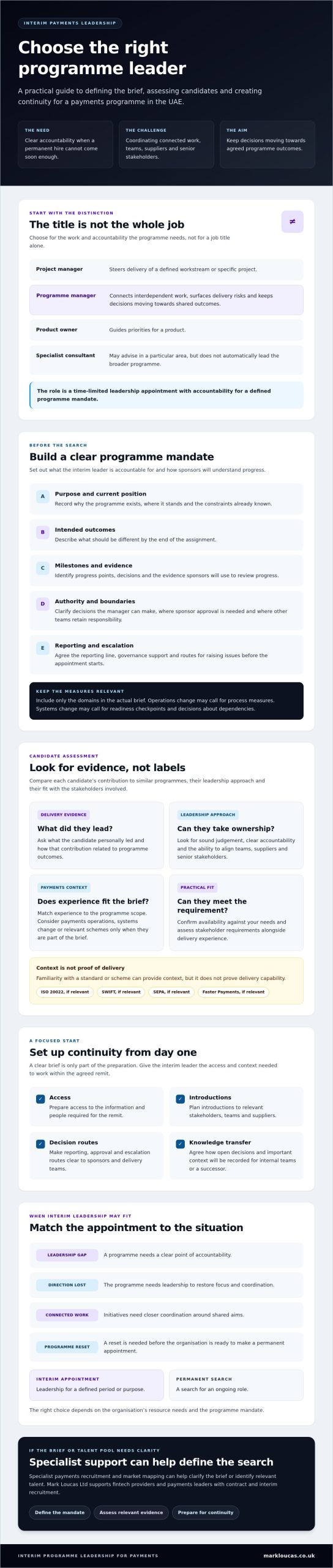
That distinction matters. A project manager may steer a defined workstream, while programme leadership connects interdependent work, surfaces delivery risks and keeps decisions moving towards agreed outcomes. Choosing by title alone can leave gaps where the stakes are highest.
This guide offers a practical framework for defining the programme before hiring, assessing candidates against relevant delivery evidence and stakeholder needs, and selecting someone suited to your payments environment. It also explains how to agree authority, success measures and knowledge transfer from the outset, so interim leadership provides continuity rather than another layer of uncertainty. Mark Loucas Ltd supports fintech providers and payments leaders with contract and interim recruitment, as well as specialist payments recruitment and market mapping when the brief or talent pool needs clarification.
Key Takeaways
- Define the programme mandate, intended outcomes and decision-making authority before beginning the search.
- Assess an interim programme manager for payments against relevant delivery evidence, leadership approach and stakeholder needs, not job titles alone.
- Compare candidates’ specific contributions to similar programmes and confirm their availability against your requirements.
- Prepare access, stakeholder introductions and decision routes so the interim leader can make a focused start.
- Consider specialist recruitment or market mapping if you need help clarifying the brief or identifying relevant talent.
If your payments programme needs temporary leadership, discuss your hiring requirements with Mark Loucas Ltd.
Why appoint an interim programme manager for payments?
A leadership vacancy can leave a payments programme without a clear point of accountability. Interim support may also suit a programme that has lost direction, connected initiatives that need closer coordination, or a reset before the organisation is ready to make a permanent appointment. The need is not simply for someone to keep a plan updated. It is for a leader with a defined remit.
An interim programme manager is a time-limited leader accountable for a defined programme mandate. Programme management brings connected work together around shared aims. It differs from project management, which centres on delivering a specific project, and product ownership, which guides priorities for a product. Specialist consultants may offer advice in a particular area, but do not automatically take responsibility for leading the broader programme. This distinction is also reflected in the overview of Program management.
What does an interim programme manager do?
The employer’s brief determines the remit. It may include coordinating workstreams, monitoring dependencies, supporting governance and keeping senior stakeholders aligned. Before appointing, clarify the manager’s authority, reporting line and escalation routes. This ensures the role fits the programme’s needs and that sponsors and delivery teams understand who is accountable for what.
When can interim payments leadership make sense?
A temporary leadership gap, complex change or time-sensitive need may make an interim appointment worth considering. A permanent search addresses an ongoing role, while an interim appointment can provide leadership for a defined period or purpose. The right choice depends on the organisation’s resource needs and the programme mandate. Specialist payments industry recruitment may help when you need a candidate with experience that fits the brief.
If you’re defining outcomes for a payments programme, discuss your interim hiring requirements with Mark Loucas Ltd.
What should an interim payments programme manager deliver?
Start with the change the organisation needs, then translate it into a concise set of outcomes, milestones and decision points. A programme focused on payments operations may need measures linked to agreed process changes, while a systems programme may need readiness checkpoints and decisions about dependencies. Include only the domains that are part of the actual brief.
A strong brief connects the interim manager’s authority to agreed outcomes and measures. This clarifies accountability and helps sponsors assess progress without confusing programme leadership with specialist delivery. Technical configuration, product decisions or specialist advice may remain with other teams. State where the programme manager coordinates, where they can make decisions and where they need input or approval.
- Outcomes: What should be different by the end of the assignment?
- Milestones: Which points will show progress or require a decision?
- Measures: What evidence will sponsors use to review progress?
Set outcomes and boundaries for the mandate
Record the programme’s purpose, current position, intended outcomes and known constraints. Clarify which decisions the interim manager can make and which require sponsor approval. Identify handover and knowledge transfer expectations before the assignment begins, including how open decisions and relevant context will be recorded for internal teams or a successor.
Match delivery experience to the payments environment
Match experience to the programme’s actual scope. Payments operations or systems change may be relevant when those areas are involved. Consider ISO 20022, SWIFT, SEPA or Faster Payments only if the brief calls for them. Familiarity with a standard or scheme provides context, but does not prove delivery capability. Ask what the candidate personally led and how their contribution related to the programme’s outcomes.
Interim appointments form part of a wider contingent workforce, which can include project and programme management roles. The value of the appointment depends on a well-defined assignment, not simply its temporary status.
If you’re shaping a brief or exploring interim talent, discuss your payments recruitment requirements with Mark Loucas Ltd.
How do you assess an interim programme manager for payments?
A polished CV and a familiar programme title can make a candidate look suitable, but neither shows how they lead when ownership is unclear or priorities shift. Assess evidence against the mandate you have defined, including the required outcomes, the authority available and the stakeholders involved. The right interim programme manager for payments should be able to explain their personal contribution, not just describe a programme they were part of.
Which evidence should employers test?
Ask candidates to describe a relevant assignment in a consistent way: the starting situation, their remit, the decisions they made and the results they can evidence. Explore how they identified dependencies, risks or gaps in governance, and what they did next. Then ask how they adapted when scope or priorities changed. Specific examples reveal judgement and working style more clearly than broad claims of delivery success.
Assess mobilisation as well as past performance. An interim leader may need to understand an existing plan, meet key stakeholders and establish where decisions are stuck. Ask what they would seek to learn first, how they would check the programme’s status and what they would raise with the sponsor. This helps you judge whether their approach fits your context without expecting them to make assumptions before seeing the details.
How should you compare candidates fairly?
Use the same core questions and agreed criteria for each shortlisted candidate. A simple comparison framework can keep the discussion focused:
- Programme relevance: How closely does their experience match the scope and challenge?
- Leadership evidence: What did they personally own, decide or change?
- Stakeholder approach: How do they build alignment and handle disagreement?
- Availability: Does their availability fit the assignment requirements?
Record evidence against each criterion rather than relying on impressions. Separate the candidate’s actions from the wider team’s contribution, and ask how outcomes were measured. Do not treat experience in one payments domain or a particular credential as essential unless your programme requires it. For example, a scheme-specific background may matter for a scheme-related change, but may be less relevant to a programme focused on governance or cross-team coordination.
Complete reference checks and confirm assignment details through your normal process. Specialist payments industry recruitment can also help you explore relevant talent when the brief or candidate pool needs clarification.
For help shaping a focused interim brief, discuss your payments hiring requirements with Mark Loucas Ltd.
How should you brief and onboard an interim payments programme manager?
A considered start depends on practical preparation, not just a well-written role description. Make sure the people, information and access the interim manager needs are ready, and explain to internal teams how the appointment fits into existing governance. This reduces avoidable delays while the manager builds an informed view of the programme.
What belongs in the interim role brief?
Alongside the agreed mandate, note the programme’s current status, key contacts, known dependencies and constraints. Describe reporting arrangements and expected authority in plain terms. Confirm engagement conditions and availability requirements with the business before sharing them with candidates. Agree how decisions, open issues and useful context will be recorded for colleagues who will continue the work.
How can the organisation support a strong start?
Prepare the working environment and agree a simple sequence with the sponsor:
- Arrange access to relevant documents, systems and decision makers before the start date.
- Introduce the interim manager to key stakeholders and explain how teams work together.
- Agree immediate priorities, escalation routes and a regular review rhythm with the sponsor.
- Use review discussions to surface new information, adjust priorities where needed and record decisions.
- Plan knowledge transfer so internal teams retain useful context and can follow up open actions.
These review points are management practices, not promises of specific milestones or results. If your organisation needs further resourcing support, discuss whether contract or interim recruitment is relevant to the requirement.
If you’re considering specialist support for an interim payments search, share your brief with Mark Loucas Ltd to discuss the requirements.
How can specialist recruitment help you find an interim payments programme manager?
Direct sourcing may suit an organisation with the time, networks and internal expertise to identify and assess candidates. Specialist recruitment support can be useful when the brief is complex, the relevant talent pool is unclear or the hiring team needs help comparing experience across payments and fintech. The choice depends on your capacity and search needs, not on an assumption that one route will always be faster or better.
A clear brief gives a recruitment partner a sound basis for assessing fit. Set out the programme’s purpose, outcomes, authority, stakeholder environment and any experience that is genuinely required. For an interim programme manager for payments, this helps distinguish candidates who have led comparable, connected work from those whose experience is limited to a similar title. Mark Loucas Ltd focuses on fintech and digital banking, and provides contract and interim staffing solutions for fintech providers and payments leaders. This is relevant context for a search, not a guarantee that a particular candidate will be available.
What should you expect from a specialist recruitment partner?
Look for a partner who can discuss the payments remit in precise terms and ask useful questions about scope, dependencies and decision rights. Agree how candidate experience, motivation and assignment fit will be assessed, and how the partner will distinguish personal contribution from a wider team’s results. Before the search begins, confirm its scope, communication arrangements and how feedback and decisions will be handled.
If the hiring team needs a clearer view of the talent landscape before settling the brief, market mapping can help inform the search. It can support discussion about relevant experience and potential candidate profiles, without treating any one payments domain or credential as essential unless the programme requires it. Mark Loucas Ltd provides payments industry recruitment alongside market mapping and intelligence.
What should happen before you appoint?
Before engaging a partner or selecting a candidate, confirm the outcomes, authority, required experience and practical engagement conditions. Align stakeholders on assessment criteria and agree who will make the final decision. This shared understanding gives the search a clearer focus and helps reduce avoidable changes to the brief.
The next step is to prepare a concise mandate and discuss the search requirements with a recruitment partner. Contact Mark Loucas Ltd to share your brief and explore whether specialist payments recruitment or market mapping fits your needs.
Set your payments programme up for clear leadership
A well-chosen interim appointment starts with a clear mandate. Define the outcomes and authority the role needs, then assess candidates on relevant evidence, personal contribution and how they would approach the work. Thoughtful onboarding, with access, introductions and decision routes agreed in advance, helps establish the conditions for effective leadership.
Choosing an interim programme manager for payments is a considered response to a specific programme need, not simply a way to fill a vacancy. Mark Loucas Ltd provides contract and interim solutions for fintech providers and payments industry leaders. Its market mapping and talent advisory services can also help inform hiring decisions when the brief or talent landscape needs further definition.
For a practical next step, discuss your interim payments hiring requirements with Mark Loucas Ltd. A conversation about your programme can help you decide what support may fit. With the mandate defined, you can move forward with greater confidence.
Frequently Asked Questions
What does an interim programme manager for payments do?
An interim programme manager for payments leads a defined programme for a limited period, with responsibilities set by the organisation. Depending on the brief, they may coordinate connected workstreams, track dependencies, support governance and keep sponsors informed. Their remit should make clear which decisions they can make, what outcomes they’re accountable for and where specialist tasks remain with internal teams or other advisers.
When should a business hire an interim payments programme manager?
Consider interim leadership when a programme has lost its lead, delivery needs a reset or complex change requires clear ownership before a permanent appointment is practical. An interim can address a defined, time-limited need, while permanent recruitment is intended to fill an ongoing role. The choice depends on the organisation’s resource gap, programme scope and longer-term plans, rather than urgency alone.
How is an interim programme manager different from a project manager?
A programme manager coordinates related projects and workstreams towards broader outcomes, managing dependencies and alignment across the programme. A project manager usually leads a defined project with its own scope, plan and deliverables. The distinction depends on the mandate: if the need is to coordinate connected initiatives and resolve cross-programme decisions, programme leadership may fit. If the work is contained within one project, project management may be more suitable.
What experience should an interim payments programme manager have?
Look for experience that matches the work, such as leading payments operations change, systems implementation or cross-team delivery, if these are part of the brief. Familiarity with a payment scheme or standard may be relevant, but should not be treated as essential unless the programme requires it. Ask candidates to explain their remit, decisions and contribution to outcomes, rather than relying on employer names or project titles.
How quickly can an interim payments programme manager start?
There’s no reliable start date without confirming the candidate’s availability, the role requirements and the organisation’s selection process. Clarify the expected start window early, along with any engagement conditions or access arrangements that may affect commencement. A recruitment partner can discuss the search against those requirements, but candidate availability should be confirmed rather than assumed. Avoid setting a programme plan around an unverified start date.
What should an interim payments programme manager role brief include?
Include the programme purpose, current status, intended outcomes, known constraints and expected authority. Set out reporting lines, decision and escalation routes, relevant workstreams, stakeholders and dependencies. Clarify required experience only where it relates to the actual scope, and confirm engagement conditions and availability needs with the business. Agree how progress will be reviewed and what knowledge, decisions and open actions must be handed over at the end.

Article by
Liam Henfrey
Liam Henfrey is a seasoned specialist in the payments and banking sectors with over two decades of experience. As the Founder and CEO of FINOPSIS and Managing Director at Mark Loucas Ltd, he advises organisations on complex financial operations and technology. His career includes senior roles at PwC, Deloitte, and Visa Europe.
Related Fintech Recruitment Guides
If you liked this guide then you may also like the following: