


Slovakia Fintech Recruitment for Strategic Hiring in 2026
The most visible candidate isn’t always the right fintech hire. Mark Loucas Ltd understands that slovakia fintech recruitment starts with the role, then selects the search approach most likely to reach people with the experience it needs. A vacancy listing can attract applicants, but it may not reach experienced specialists who aren’t actively looking.
If you’re finding it hard to separate genuine fintech experience from broader financial services backgrounds, start by defining what the role will involve. The distinction matters for positions in payments, digital banking, compliance and specialist technology. A clear view of the business need and the role’s context helps shape a focused search across the United Arab Emirates and international markets.
This guide compares recruitment routes for fintech hiring in Slovakia and explains how to match the approach to your vacancy’s seniority and specialism. It covers what to define before a search begins, how market mapping can inform target profiles, and where permanent recruitment, executive search and interim solutions fit. The aim is a deliberate hiring decision based on the experience the role genuinely requires.
Key Takeaways
- Define the capability the business needs before choosing how to search, from specialist engineering expertise to fintech leadership.
- For Slovakia fintech recruitment, match the hiring route to the role’s seniority, specialism, confidentiality and urgency.
- Separate essential fintech experience from desirable background when briefing a recruiter and setting assessment criteria.
- Market mapping can help clarify target profiles and inform a search before a vacancy is advertised.
- Permanent recruitment, executive search and interim solutions address different needs, so choose the approach that fits the position.
Planning a specialist fintech search in Slovakia? Discuss your hiring requirements with Mark Loucas.
Why Slovakia fintech recruitment needs more than a vacancy listing
The first decision is not how to attract the most applications. It is what capability the business needs, at what level, and for what purpose. A vacancy listing describes the position, but it does not show whether suitable candidates are actively looking or how to reach experienced specialists beyond the public market.
Specialist fintech recruitment is a focused search for experienced professionals whose skills match a financial technology business’s products, infrastructure and stage of growth. For a Slovakia-based role, that might mean hiring for digital banking, payment services, fintech engineering or leadership across several areas. The What is Fintech? overview offers general context, but the hiring brief needs to define what fintech means for the organisation and the role.
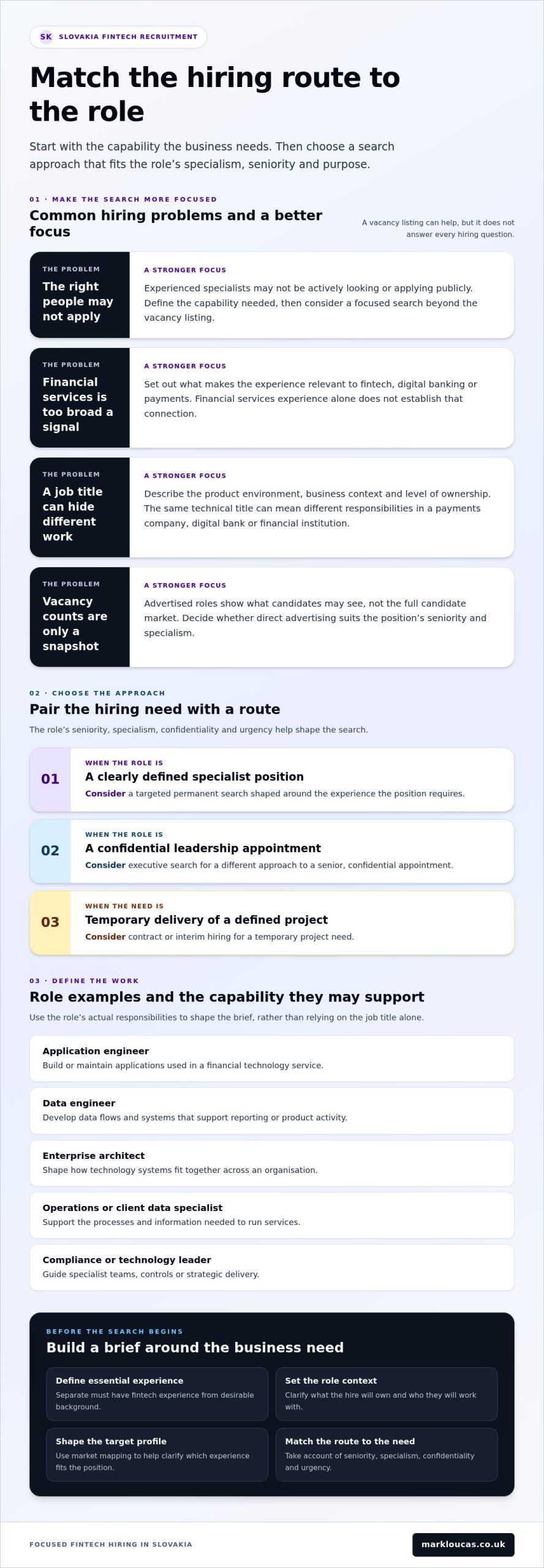
Role scope and seniority shape the search. A clearly defined specialist position may suit a targeted permanent search, while a confidential leadership appointment calls for a different approach. A temporary need to deliver a defined project may point towards contract or interim hiring. Business context matters too: the same technical title can mean different responsibilities in a payments company, a digital bank or a financial institution modernising its systems.
Job boards show advertised opportunities, while employers need to establish the capabilities required and decide how to reach suitable people, including those who are not applying publicly. That distinction is central to fintech hiring in Slovakia. A list of vacancies shows what has been advertised, not which recruitment route will best serve a particular appointment.
What employers mean by fintech talent in Slovakia
Fintech, digital banking and payments overlap, but they are not interchangeable. A fintech engineering brief might focus on building financial technology products; a digital banking role could centre on customer journeys or banking platforms; a payments position may require experience with transaction systems or payment operations. These are examples of different search areas, not a fixed list of roles. A specialist digital banking recruitment search should be shaped around the capabilities the role needs.
Financial services experience alone does not make a role fintech. An insurance position, for example, may sit outside the target if it has no relevant connection to financial technology, digital banking or payments. Define that connection before deciding which candidates fit.
Why a vacancy count does not define the available talent pool
Job-board counts are snapshots of advertised roles. They can show the kinds of opportunities candidates may see, including technology, data and business positions, but they do not measure the full candidate market. Listings change, and people with relevant experience may not be applying publicly.
For employers, the practical questions are whether the role can be clearly distinguished, what experience is essential, and whether direct advertising suits its seniority and specialism. Start with those decisions rather than treating an application count as a measure of the talent available.
Discuss the capabilities your fintech team needs with Mark Loucas’s recruitment team.
Which fintech roles and capabilities should a Slovakia search cover
A useful search begins with the work the hire must enable, not a list of familiar job titles. A fintech business may need people to build technology, manage data, support payments or banking operations, oversee compliance, or lead teams through change. The right search areas depend on the employer’s product, operating model and priorities.
The Slovakia’s Digital Economy and Fintech Landscape provides broader context about the country’s digital economy. For recruitment, connect that context to a specific business need: what the hire will own, who they will work with, and what experience is essential from day one.
Example role
Business capability it may support
Application engineer
Build or maintain applications used in a financial technology service.
Data engineer
Develop data flows and systems that support reporting or product activity.
Enterprise architect
Shape how technology systems fit together across an organisation.
Operations or client data specialist
Support the processes and information needed to run services.
Compliance or technology leader
Guide specialist teams, controls or strategic delivery.
Technical and data roles in digital finance
Application engineer, data engineer and enterprise architect are distinct roles. They may involve developing an application, organising data or aligning systems, so the title alone does not define the employer’s requirements. A strong brief should specify relevant platforms, the product environment and the level of ownership. For roles that bring financial products and technology together, fintech banking technology recruitment is a relevant specialist focus.
Payments, banking operations and specialist leadership
Payments hiring may centre on transaction services and the systems or processes that support them. Digital banking roles can focus on banking platforms, customer-facing services or day-to-day operations. An operations or client data position may have a different emphasis, while senior technology roles add broader accountability for direction and delivery. Employers can shape a search around payments industry recruitment where that capability is central.
Consider compliance where the business needs relevant oversight or specialist expertise. It is not a substitute label for every financial services role. Similarly, a senior technology title alone does not establish fintech experience. Define the connection between each role and the financial technology work it supports, then separate essential expertise from desirable background. This gives candidates and recruiters a clearer basis for assessing fit.
For Slovakia fintech recruitment, let the role map guide the search. Employers developing a brief across technology, operations or leadership can discuss a specialist fintech search shaped around the capabilities required.
Discuss the right recruitment route for your fintech role with Mark Loucas’s specialist team.
Compare recruitment routes for hiring fintech talent in Slovakia
There is no single best route for every fintech vacancy. The right choice depends on the brief: the role’s seniority and specialism, how difficult its requirements are to find, whether the appointment needs to be confidential, and how quickly the business needs additional capability. Use the comparison below as a guide, not a ranking or a promise of results.
Route
When it may fit
Considerations
Direct advertising
A defined role where the employer wants visible applications.
Useful for public reach, but a listing reflects advertised interest, not candidate suitability. Confidentiality is limited.
General recruitment
A role that needs recruitment support but does not call for deep fintech specialism.
The brief must make relevant sector experience clear, especially for niche or senior positions.
Specialist search
Experienced, scarce or leadership talent in fintech, digital banking or payments.
Can support a focused and discreet search beyond public applications. The scope depends on the role and brief.
Interim hiring
A defined short-term need, such as project delivery or temporary specialist capacity.
Set out the required expertise, responsibilities and expected length of the assignment before searching.
When job advertising or direct sourcing may fit
Public advertising gives employers a visible way to invite applications, particularly when the role is clearly scoped and the organisation wants candidates to approach directly. Direct sourcing lets an employer approach people who may be relevant, rather than relying only on applicants who find a listing. Judge either route by fit, not volume alone. Job-board results show vacancies being advertised, not whether applicants meet the experience and capability requirements.
When specialist search or interim hiring may fit
For an experienced professional with a specific fintech background, a senior appointment or a confidential brief, specialist search offers a tailored route. Mark Loucas focuses on fintech, digital banking and payments recruitment, bringing a sector-specific perspective to experienced and leadership hiring. Its fintech banking technology recruitment focus is relevant where technology capability sits at the heart of the role.
Interim hiring may suit a business with a defined short-term requirement rather than a permanent addition to the team. Let the assignment’s purpose and scope guide the search. For Slovakia fintech recruitment, compare routes against the actual brief, considering seniority, specialist requirements, privacy and urgency rather than assuming one approach will suit every hire.
To discuss a specialist approach for an experienced fintech role, speak with Mark Loucas about your hiring brief.
How to brief a recruiter for a Slovakia fintech search
A clear brief gives a search a sound basis. It helps the recruiter understand the business need, distinguish essential expertise from desirable experience and assess candidates against consistent priorities. For Slovakia fintech recruitment, precision at the outset helps keep the search aligned with the role instead of drifting towards adjacent experience that may not meet its needs.
A precise brief gives the recruiter a shared standard for identifying, assessing and presenting relevant candidates.
Define the business outcome and role boundaries
Begin with the problem the appointment should address and the contribution expected from the person hired. Then set out the level of responsibility and whether the requirement is permanent, executive, contract or interim. These details shape the candidate profile and search approach.
- Describe the business need. Explain what the organisation wants the hire to deliver or improve. For example, a data role might support a defined product or operational need. Essential expertise could include building relevant data systems; desirable experience might be familiarity with a particular type of financial services business.
- Set the scope and seniority. Clarify the decisions the person will own, the teams they will work with and whether the role leads others. For a technology leadership appointment, leading technical teams may be essential, while experience in a closely related financial institution could be desirable, depending on the business need.
- Separate relevant fintech experience from adjacent backgrounds. State what direct experience in financial technology, digital banking or payments is required. Identify which broader financial services experience could transfer and which skills must be present from the start. This helps avoid treating sector familiarity as a substitute for role-specific capability.
- Supply the practical context. Include location, working arrangement and reporting line where the employer has defined them. Add role-specific constraints or relationships that would affect how the person works. Avoid assumptions where these details are not settled.
Align assessment and market intelligence
Before outreach begins, agree what evidence would demonstrate the required capability. Depending on the role, this could include examples of relevant work, technical depth, decision-making or leadership experience. Set out the interview stages, who will assess candidates and who has authority to make the final decision. A shared assessment plan makes comparisons more consistent.
Market mapping can inform the search before a role is advertised. It helps structure discussion about target profiles and test assumptions in the brief, such as which adjacent experience may be relevant. Use it to inform decisions, not as a replacement for a clear definition of the appointment. Employers considering a broader financial talent search can draw on specialist financial recruitment shaped around their requirements.
Once the business outcome, essential experience and assessment criteria are agreed, the recruiter has a useful framework for conducting a focused search. Share your fintech hiring brief with Mark Loucas to discuss a specialist recruitment approach.
Discuss your fintech hiring requirements and the recruitment approach that fits the role’s scope.
How Mark Loucas supports specialist fintech recruitment for Slovakia
Mark Loucas is an independent specialist consultancy founded in 2011, focused on fintech, digital banking and payments recruitment. For employers planning Slovakia fintech recruitment, this sector focus can help frame the role’s requirements and the experience that matters. The search is shaped around the appointment the business needs, rather than broad financial services labels alone.
A specialist search shaped around the hiring brief
A clear brief connects the business need to relevant experience. The role’s responsibilities, seniority and essential capabilities can guide the search, whether the appointment concerns fintech technology, digital banking, payments or leadership. Mark Loucas supports employers seeking experienced professionals and leaders, tailoring the recruitment approach to the position rather than treating every vacancy as interchangeable.
Market mapping can support planning before a role is advertised. It helps employers consider the talent landscape and refine target profiles, role expectations and assumptions about relevant experience. Use it as a planning tool to inform decisions about the brief and search. For Slovakia-focused hiring, ground the brief in the employer’s requirements and the capabilities the role needs.
The recruitment options serve distinct purposes. Permanent recruitment supports an ongoing appointment to the organisation. Executive search suits leadership requirements where seniority, remit and fit call for a focused search. Contract and interim solutions can address a defined temporary need or period of work. Market mapping and talent advisory can help employers clarify the search and plan next steps.
Choose the next step for your hiring requirement
Start by identifying the nature of the appointment. A continuing role may call for permanent recruitment; a senior leadership position may warrant executive search; a defined temporary requirement may suit an interim approach. Where the brief is still taking shape, market mapping can inform planning before the employer settles on a route.
Mark Loucas brings its specialist focus across fintech, digital banking and payments to these conversations. Share the role’s purpose, essential experience and preferred recruitment route to discuss an approach suited to the appointment.
For a considered discussion about your Slovakia fintech recruitment needs, contact Mark Loucas to discuss your search.
Set your next fintech search in motion
Turn your hiring priorities into a decision the business can act on. Agree what expertise must be in place, which experience can be developed, and how the appointment will support your plans in Slovakia. This gives your recruitment partner a clear basis for shaping the search and keeps the process focused as requirements evolve.
A well-defined approach to Slovakia fintech recruitment helps the hiring team stay aligned on what matters, from the role’s remit to the evidence that will demonstrate a candidate’s fit. Begin with the business outcome, then choose a recruitment route that reflects the position’s seniority and specialism.
For a considered discussion about your next fintech appointment, discuss a tailored search with Mark Loucas. Start with a clear brief covering the role and the experience it requires.
Frequently Asked Questions
Is Slovakia a suitable market for fintech recruitment?
It can be, when the role’s requirements and the employer’s plans align with the talent they aim to reach. For Slovakia fintech recruitment, assess the specific capability needed, such as experience with payment infrastructure or digital banking products, rather than relying on a broad market label. Define location and working arrangements early, then use those details to shape the search brief.
What fintech roles are employers recruiting for in Slovakia?
Employers may need people to solve particular business problems rather than hire against a standard list of fintech titles. For example, a company extending a payments product might need someone to improve transaction processes, while a digital finance business could need a specialist to connect product data with business decisions. These are illustrative scenarios. The right title and experience depend on the work the hire will own.
How can employers find senior fintech candidates in Slovakia?
For senior roles, begin with a clear account of the mandate, decision-making authority and outcomes expected from the appointment. A discreet, direct search can help an employer approach experienced leaders who may not be applying for advertised roles. Agree who will assess candidates and what evidence matters, such as experience leading a product launch or managing a technology function.
Should a fintech business use a specialist recruiter in Slovakia?
A specialist recruiter can be useful when the role depends on experience that is difficult to assess from a general financial services background. An employer hiring for payments leadership, for example, may need to distinguish direct responsibility for payment products from broader banking experience. A specialist can help define that distinction in the search and candidate assessment. Consider the role’s complexity, seniority and need for sector-specific understanding.
Can international recruiters support fintech hiring in Slovakia?
Yes. An international recruiter can support a search, particularly where the business is coordinating hiring across more than one market. Provide the role location, working arrangement, reporting line and any location-related expectations the organisation has set. Keep assessment criteria consistent for every candidate. For jurisdiction-specific employment questions, employers should rely on appropriate professional advice rather than assume recruitment support covers them.
When should a fintech employer choose interim recruitment instead of a permanent hire?
Interim recruitment may suit a defined, temporary requirement, such as bringing in an experienced professional to support a project or cover a short-term resource gap. A permanent hire is generally more suitable when the business needs ongoing ownership, continuity and development of a function. Before choosing, define the work to be delivered, the expected duration and whether the need is temporary or part of the organisation’s long-term structure.
What should a fintech recruitment brief include?
A useful brief explains the business reason for the hire, the role’s main responsibilities and the level of experience required. Separate essential skills from desirable ones, and give a practical example of work that would demonstrate each essential capability. Include the location, working arrangement, reporting line and hiring stages if the employer has set them. Naming the decision-makers and the evidence they will assess helps keep evaluation consistent.

Article by
Liam Henfrey
Liam Henfrey is a seasoned specialist in the payments and banking sectors with over two decades of experience. As the Founder and CEO of FINOPSIS and Managing Director at Mark Loucas Ltd, he advises organisations on complex financial operations and technology. His career includes senior roles at PwC, Deloitte, and Visa Europe.
Related Fintech Recruitment Guides
If you liked this guide then you may also like the following: